

Webb’s first “little red dots” force a rethink of early black hole timelines
Charlotte Mason says new Webb-era discoveries of early galaxies and black holes are colliding with expectations, triggering fresh theories.
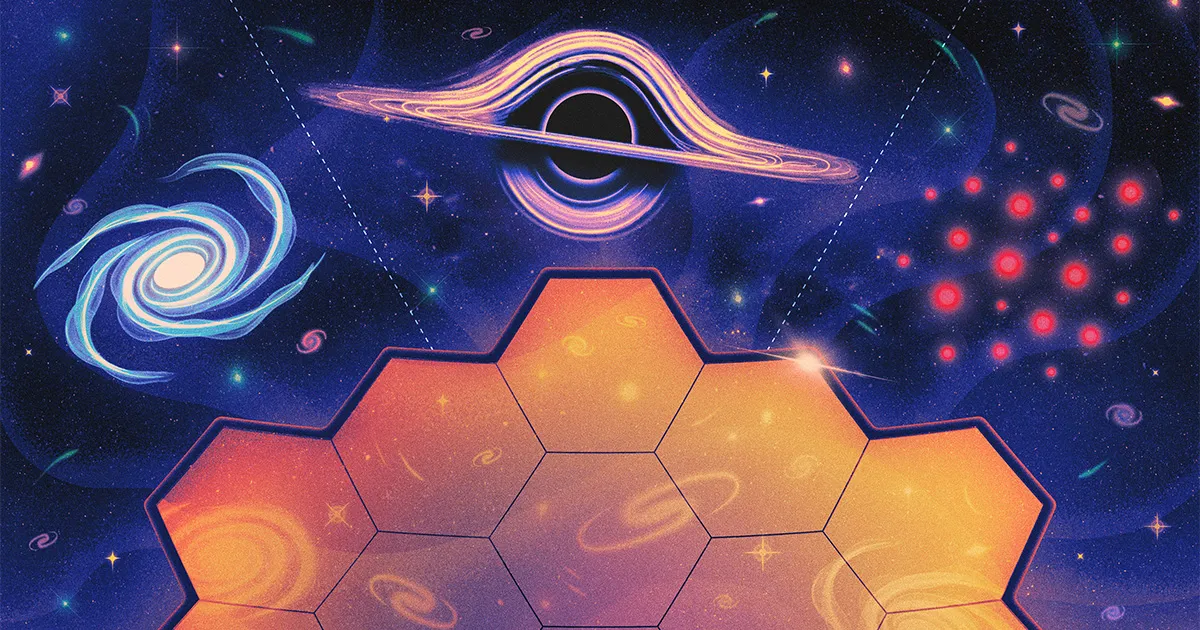
Astrophysicist Charlotte Mason of Copenhagen’s Cosmic Dawn Center says James Webb Space Telescope images show hundreds of puzzling “little red dots,” alongside early black holes and galaxies that models did not expect. For decision-makers, the lesson is how fast evidence can force theory refresh cycles, and why scientific uncertainty still has operational consequences for future research investment.
When Charlotte Mason sketches her cosmic mysteries, she starts with “little red dots.” Mason, an astrophysicist at the Cosmic Dawn Center in Copenhagen, told Quanta Magazine she is “quite a visual person,” and she has been drawing pictures to understand what is happening in the James Webb Space Telescope images. The key problem is not that Webb is barely working. It is that Webb is working so well that it is finding early-universe objects by the hundreds that do not fit the expectations scientists had before they saw them.
Faced with observations of early black holes and galaxies that were not expected to exist, scientists have come up with “a wealth of new theories to explain them.” The immediate question is brutally practical for researchers: which of these theories is true? In other words, Webb did not just add data. It created a decision problem with multiple competing explanations, each with different implications for how galaxies form and how black holes grow in the early universe.
To understand why this matters beyond the astronomy community, zoom out to how scientific industries behave. In most fields, when new measurements arrive, teams do not throw away everything at once. They test, refine, and reweight models. But early black holes and early galaxies are not minor calibration errors. They are constraints on the timeline of the universe itself. When those constraints do not match what earlier models predicted, the entire architecture of the story gets pressure-tested. That pressure is exactly what Quanta’s piece is about: scientists are not just puzzled, they are rapidly building alternative frameworks to keep the narrative coherent.
The “little red dots” Mason mentioned are emblematic of a broader pattern in Webb-era astronomy. Webb observes in the infrared, allowing researchers to see light from very distant times. But the farther you look, the harder it gets to interpret what you see. Red color can mean different physical things depending on distance, dust, and the intrinsic properties of galaxies. So when images reveal objects that arrive “by the hundreds,” they become both a discovery and a classification challenge. The second-order effect is that even as new theories get proposed, teams still have to decide what counts as comparable evidence. That is where model selection turns into an operational workflow.
This is also where uncertainty behaves like a market variable. Scientific research budgets, telescope time, and the talent pipeline depend on confidence that the community will converge. When observations force a “wealth of new theories,” that can feel like paralysis, but it can also be a productive phase shift. Competing explanations can help researchers identify which measurements are most discriminating. The strategic question for lab leaders and funders becomes: do you support broad exploration, or do you concentrate resources on the most testable hypotheses? Webb provides the raw material, but scientific decision-makers still have to choose what to bet on while the truth is unknown.
There is another angle that decision-makers outside astronomy can appreciate: the early universe discoveries raise the stakes for how the scientific process handles surprises. The source frames this as a puzzle, and the language is telling. Scientists do not claim certainty from the first sighting. They generate theories and then work to determine which ones are correct. That is a discipline, not a shrug. It is the same discipline that industries need when early signals conflict with existing forecasts, whether the signal comes from a new clinical trial cohort or a new dataset in machine learning. A surprise is not a verdict. It is a prompt for better tests.
Finally, the question “which ones are true” is the strategic hinge. Mason’s doodles and the broader theoretical explosion point to one outcome: the community will either reconcile Webb’s early universe with revised formation pathways, or it will have to rethink fundamental assumptions about how black holes and galaxies assemble over time. For executives, investors, and boards supporting frontier research, the lesson is simple but uncomfortable. Breakthrough instruments can accelerate learning, but they also increase uncertainty in the short run. The best players prepare governance for fast iteration: clear criteria for what evidence resolves the puzzle, flexible funding that can follow the discriminating experiments, and timelines that respect convergence may come after multiple rounds of theory.
Quanta’s story is not just about astrophysics. It is about what happens when reality refuses to match the spreadsheet. Webb’s early universe sightings, including early black holes and galaxies that models did not expect, have forced scientists into a rapid theory-refresh cycle. Now the work is deciding which theories survive contact with data.
This story's Key Insights and Take-aways are locked.
Create a free account to unlock Executive Actions for one credit.
Register to UnlockAlways free for Executives Club members. Join the Club
More in Science

Alaska's 1,580-foot tsunami had warning signs. Scientists just found them.
Rapid glacier retreat, heavy rainfall, and thousands of tiny tremors preceded Alaska's 1,580-foot tsunami, a warning for every coastal community in a warming world.

The rare mutation that lets high-risk brains dodge Alzheimer's
Scientists found a natural defense against protein buildup, opening a new path to preventive treatments.

3,000 steps a day may halve Alzheimer's decline, study finds
New research links a modest daily walk to less tau buildup and nearly half the cognitive and functional decline, even for those with early signs.