

Webb spots Beta Pictoris d: carbon monoxide confirms a “hidden” giant planet
A spectroscopy-first detection finds the system’s third imaged planet and expands how exoplanets get discovered.
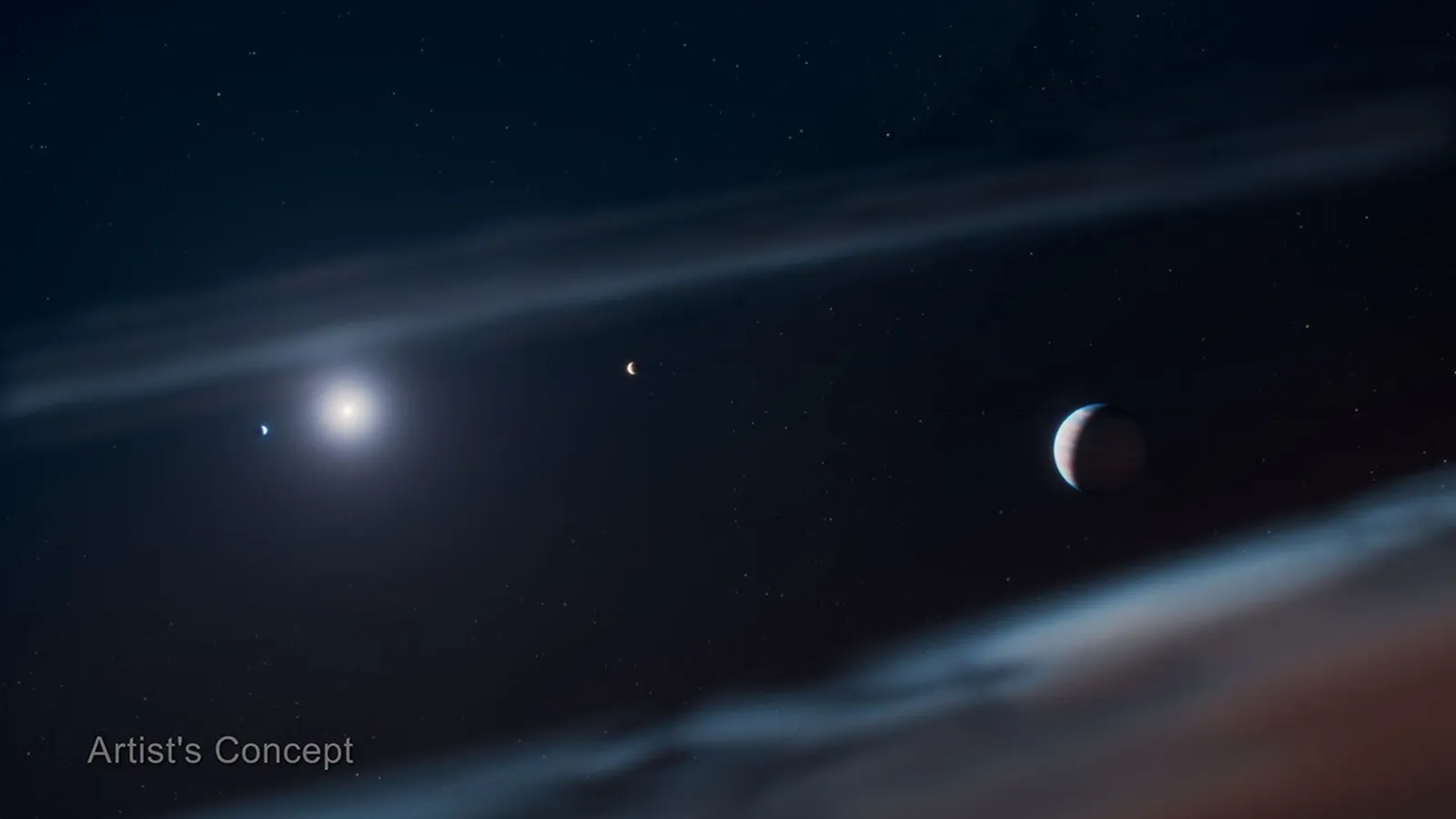
Astronomers using NASA's James Webb Space Telescope have discovered Beta Pictoris d, a giant exoplanet in the Beta Pictoris system. The find was confirmed with Webb instruments and published Wednesday in the Astrophysical Journal Letters, showing spectroscopy can reveal worlds even inside bright, dusty disks.
Astronomers using NASA’s James Webb Space Telescope have discovered Beta Pictoris d, the system’s third imaged planet, and it stayed hidden in plain sight for years. The twist is how Webb found it: not by spotting a bright point of light, but by detecting a chemical fingerprint in the planet’s atmosphere. In particular, the team saw carbon monoxide absorption lines in spectroscopic data, in a distinctive pattern spread out like a barcode.
The data that mattered came from Webb’s NIRSpec (Near-Infrared Spectrograph) using its Integral Field Unit, which obtains both an image and a spectrum from each pixel in an image. During observations aimed at studying the atmosphere of Beta Pictoris b, the researchers expected the light bouncing off dust to produce a smooth spectrum. Instead, they found unexpected peaks and troughs, and those “telltale” carbon monoxide lines showed up where the team didn’t expect them. Lead author Aidan Gibbs, a postdoctoral researcher at the University of California, San Diego, said in connection with the study published Wednesday in the Astrophysical Journal Letters that Beta Pictoris has long served as a laboratory for how planetary systems form and evolve, and the new planet adds another piece to that story.
Here’s why this matters beyond the astronomy nerds in the room. Beta Pictoris is located 63 light-years from Earth and is about 23 million years old, making it a relatively nearby, young system. It is already known to host two giant planets: Beta Pictoris b, one of the first exoplanets ever directly imaged, and Beta Pictoris c. With Beta Pictoris d, the Beta Pictoris system becomes only the second planetary system known to contain at least three imaged planets. But unlike b and c, d was discovered through molecular spectroscopy. That shifts the “how we find planets” playbook from eyeballing brightness to reading atmospheres, which can be more reliable when the environment is chaotic.
The environment in this case is famously messy. Beta Pictoris d lies within one of the brightest debris disks known. That dusty disk scatters starlight, acting like fog that makes it hard for conventional imaging to separate planets from surrounding structures. The spectroscopic approach effectively ignored the dust by isolating narrow molecular signatures unique to a planetary atmosphere. Scientists say the planet’s presence may help explain why the debris disk has a sharply defined inner edge and other puzzling structures, and the source notes that astronomers had already predicted a planet like Beta Pictoris d to account for that unusual disk structure.
Once the carbon monoxide pattern suggested a planet, Webb’s spectroscopy helped do the next critical job: verify it isn’t just a background object. Because spectroscopy can reveal both chemical composition and motion, the team extracted radial velocity from the data. They then determined the planet’s speed, position, and alignment with the debris disk. Those measurements were consistent with something orbiting Beta Pictoris, rather than a background star or a brown dwarf that just happens to have carbon monoxide in its atmosphere. The discovery also included a practical lesson on detection risk: Jean-Baptiste Ruffio, a research scientist at UC San Diego and principal investigator of the first Webb observations where the discovery was made, said that bright blobs in images can be instrumental artifacts or structures in the debris disk, but obtaining a spectrum at the same time let the team confirm quickly.
Follow-up observations sharpened the case and deepened the science. With Webb’s MIRI (Mid-Infrared Instrument) through a Director’s Discretionary Time request, the team detected water vapor and methane. That both confirmed the planet’s identity and provided a richer look at its atmosphere. Meanwhile, a separate imaging study led by Ben Sutlieff of the University of Edinburgh and Markus Bonse of the European Southern Observatory, using the European Southern Observatory’s Very Large Telescope along with Webb’s NIRCam (Near-Infrared Camera), independently confirmed Beta Pictoris d.
So what is Beta Pictoris d, in numbers? Modeling suggests it likely circles its star at about 30 astronomical units, comparable to the region occupied by Neptune in our own solar system. It has the widest orbit among the known three planets in the system, yet it still sits inside the inner edge of the debris disk. The team estimates its mass is likely at least two times the mass of Jupiter, which makes it the smallest of the three known giant planets in the system. And in a cosmic “smaller than expected” twist that still feels big, Webb effectively turned a dusty visual problem into a molecular one.
From an executive-brain perspective, this is a reminder that tooling can be strategy. Webb’s spectroscopy-first method, as described in the source, is “the first directly imaged planet discovered primarily through moderate-resolution spectroscopy,” showing that even when planets are washed out by surrounding material, you can isolate what matters: the atmosphere’s signature. For decision-makers watching how research programs deliver breakthroughs, the second-order implication is straightforward. Instrument design, observation strategy, and data analysis pipelines can make the difference between “we looked and couldn’t see it” and “we detected it hiding in the noise,” with downstream effects on how future missions prioritize detection methods, budgets, and time on scarce, high-demand instruments.
This story's Key Insights and Take-aways are locked.
Create a free account to unlock Executive Actions for one credit.
Register to UnlockAlways free for Executives Club members. Join the Club
More in Science

Alaska's 1,580-foot tsunami had warning signs. Scientists just found them.
Rapid glacier retreat, heavy rainfall, and thousands of tiny tremors preceded Alaska's 1,580-foot tsunami, a warning for every coastal community in a warming world.

The rare mutation that lets high-risk brains dodge Alzheimer's
Scientists found a natural defense against protein buildup, opening a new path to preventive treatments.

3,000 steps a day may halve Alzheimer's decline, study finds
New research links a modest daily walk to less tau buildup and nearly half the cognitive and functional decline, even for those with early signs.