
What Surrounds Us turns circles into a co-op philosophy you feel in your hands
A trippy donut-world MMO-lite makes you collaborate by literally moving through a map of circles.
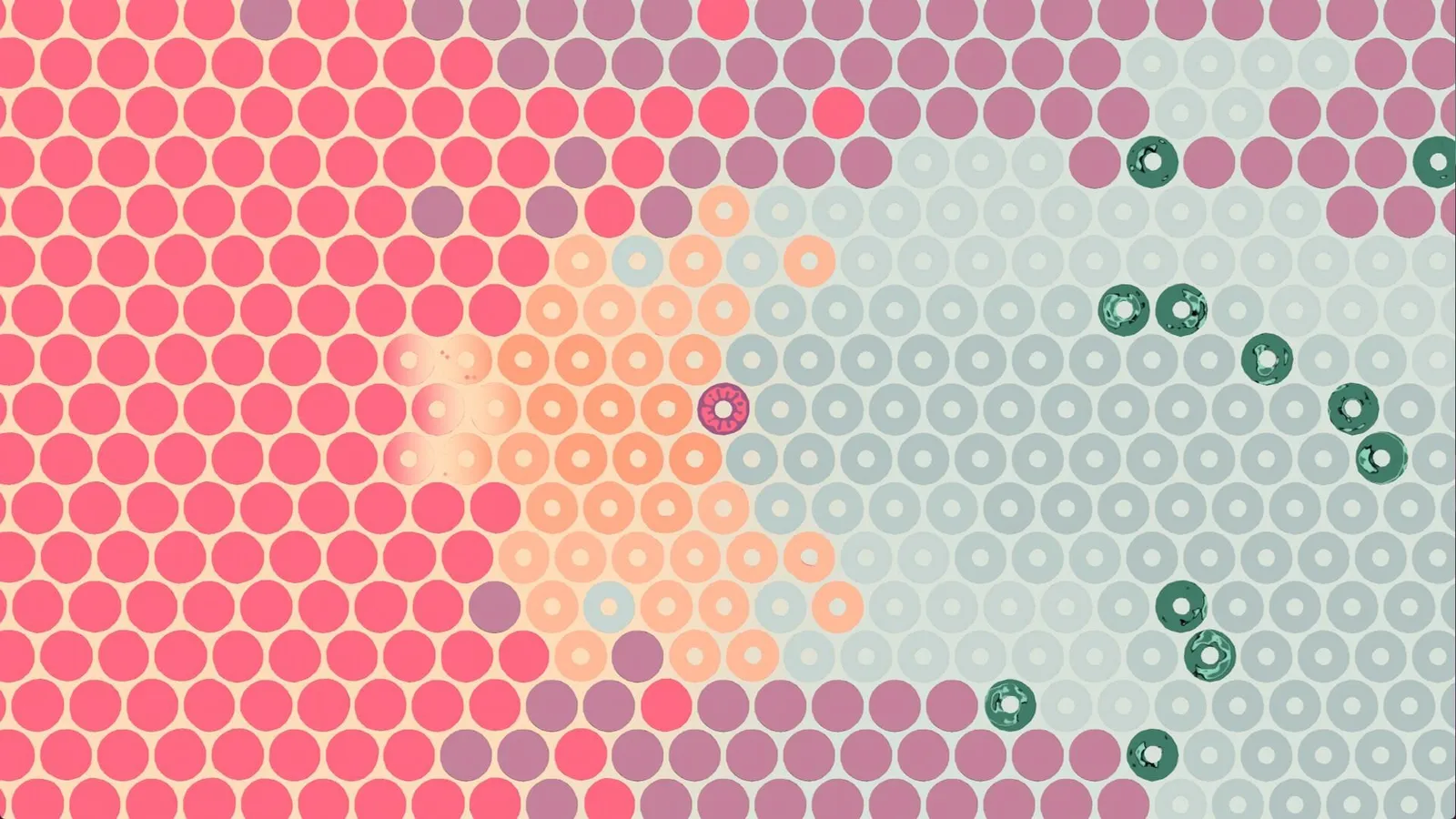
What Surrounds Us, a game covered by The Verge, takes its title literally: you play a moving circle that travels a circle-only map. Its design is not just “cool visuals”; it pushes a teamwork-in-nature theme that shapes how players navigate and meet each other.
What Surrounds Us makes you think about circles, but not the way you think you are supposed to. You play as a circle that surrounds a hole in its middle, like a donut with frosting. The look is instantly meme-able. The mechanics are where it gets interesting. Instead of treating circles as a theme you watch from the sidelines, the game makes “circle-ness” part of how you exist in the world: you are literally a circle moving through circles.
The payoff is that you do not just wander. You work together with other sentient moving circles, and sometimes helping them joyfully meet with others. That matters because the game’s co-op idea is embedded in the geometry. You are not coordinating with strangers in a generic “team up” way. You are collaborating in a world where the environment itself is made to be interacted with, literally everywhere.
There is a familiar structure under the trippiness. As The Verge describes, despite the design that feels dreamlike, What Surrounds Us lands in a familiar format that evokes The Legend of Zelda. You trek across a large map that is composed entirely of a series of circles. That is the kind of choice that looks like a gimmick until you realize it is doing multiple jobs at once: it simplifies navigation visually, it creates a consistent mental model for orientation, and it also turns the “world” into a kind of always-on teaching tool for the theme the game wants you to internalize.
Zoom out for a second and you can see why this is a useful lens for decision-makers, not just players. In product terms, What Surrounds Us is a design case study in “systems thinking.” The game is using one repeated element, circles, across both the avatar identity (you are a circle), the social interaction (you meet and help other circles), and the environment (the map is circles only). That is the opposite of scattershot aesthetic experimentation. It is a cohesive user experience where the same concept repeats until it becomes intuitive.
Now, tie that to incentives, the unglamorous part of why games and software keep shipping the way they do. When teams build something “cohesive,” it reduces the burden on onboarding and lowers friction between what players see and what players can do next. If your world is made of the same shapes your character is, fewer things need to be explained. In a crowded market, that is not a small advantage. Players get a faster sense of agency, and the game can spend more time on actual interaction rather than teaching the basics.
There are also second-order implications for studios, investors, and platform partners who care about retention. Co-op and collaboration mechanics often rely on social momentum: players need a reason to keep coming back because the next session might lead to another encounter, another “joyfully meet with others” moment, another opportunity to help. When that social mechanic is synchronized with the world geometry, the collaboration is not a bolt-on feature. It becomes part of the fantasy loop, the “why I am here” loop.
On the market side, this kind of design is part of a broader shift in how games are marketed and understood. The Verge frames the circles as more than artistic choice, and that is important. If you only sell the visuals, you attract curiosity but risk shallow engagement. If the visuals are tied to theme and interaction, you can earn deeper buy-in. Executives know this dynamic well, because it affects everything from content strategy to community management. Players talk differently when the aesthetic is also gameplay logic.
And the theme is explicit in the source: the circles underscore themes about working in connection with the environment and the things around us. That is a directional signal for peers in the industry. When a game’s core identity is built from how the world is structured, you get a product that feels inevitable rather than arbitrary. For executives considering where to place bets, the strategic stake is straightforward: coherence sells, and coherence can also reduce support and confusion costs later because the player learns through play.
If you are running a studio, evaluating an investment, or steering a platform, What Surrounds Us offers a clean lesson: you can build a trippy-looking product that still behaves like a grounded system. Circles are not just an art style here. They are the rule set, the navigation, the collaboration cue, and the theme you carry with you as you trek across the map. That is why The Verge’s basic description lands with extra weight. It looks like frosting. It plays like philosophy.
This story's Key Insights and Take-aways are locked.
Create a free account to unlock Executive Actions for one credit.
Register to UnlockAlways free for Executives Club members. Join the Club
More in Technology

doubleAI's Maxwell rewrites code while it runs, claims 38x speedups
The Tel Aviv startup's code execution model formally verifies optimizations, turning AI into an agent for the hardware itself.
Saudi military official paid to fly OpenAI bugging suspect's family out, prosecutors say
A court filing says a Saudi military official funded the family's exit and Riyadh offered bail, putting foreign-influence risk squarely on AI boards.

AI researcher's 26,000-word claim: Neural nets aren't tangled after all
Nick Cammarata's Goodfire post has the AI world split - if he's right, monitoring frontier models just got a lot easier.