
Xbox adds PC and handheld backwards compatibility with four legacy games
The program launches with BLiNX, Conker, Crimson Skies, and Fuzion Frenzy, expanding where Xbox classics can be played.
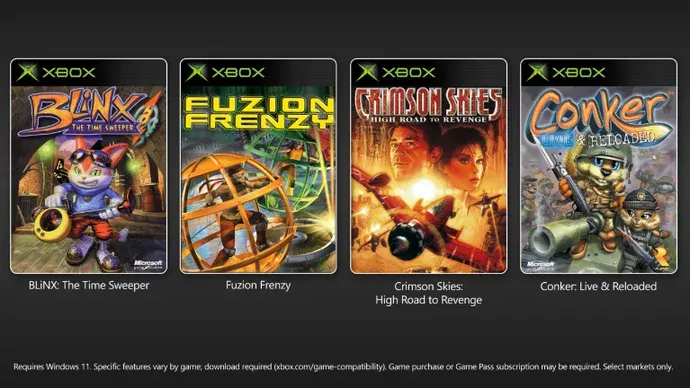
Xbox is introducing backwards compatibility for PC and handheld devices, beginning with four original titles: BLiNX: The Time Sweeper, Conker: Live and Reloaded, Crimson Skies: High Road to Revenge, and Fuzion Frenzy. For decision-makers, it signals a strategy shift toward letting legacy libraries travel across platforms, not just consoles.
Xbox is introducing backwards compatibility for PC and handheld devices, starting with four original titles: BLiNX: The Time Sweeper, Conker: Live and Reloaded, Crimson Skies: High Road to Revenge, and Fuzion Frenzy.
That matters because it is not a small patch or a limited nostalgia drop. Backwards compatibility is a distribution and rights-heavy promise: players keep access to familiar games as they move between devices, and platforms build value by treating older software as an asset instead of an orphaned relic. Xbox is effectively extending the lifespan of these titles beyond their original target hardware, and it is doing it with a curated first set rather than a vague “someday” list.
Zoom out for a second and you can see the incentive logic. For players, backwards compatibility reduces friction. You do not need to hunt down older consoles or re-buy the same experiences in a new wrapper. For publishers and platform owners, it turns legacy catalogs into ongoing engagement. Older games can become new entry points for returning players and a low-risk testing ground for features like cross-device play experiences, save migration, or broader discovery. And because Xbox is starting on PC and handheld devices, the “where can I play this” question shifts from a console ecosystem constraint to a broader device ecosystem reality.
It also lands in a market where hardware cycles are fast and attention is expensive. Handhelds, in particular, create a different usage pattern. People do not just sit down for long sessions in one place anymore; they play in slices. If classic Xbox titles show up as playable options on those form factors, the platform gets to capture that fragmented time. On PC, the same logic applies, but with a different twist: PC libraries already exist in abundance, so the value of a platform becomes less about “new releases only” and more about curating a library that players trust.
There is also a rights and compliance subtext hiding inside the word “backwards compatibility.” Moving games to new device categories typically forces platform owners to revisit licensing, technical compatibility, and distribution agreements. Even when the underlying IP is already owned or controlled, porting or enabling a title across environments raises questions about how the software is packaged and delivered, how player data is handled, and what technical standards the game needs to meet to run reliably. That is the unglamorous work that usually decides whether a backwards-compatibility program succeeds or becomes a patchwork of unstable launches.
While the source does not provide additional details on timelines, eligibility, or the full library scope beyond the four announced titles, the structure of the announcement itself is instructive. Starting with BLiNX: The Time Sweeper, Conker: Live and Reloaded, Crimson Skies: High Road to Revenge, and Fuzion Frenzy suggests an intentional rollout. A smaller initial batch lets Xbox validate the customer experience, technical performance, and operational readiness for PC and handheld deployment. It also lets Xbox gauge demand from players who care about legacy content, not just day-one new releases.
Second-order implications are where executive attention should go. If backwards compatibility becomes a platform pillar across PC and handheld devices, it changes how competitors think about libraries. Catalogs stop being “background value” and start being a differentiator that can be activated. Boards and investors should note that library strategy is a compounding bet: the more devices a company supports, the more it can monetize existing content without proportionally increasing production spend. That can affect how studios and publishing partners evaluate long-term partnerships, since legacy access may become part of future negotiation leverage.
For peers running platform, publishing, or subscription businesses, this is a clear signal to watch: Xbox is extending the center of gravity of its classic catalog beyond a single hardware lane. If players can follow their games from console expectations into PC and handheld realities, platforms that rely purely on new releases will feel more pressure, and platforms that invest in compatibility and distribution infrastructure will likely harvest a steadier, cross-device relationship with customers.
This story's Key Insights and Take-aways are locked.
Create a free account to unlock Executive Actions for one credit.
Register to UnlockAlways free for Executives Club members. Join the Club
More in Entertainment
12TB Steam 'teraleak' goes beyond Valve: GTA 3, Mafia 2 prototypes exposed
A 12-terabyte dump of Steam data reveals prototypes and builds of third-party classics like GTA 3 and Mafia 2, plus unreleased Valve content, rewriting game history.

LinkedIn's romance problem: 1 in 4 workers say dating on it is fair game
A new survey shows a quarter of U.S. employees treat the professional network as fair game for romance, even as LinkedIn bans it and removes hundreds of thousands of offending posts.

Enhypen's first No. 1 album breaks K-pop's Billboard 200 streak
The K-pop group's 98,000-unit debut tops the chart while Dolly Parton's catalog reentry shows how death reshapes streaming.