
Young Indian Ocean volcano carries fingerprints of Earths primordial magma ocean
Traces of early Earth are showing up in fresh volcanic material, reshaping how scientists read the planet's deepest origins.
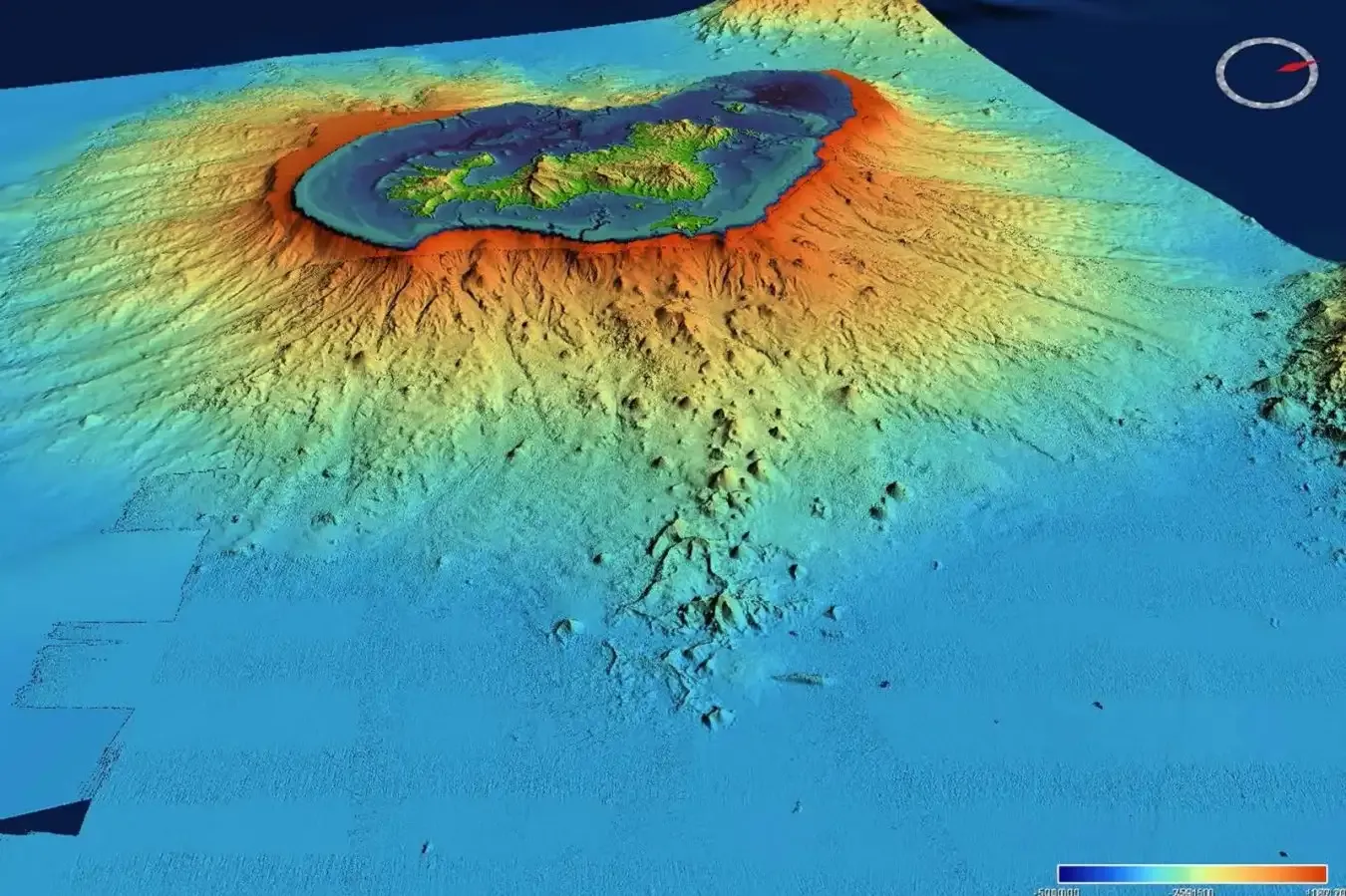
A young volcano in the Indian Ocean is preserving traces of Earth's primordial magma ocean in its magma. For decision-makers in science funding and research ecosystems, this is a reminder that fundamental discoveries can come from targeted, modern geology.
Earth was once covered by a global magma ocean, which later cooled and crystallised. That is the headline version of a 4.5-billion-year story. The new twist, reported by New Scientist, is that remnants of this primordial event have been found in magma from a young volcano in the Indian Ocean.
In other words, the planet's earliest chapter is not just locked in ancient rocks. It is apparently still chemically encoded in volcanic melt rising from deep Earth today. The result is grounded in a simple but powerful idea: magma from a young volcano can sample the mantle and, depending on how materials evolved and were recycled, can carry signatures from far earlier processes. Here, those signatures are being interpreted as traces of the primordial magma ocean.
To understand why this matters beyond geology trivia, zoom out to how evidence is created in any field that depends on the past. Scientists cannot rerun Earth’s formation. They look for proxies. In the early decades of Earth science, researchers leaned heavily on the oldest accessible rocks, because age is often the best “time machine.” But the tradeoff is brutal: older material is scarce, altered, and hard to interpret cleanly. Younger rocks, by contrast, are easier to access and analyze, but executives should think of them as “noisy” in the sense that they have had less time to become directly linked to the earliest events. The exciting part of this New Scientist report is that a young volcano appears to bridge the gap, acting like an accessible courier for deep-time chemistry.
This also connects to something any operator or investor who funds R&D eventually learns: breakthroughs are rarely born from one lab’s talent alone. They come from systems that let the right observations survive review. Volcanic sampling sits at the intersection of fieldwork, analytical instrumentation, and peer scrutiny. A young volcano in the Indian Ocean is not a random location picked for vibes. It offers magma that can be studied without the same level of long-term alteration you might worry about in extremely ancient specimens. When a result claims an origin story as sweeping as a primordial magma ocean, it must withstand intense methodological pressure, because the underlying claim reaches across the whole narrative of planetary differentiation, cooling, and crystallisation.
Regulatory background is less about government rules for rocks and more about the governance of scientific credibility and public funding. In science ecosystems, standards for data quality, sampling transparency, and reproducibility function like a compliance layer. They prevent “just-so stories” from becoming policy-grade narratives. That matters here because an interpretation like “traces of the primordial event” can be misread if it is treated as a single line item rather than a set of measured chemical or mineralogical relationships. For decision-makers who oversee grants, institutional strategy, or research partnerships, this is a signal that credible discoveries still depend on rigorous process, even when the headline is mind-blowing.
Second-order implications also show up in how teams prioritize discovery pipelines. If young volcanic systems can preserve deep primordial signals, then search strategies may need recalibration. Instead of relying exclusively on the oldest rocks, researchers can broaden the net toward places where relatively fresh magma can interact with older mantle reservoirs or preserve early-formed components. That could influence where future field expeditions go, which instruments get funded, and how collaboration networks are structured across geochemistry, petrology, and geophysics.
For peers making decisions in research leadership roles, the strategic stakes are straightforward. A finding like this is a reminder that the “where do we look” question can be just as valuable as the “how do we measure” question. It also underscores that the planet’s most consequential history can sometimes be accessed through comparatively recent windows. In the language of operational strategy, you get a higher signal-to-effort ratio when the target is accessible and the interpretation is disciplined.
And yes, the story is cosmic. But the executive lesson is terrestrial: when evidence links modern samples to primordial processes, it can reorganize entire frameworks for understanding how systems evolve. Here, traces of Earth’s primordial magma ocean are being read in magma from a young Indian Ocean volcano. That means the next wave of deep-time research may be less about chasing the oldest artifacts and more about finding the smartest conduits to the past.
This story's Key Insights and Take-aways are locked.
Create a free account to unlock Executive Actions for one credit.
Register to UnlockAlways free for Executives Club members. Join the Club
More in Science

Alaska's 1,580-foot tsunami had warning signs. Scientists just found them.
Rapid glacier retreat, heavy rainfall, and thousands of tiny tremors preceded Alaska's 1,580-foot tsunami, a warning for every coastal community in a warming world.

The rare mutation that lets high-risk brains dodge Alzheimer's
Scientists found a natural defense against protein buildup, opening a new path to preventive treatments.

3,000 steps a day may halve Alzheimer's decline, study finds
New research links a modest daily walk to less tau buildup and nearly half the cognitive and functional decline, even for those with early signs.