

128 Nations Agree to 'Elaborate' on Killer Robots. That Word Cost Two Years.
The US, Russia and Israel blocked a push by nearly 100 countries for binding rules on lethal autonomous weapons, leaving a two-year mandate campaigners call 'watered down' while AI targeting systems are already in combat.
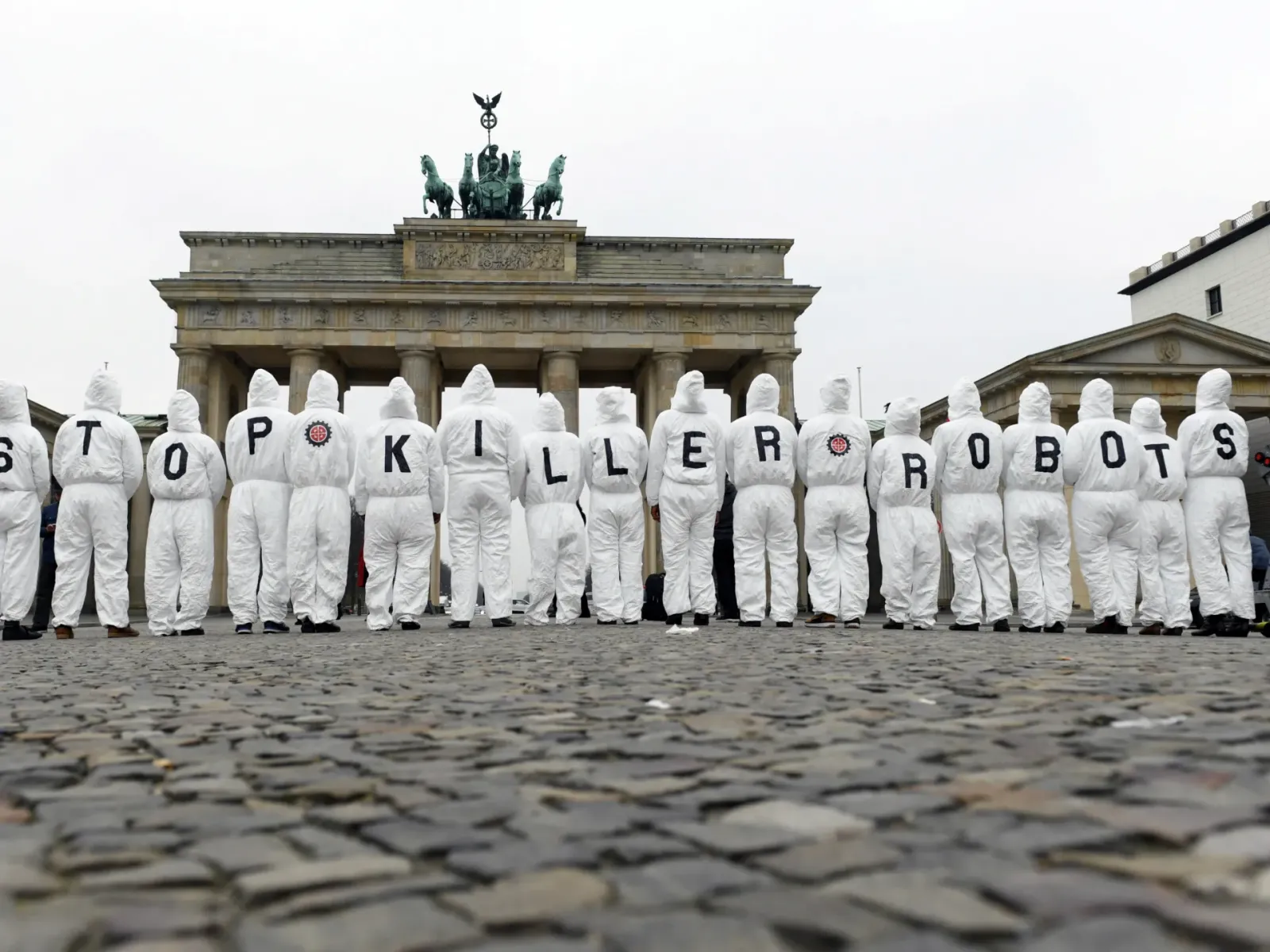
The 128 members of the UN's Convention on Certain Conventional Weapons agreed in Geneva to 'elaborate' on rules for lethal autonomous weapons within two years, after the United States, Russia and Israel opposed a push by nearly 100 nations for swift, legally binding rules. For executives in defense, AI and dual-use tech, the outcome means no global compliance standard is coming soon, and the definitional fight over what gets banned versus regulated will run through 2028.
The word that decided the future of "killer robots" is not "ban" or "treaty". It is "elaborate". On Saturday in Geneva, the 128 member countries of the UN's Convention on Certain Conventional Weapons (CCW) agreed to "elaborate" on a possible accord regulating lethal autonomous weapons over the next two years. That verb was not an accident. Julien Thoeni, the Swiss diplomat who chaired the conference, told reporters that some countries had rejected the word "negotiate" outright, so the final text refers instead to the "elaboration" of an instrument. In a consensus body, one objection is enough to change the language, and the language is the outcome.
The split was not subtle. Nearly 100 nations pushed for swift adoption of legally binding rules on weapons capable of killing without a human making the final decision to fire. Key arms-producing nations, including the United States, Russia and Israel, opposed the push. Because decisions under the convention require the agreement of all member states, that opposition was decisive. Diplomats said Russia's objections over procedure led to some formal sessions being called off, and talks over the final wording ran through the night. What emerged was a mandate to keep talking, not a mandate to write law.
Thoeni framed it as progress. He said more than 10 years of talks had produced a significant step for humanitarian disarmament, and that the process should determine which weapons can be banned under international humanitarian law and which can be permitted but regulated. "It shows that even in today's deeply divided world, multilateral diplomacy can still deliver concrete results," he told reporters as the meeting wrapped up.
Not everyone bought that. Stop Killer Robots, a coalition of 300 organisations opposed to the development and use of autonomous weapons, called the mandate "watered down", saying it offered no clear route to legally binding rules. Its executive director, Nicole van Rooijen, said autonomous weapons were already being deployed in combat, including systems that use artificial intelligence to choose targets. "Delaying the creation of a legally binding instrument puts civilians and humanity at risk," she told AFP.
Verity Coyle, deputy director for arms at Human Rights Watch, was similarly blunt. "It does not provide the urgent action needed to agree new rules - but the technology is racing ahead," she told AFP. That gap between the pace of the talks and the pace of the technology is the whole story. A two-year elaboration mandate lands around 2028, which in AI terms is a very long time.
For context, the CCW is a UN framework built on consensus, which means any single member state holds an effective veto over the whole room. That design has historically produced slow, incremental agreements rather than fast bans, and it explains how a bloc of nearly 100 states can want binding rules and still walk away with a promise to elaborate. The convention's own summary of Saturday's outcome is blunt: members failed to agree on swift adoption of legally binding rules.
Why should anyone outside a Geneva negotiating room care? Because autonomy is moving into the defense stack at speed, and the rules that govern it are being written, or not written, in public. Companies building AI-enabled targeting, navigation or decision-support systems face a world with no single global compliance standard: what is permitted in one jurisdiction may be restricted in another, and the CCW process is the closest thing to a global reference point. Defense primes, startups, insurers and investors all price that ambiguity differently. A binding instrument would create a clear line to build against. A two-year elaboration mandate creates a moving target.
The practical read for boards: the window between now and 2028 is when the technical and legal defaults get set. Thoeni's framing suggests the next phase will sort weapons into two buckets, those banned under international humanitarian law and those permitted but regulated, which means the fight ahead is about definitions, not just prohibitions. Watch whether "elaboration" quietly becomes "negotiation", whether the United States, Russia and Israel hold their positions, and whether the coalition of nearly 100 states keeps pushing. For anyone with exposure to autonomous systems, the mandate is not a pause. It is a countdown.
This story's Key Insights and Take-aways are locked.
Create a free account to unlock Executive Actions for one credit.
Register to UnlockAlways free for Executives Club members. Join the Club
More in Technology

Anthropic Mathematician Claims Claude Helped Prove Riemann Hypothesis in Six Weeks
Levent Alpöge says the AI tool helped him develop a solution to one of math's most important unsolved problems in about six weeks, a claim that, if verified, would reshape AI's role in research.

Anthropic mathematician claims Claude helped crack the Riemann hypothesis
If the proof holds, AI has toppled math's most famous open problem; if it does not, it is a case study in announcing breakthroughs before anyone verifies them.

AI's $4 Trillion Wipeout Erases Nasdaq's Gains for the Year
A brutal week took roughly $4 trillion off the AI sector and left the Nasdaq flat for the year, and the damage ran the full length of the supply chain.