
S&P 500 Enters Correction, Down 10% From Its High on AI Worries
The index's slide past the 10 percent line is a symbolic verdict on investor mood, and the AI trade that powered the rally is now the thing testing it.

The S&P 500 closed more than 10 percent below its recent high, the threshold that defines a market correction, as worries about artificial intelligence intensified. For executives and boards, the shift raises the cost of capital, cools private market appetite, and puts every AI spending commitment under a harsher light.
The S&P 500 ended the day more than 10 percent below its recent high, the threshold that turns an ordinary pullback into a correction. That number is not a technicality. It is the market's shorthand for a change in mood, and according to the New York Times, the mood has soured. A decline of 10 percent or more from a peak is the line Wall Street has long used to separate a wobble from a trend, and the index has now crossed it. The move is symbolic in the truest sense: nothing about the underlying economy changed in a single trading session, but the collective judgment of investors did.
The driver, as the Times frames it, is intensifying worry about artificial intelligence. That is the part worth sitting with. For the past few years, AI has been the story that justified the market's richest valuations, the reason investors tolerated premium multiples on the theory that the payoff was coming. When that story gets questioned, the repricing rarely stays contained to a handful of companies. The largest AI-linked names carry outsized weight in the S&P 500, so when their shares move, the index moves with them. A debate about AI economics becomes, quickly, a debate about everyone's portfolio.
For context on how to read the number: a correction is not a crash, and it is not a bear market. A correction is commonly defined as a decline of at least 10 percent from a recent high; a bear market is typically defined as a fall of 20 percent or more. The distance between those two markers is where the next stretch of trading gets decided. Historically, corrections have been a recurring feature of long bull markets rather than a rare event, which is why strategists tend to treat them as a test of conviction rather than a verdict. The question is never whether the drop happened. It is whether the reasons for it are temporary or structural.
On AI, the worry is structural until proven otherwise. The questions investors typically raise are straightforward: how much are companies spending on AI infrastructure, how quickly does that spending turn into revenue, and what happens to the math if the returns arrive later than the spending does. Those questions get sharper when the companies buying the technology, the companies selling it, and the investors funding it start to overlap. Heavy capital spending is easy to applaud in a rising market and much harder to defend in a falling one, because the costs are visible today and the payoffs are promised tomorrow.
The second-order effects are where this stops being an index story. Public market valuations set the tone for private ones, and a sustained correction tends to cool the appetite for new listings, late-stage funding rounds, and acquisitions priced off public comparables. It also changes the cost of capital conversation inside boardrooms: buyback plans, debt issuance, and expansion budgets all get re-underwritten when the equity market stops handing out free optimism. Credit markets usually move more slowly than stocks, but when they do move, the terms get stricter and the refinancing calendar gets more uncomfortable. None of that requires a recession. It only requires a market that has stopped paying for the future at yesterday's prices.
For anyone with a retirement account, a 401(k), or an index fund, the correction is not abstract. Broad index funds are built to hold the market's largest companies, which means the AI debate is now a household finance topic, not a Silicon Valley one. That is also why the mood matters beyond portfolios. Falling markets tighten the feedback loop between confidence and spending: hiring plans get a second look, discretionary budgets get trimmed, and the tone of earnings calls shifts from ambition to discipline.
What to watch from here is simple to state and hard to predict. The first marker is whether the decline deepens toward the 20 percent bear market line or stabilizes above it. The second is whether AI-related earnings and guidance validate the spending that has been promised. The third is whether the souring mood spreads from equities into credit and private markets, where the feedback loops run slower but hit harder. For executives and boards, the practical takeaway is not to panic but to prepare: know which projects depend on cheap capital, know which promises depend on a friendly market, and be ready to explain both in plain language if the correction stops being symbolic.
This story's Key Insights and Take-aways are locked.
Create a free account to unlock Executive Actions for one credit.
Register to UnlockAlways free for Executives Club members. Join the Club
More in Business

Dow and S&P 500 enter correction as Nasdaq logs worst week since 2020
All 11 S&P 500 sectors fell more than 1% in the same week for the first time since April 2025, a breadth signal that matters more than any single index level.

Chip stocks lose $2.3 trillion in a week, worst run in 25 years
A $2.3 trillion weekly wipeout in semiconductors is forcing every board with an AI story to ask whether it owns a thesis or just a crowded trade.
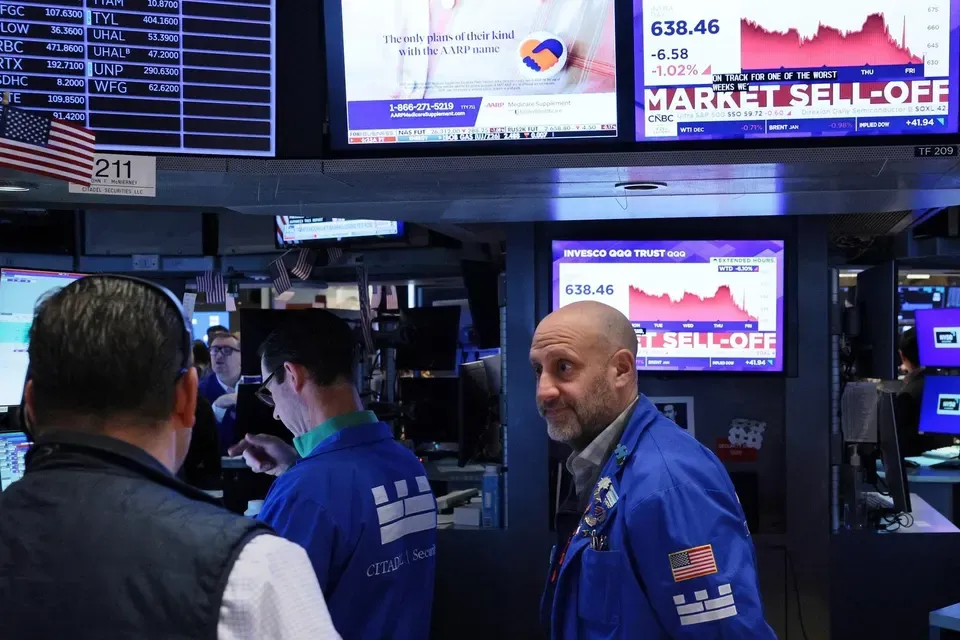
Nvidia and Broadcom Lead Friday Rout as S&P 500 Hits 7-Month Low
Chipmakers took the brunt of a tech-and-AI-driven sell-off, and the index's slide to a seven-month low turns AI enthusiasm into a two-way trade for every board.