
Chip stocks lose $2.3 trillion in a week, worst run in 25 years
A $2.3 trillion weekly wipeout in semiconductors is forcing every board with an AI story to ask whether it owns a thesis or just a crowded trade.

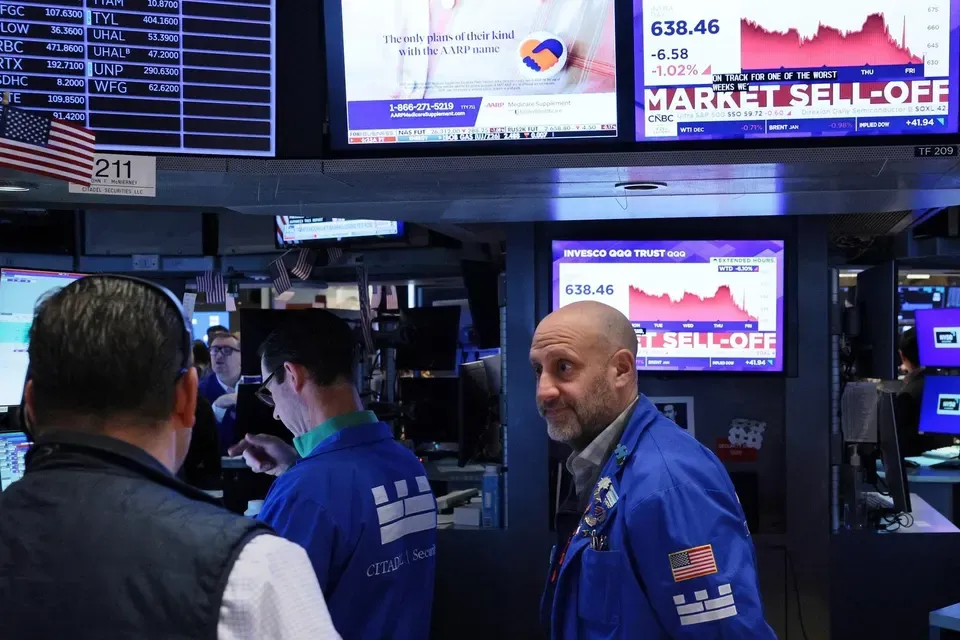
A major semiconductor index just posted its worst weekly performance in 25 years, with chip stocks shedding $2.3 trillion in market value in a single week as panic spread through the AI trade, according to MarketWatch. For decision-makers, the wipeout turns an abstract debate about AI valuations into a live question about capital costs, capex commitments, and how much of the corporate story was priced only for the up case.
The number is $2.3 trillion, and it disappeared in five trading sessions. A major semiconductor index just posted its worst weekly performance in 25 years, according to MarketWatch, as panic spread through the trade that has carried the stock market for the better part of three years. Chip stocks, the purest available bet on artificial intelligence, took a weekly wipeout measured in trillions, not billions. That is not a pullback in one company or one product line. It is a repricing of an entire supply chain, from the designers of AI accelerators to the foundries that print them to the equipment makers that supply the fabs.
Read the scale carefully. $2.3 trillion is roughly the annual economic output of a top-ten national economy, gone from a single slice of the market in a single week. When an index sheds that much value that fast, the damage does not stay inside the index. It moves through pension funds, retirement accounts, hedge fund margin calls, and the venture math behind every AI startup that raised at a premium. The people who feel it first are not the ones who made the boldest bets. They are the ones whose savings happen to be indexed to the same handful of names.
Semiconductors sit at the center of the AI trade for a simple reason: they are the toll booth. Every large language model, every data center expansion, every training run ultimately converts into orders for silicon. That makes chipmakers the highest-conviction and highest-beta expression of AI enthusiasm. When money floods into the theme, chips outperform everything. When conviction cracks, chips crack first and hardest, because they carry the most crowded positioning and the most optimistic earnings expectations baked into their prices. The index is not a proxy for AI sentiment. It is AI sentiment, with a ticker.
Panic in a crowded trade has a mechanical quality that has little to do with any single company's results. Momentum funds that piled in on the way up are forced to sell on the way down. Volatility-targeting strategies cut exposure as swings widen. Options dealers who sold downside protection hedge themselves by selling the underlying. Margin calls turn one investor's decision into another investor's forced sale. None of that requires a change in the underlying business. It only requires that enough people want out at the same time, and that the exit is narrower than the entrance.
There is also a concentration problem underneath all of this. The AI trade has been the market's engine, and a small group of very large companies has done an outsized share of the lifting. That means a chip-led selloff is not a sector story. It is an index story, a retirement-account story, and a story about what happens when the most crowded idea in finance has to find a new buyer at a lower price. Correlations tend to go to one in a panic, and diversification that looked real in a calm market often turns out to be thinner than advertised.
The 25-year marker is the part that should stop you. Twenty-five years back puts you in 2000, the year the dot-com bubble finished deflating and the first generation of internet darlings was being repriced toward zero. That comparison is not a forecast. It is a reminder that semiconductor cycles have historically been brutal in both directions, and that markets have a long memory for the last time they fell in love with a technology story and then fell out of it. The industry's own history says the swings are the feature, not the bug.
The second-order effects are where this gets interesting for operators. Data center buildouts are planned years in advance and financed with debt and equity raised against a share price. A sustained drawdown raises the cost of that capital and makes boards ask harder questions about committed capex. Private AI companies that benchmarked their valuations against public comparables suddenly have a moving target. The IPO window, already selective, gets narrower. Power contracts, land deals, and long-lead equipment orders all get re-underwritten at a different discount rate than the one used six months ago.
The question that matters now is whether this is a positioning flush or a thesis break. A flush is violent, fast, and largely technical: leverage unwinds, the strongest hands buy, and the trend resumes. A thesis break is slower and quieter: guidance gets trimmed, capex plans get stretched, and the story stops being about how big the opportunity is and starts being about how long it takes to arrive. The two look identical in week one. They diverge in the quarters that follow, and the market will spend the next several weeks trying to tell them apart.
For executives and boards, the lesson is about how much of the corporate narrative has been tied to a single theme. Companies that sold the market on AI exposure now own the volatility that comes with it. Compensation plans, capital allocation, hiring, and investor messaging built on one assumption are exposed the moment that assumption gets tested. The prudent move is not to abandon the thesis. It is to know, before the next week like this one, exactly which parts of your plan survive a 25-year record drawdown and which parts were only ever priced for the up case.
This story's Key Insights and Take-aways are locked.
Create a free account to unlock Executive Actions for one credit.
Register to UnlockAlways free for Executives Club members. Join the Club
More in Business

S&P 500 Enters Correction, Down 10% From Its High on AI Worries
The index's slide past the 10 percent line is a symbolic verdict on investor mood, and the AI trade that powered the rally is now the thing testing it.

Dow and S&P 500 enter correction as Nasdaq logs worst week since 2020
All 11 S&P 500 sectors fell more than 1% in the same week for the first time since April 2025, a breadth signal that matters more than any single index level.
Nvidia and Broadcom Lead Friday Rout as S&P 500 Hits 7-Month Low
Chipmakers took the brunt of a tech-and-AI-driven sell-off, and the index's slide to a seven-month low turns AI enthusiasm into a two-way trade for every board.