
Nvidia and Broadcom Lead Friday Rout as S&P 500 Hits 7-Month Low
Chipmakers took the brunt of a tech-and-AI-driven sell-off, and the index's slide to a seven-month low turns AI enthusiasm into a two-way trade for every board.
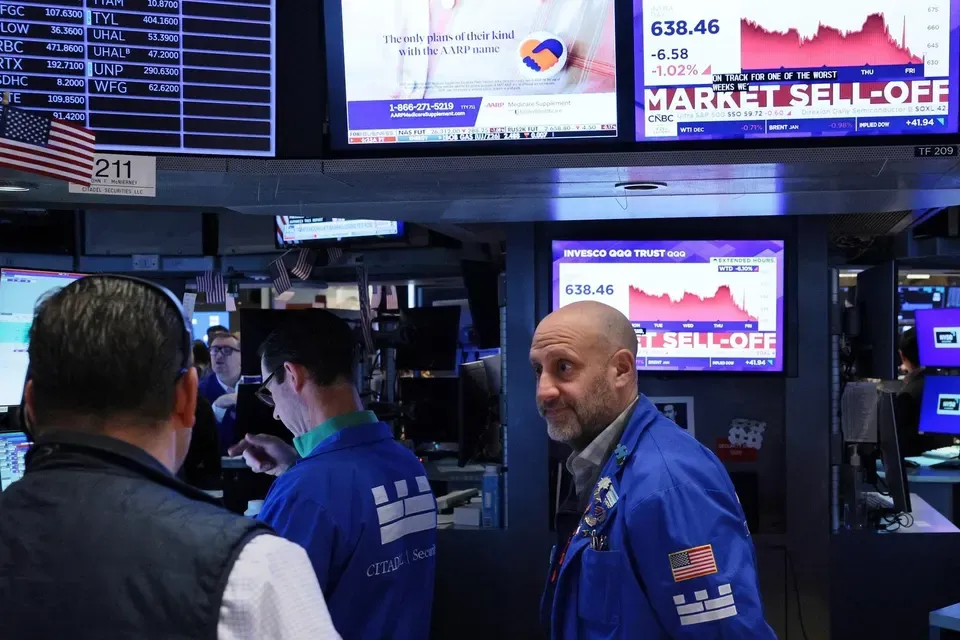
Nvidia and Broadcom led a broad technology sell-off Friday that pushed the S&P 500 to a seven-month low, with chipmakers and chip designers absorbing the worst of the decline. For decision-makers, the move reprices AI-linked equity risk and puts a higher cost of capital underneath every multi-year AI capital plan.
The S&P 500 closed Friday at its lowest level in seven months, and the pain was not spread evenly. Chipmakers and chip designers absorbed the worst of it, with Nvidia and Broadcom taking the brunt of the slump as major technology company stocks tanked across the board. Forbes' reporting frames the driver plainly: concerns about tech and AI are fueling the sell-off. That is the whole story in one line, and it is a story every operator with AI exposure should read twice.
Start with what a seven-month low actually is. It is not a percentage. It is a reference point. The index is trading at a level it has not touched in roughly seven months, which means the ground the market covered over that stretch has been given back. For anyone who marks performance against the index, the benchmark just moved. For anyone who raised capital, priced a round, or set a budget against a rising tape, the assumption underneath that plan has changed.
Why chips first? Because they are the purest listed proxy for AI spending. Nvidia designs the graphics processors that train and run large AI models. Broadcom designs custom silicon and networking chips that sit inside the same data centers. Neither company sells AI directly to consumers. Both sell into the capital budgets of a relatively small number of very large buyers. That structure makes their shares a leveraged bet on AI conviction: when enthusiasm rises, they lead the market up, and when it wobbles, they lead it down. Friday was the second half of that sentence.
There is a mechanical reason the damage looks so broad, too. The S&P 500 is weighted by market value, so the largest companies pull the index harder than the smallest ones. Over the past several years, a handful of megacap technology names have grown into a historically large share of the benchmark. The practical consequence is that "tech sell-off" and "index sell-off" have collapsed into the same event. A fund manager who owns the index is not diversified away from AI sentiment. They are long it.
Then there is the phrase "AI concerns," which is doing a lot of work. The source does not specify which concerns drove Friday's move, and that ambiguity is itself informative. The label typically covers a cluster of recurring debates: how quickly AI spending converts into revenue, how long the hardware behind it stays useful before it is depreciated, whether the money flowing between model builders and chip buyers is as independent as it looks, and whether power and data center capacity can keep pace. None of those questions get answered in a single trading session. All of them get repriced in one.
For executives, the second-order effects matter more than the tape. A sustained drawdown in high-multiple tech typically tightens the market for late-stage private capital, because public comparables set the ceiling for private marks. It tends to make boards more cautious about large multi-year capital commitments, particularly in infrastructure. It can slow hiring in the functions that expanded fastest during the boom. And it feeds back into consumer confidence, because equity holdings are a meaningful slice of household wealth for the upper-income households that drive discretionary spending.
The distinction that matters most right now is between a sentiment drawdown and a demand drawdown. Friday's move, as reported, is a sentiment event: investors repricing how much they are willing to pay for AI-linked earnings, not evidence that those earnings have stopped. Those two things look identical on a chart and could not be more different in a boardroom. A sentiment drawdown is a financing problem. A demand drawdown is an operating problem. Companies that confuse them cut too deep in the first case and too late in the second.
So what should peers in similar seats actually do? First, separate your equity price from your operating plan. If your stock or your valuation multiple moved with the index, that is a market statement about AI, not a verdict on your business. Second, stress-test the capital expenditure line. If your AI infrastructure commitments assume a cost of capital that no longer exists, that assumption needs a date on it. Third, watch the buyers. The chipmakers fell hardest because their revenue depends on a small set of enormous capital budgets. If those budgets hold, Friday was noise. If they blink, Friday was the first draft of something bigger.
The seven-month low is the number to remember, because it resets the baseline. Every forecast built on a rising multiple now needs a downside case attached to it. The AI trade is no longer a one-way bet, and the market just said so out loud.
This story's Key Insights and Take-aways are locked.
Create a free account to unlock Executive Actions for one credit.
Register to UnlockAlways free for Executives Club members. Join the Club
More in Business

S&P 500 Enters Correction, Down 10% From Its High on AI Worries
The index's slide past the 10 percent line is a symbolic verdict on investor mood, and the AI trade that powered the rally is now the thing testing it.

Dow and S&P 500 enter correction as Nasdaq logs worst week since 2020
All 11 S&P 500 sectors fell more than 1% in the same week for the first time since April 2025, a breadth signal that matters more than any single index level.

Chip stocks lose $2.3 trillion in a week, worst run in 25 years
A $2.3 trillion weekly wipeout in semiconductors is forcing every board with an AI story to ask whether it owns a thesis or just a crowded trade.