

17 spacecraft caught a solar eruption hiding a second, Earth-bound lobe
A record fleet of spacecraft revealed a lopsided CME that forecasters would have missed, underscoring the need for off-axis space weather monitoring as human exploration pushes deeper into the solar system.
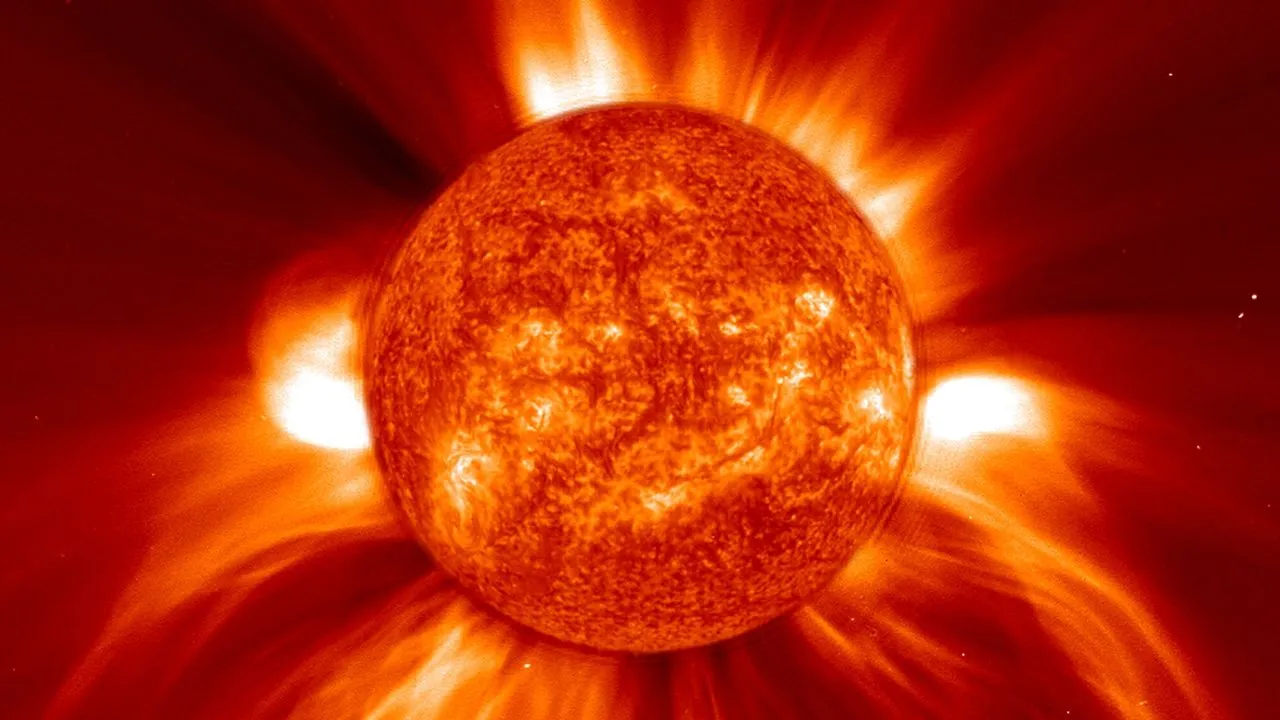
Adrienn Luspay-Kuti of Johns Hopkins University Applied Physics Laboratory led a study that used a record 17 spacecraft to track a December 2024 coronal mass ejection, revealing a hidden fast lobe aimed at Earth. The finding highlights the limitations of current space weather forecasting and the importance of multi-viewpoint observations for protecting astronauts and infrastructure.
A coronal mass ejection that erupted from the sun on Dec. 15, 2024, turned out to be a two-faced trickster. Tracked by a record 17 spacecraft scattered across the solar system, the CME revealed itself to be surprisingly lopsided, with a fast lobe heading straight for Earth that was completely hidden behind a slower, larger lobe. If forecasters had relied on the usual sun-facing instruments, they would have missed the dangerous component entirely. The discovery, published Aug. 19 in Science Advances, is a wake-up call for space weather prediction as NASA and other agencies plan missions to the Moon, Mars, and beyond.
The research, led by Adrienn Luspay-Kuti of Johns Hopkins University Applied Physics Laboratory, used observations from 17 spacecraft to track and characterize the CME, a record for a single event. The previous record was 10 spacecraft, but those were mostly lined up along the sun-Earth axis, giving a one-dimensional view. This time, the fleet was spread wide, with spacecraft at different distances from the sun and substantially off the Earth-sun line. That wide spread was crucial: it revealed that the CME had two asymmetric lobes, one moving faster than the other. The fast lobe, which headed for Earth and Mars, would have gone unseen, obscured by the larger but slower lobe that left the sun at a tangent, were it not for the off-axis vantage points.
The implications for space weather forecasting are immediate. CMEs are "burps" from the sun, huge clouds of magnetized plasma belched out from the corona by the energy of a solar flare. When they intercept Earth, they can trigger auroras, but they also pose a significant radiation hazard to astronauts, spacecraft, and even passengers on jetliners. The fast lobe in this event had an average velocity of 522 miles (840 kilometers) per second, while the slower lobe dragged its feet at 332 miles (534 km) per second)Skip. Both lobes decelerated as they plowed into the solar wind, but the range of velocities told researchers the eruption was not traveling as a single, unified front. That asymmetry is what makes forecasting so difficult: if you only see one lobe, you might underestimate the threat.
The December 2024 CME was first imaged by SOHO, the joint NASA-ESA Solar and Heliospheric Observer, which has been monitoring the sun for more than 30 years. But SOHO only saw the slower lobe that erupted at an angle to Earth; the faster lobe heading for our planet was missed, obscured by the slower, larger lobe. The CME was next detected on Dec. 16 at 0.35 astronomical units (AU) from the sun, near Mercury, by the European Space Agency's BepiColombo mission. On Dec. 17, the hidden component arrived at Earth, where a multitude of spacecraft picked it up. Interestingly, Europe's Solar Orbiter, at 0.94 AU and just 10 degrees off the Earth-sun line, did not detect the CME. That non-detection was actually vital, helping to constrain the shape of the CME. On Dec. 18, the slower lobe reached NASA's STEREO-A spacecraft, which orbits the sun at 1 AU but substantially ahead of Earth.
Beyond Earth, NASA's Europa Clipper, on which Luspay-Kuti is the Principal Investigator for the Plasma Instrument for Magnetic Sounding (PIMS) experiment, detected the faster lobe at 1.19 AU as it cruised to Mars for a gravity assist. At the red planet, the now-defunct MAVEN mission also detected the CME on Dec. 19-20. The fact that so many spacecraft, including planetary missions in their cruise phase, could track a single CME is a significant step forward. As Luspay-Kuti told Space.com, "This matters for future human exploration because a missed CME can mean losing valuable warning time. Fast CMEs can drive shocks that accelerate high-energy particles, which can pose a radiation hazard to astronauts outside Earth's protective magnetic field."
The asymmetry of this CME was a surprise, and the cause remains unclear. Luspay-Kuti and her team are investigating, but the big question is how frequent asymmetric CMEs are. "In the context of previous observations, this event is at the most extreme end of observed CME variability," she said. "Are highly asymmetric CMEs actually fairly common but we fail to recognize them because we don't have enough observational coverage, or are they genuinely rare?" The answer will determine how much investment is needed in off-axis monitoring. The European Space Agency's Vigil mission, set to launch in 2031 to the sun-Earth L5 Lagrange point, will provide additional off-axis monitoring, but until then, the gap remains.
For executives in the space industry, this finding is a reminder that the infrastructure we rely on for space weather forecasting is still dangerously one-eyed. The 17 spacecraft that detected or imaged the CME included SOHO, BepiColombo, Solar Dynamics Observatory, STEREO-A, the four MMS spacecraft, the two ARTEMIS spacecraft, Wind, ACE, GOES, DSCOVR, Europa Clipper, MAVEN, and Solar Orbiter. That fleet is impressive, but it is not designed for operational forecasting. As human exploration moves further from Earth, the need for dedicated off-axis monitors becomes critical. The cost of a missed CME is not just a lost aurora; it is a radiation dose to astronauts or a damaged satellite. The private sector, from satellite operators to lunar lander developers, should take note: space weather is a risk that can be mitigated with better data, and the demand for that data is about to grow.
This story's Key Insights and Take-aways are locked.
Create a free account to unlock Executive Actions for one credit.
Register to UnlockAlways free for Executives Club members. Join the Club
More in Science

2026 Nikon Small World Winners Reveal the Hidden Machinery of Everyday Life
A mycologist's frozen Edinburgh garden became the backdrop for vivid views inside cells, a reminder of what advanced imaging now makes visible to researchers and the industries built on biology.

Study: 1 in 4 depression cases may be a body-clock problem, not a chemical one
A 10,000-person study finds standard antidepressants often fail these patients, but melatonin and morning sunlight may hit the real root cause.

Start-Up Says A.I. Designed a Virus to Attack One Patient's Superbug
If the claim holds up, personalized phage therapy could become a new frontline weapon against antibiotic resistance - but proof is far from final.