

A flaw in PHP just forced governments to pull their own sites offline
European agencies from Belgium to Germany took websites dark to patch a critical weakness in the language behind almost 70% of the web, and the blast radius extends far beyond government portals.
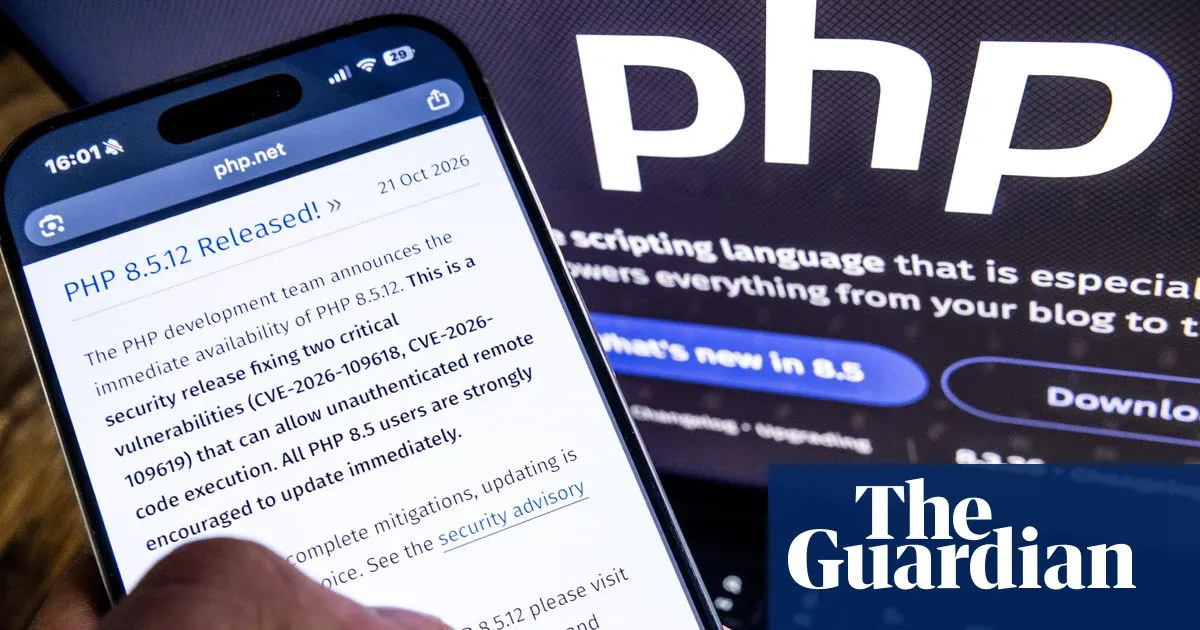
European governments from Belgium to Germany temporarily took down official websites after security experts flagged a critical vulnerability in PHP, the language that powers almost 70% of the web. For any organization running PHP-based infrastructure, the incident is a live reminder that one upstream flaw can force emergency patching across an entire digital estate.
The websites went dark not because they were attacked, but because the people running them were scared of what could happen next. Belgian, Dutch, Finnish, French and German government sites were among those temporarily taken offline as agencies scrambled to patch a critical vulnerability in PHP, the server-side programming language that underpins almost 70% of the world's websites. The takedowns were precautionary, but the message was not: security experts warn that bad actors could exploit the weakness, and the safest move was to unplug first and fix later.
To understand why a single language flaw can ripple across continents, consider what PHP actually does. It is the workhorse that runs on web servers to generate dynamic pages, the code that processes a login form, renders a shopping cart, or serves a government portal's content. When a critical vulnerability is found in that layer, it is not one website at risk; it is a meaningful slice of the entire internet. That is why the response looked less like a routine patch cycle and more like an emergency evacuation.
The incident is a reminder of how much of the modern web rests on a relatively small number of open-source foundations. PHP has been a staple of web development since the mid-1990s, and its longevity is precisely why it is so deeply embedded. For context, much of the web's content management and e-commerce infrastructure runs on PHP, which means the vulnerability's potential blast radius extends far beyond the government sites that made headlines. A flaw in a language this widely used is not a niche problem; it is a systemic one that touches everything from small business storefronts to national digital services.
The precautionary takedowns also highlight a shift in how organizations respond to critical vulnerabilities. In the past, the instinct might have been to keep services running while a patch was prepared. Here, the calculus was different: with experts warning that bad actors could exploit the flaw, the cost of a temporary outage was judged lower than the risk of a full compromise. That is a sobering trade-off for any operator who has ever explained an outage to a board, and it is a sign that security teams are increasingly willing to pull the plug first and ask questions later.
For founders and operators, the episode is a case study in dependency risk. Every layer of your stack, from the language to the framework to the hosting provider, is a potential single point of failure. The teams that weathered this incident best were likely the ones that already had a patching playbook, a way to test updates quickly, and a communication plan for stakeholders. The teams that struggled were probably the ones discovering their dependency map for the first time, and that discovery is always more expensive in the middle of an incident.
There is also a governance angle. When governments take their own sites offline, it sends a signal to the private sector about the seriousness of the threat. Regulators and security agencies across Europe are increasingly treating software supply chain risk as a systemic issue, and incidents like this one tend to accelerate that scrutiny. For companies that sell to or partner with the public sector, demonstrating a fast, disciplined response to vulnerabilities is becoming part of the cost of doing business, not an optional extra.
The strategic takeaway for decision-makers is straightforward: assume the next critical vulnerability is already on its way, and build the muscle memory now. That means knowing exactly which of your systems depend on which languages and libraries, having a tested rollback and patching process, and being honest with your team about the trade-offs between uptime and security. The PHP flaw will be patched, and the affected sites will come back online. But the pattern, a widely used foundation, a critical flaw, a global scramble, is not going anywhere.
For investors and board members, the episode is also a reminder that technical debt is financial risk. A company that has neglected its dependency hygiene may look profitable on paper, but a single critical vulnerability can force unplanned downtime, emergency engineering hours, and reputational damage that no budget line item anticipated. The organizations that treat security as a continuous discipline, rather than a quarterly checkbox, are the ones that will absorb shocks like this without missing a beat.
This story's Key Insights and Take-aways are locked.
Create a free account to unlock Executive Actions for one credit.
Register to UnlockAlways free for Executives Club members. Join the Club
More in Business

BioWare shuts down, Mass Effect 5 dead after $55B EA buyout
The legendary RPG studio's closure lands months after a $55 billion investment group buyout of EA, raising tough questions for gaming's biggest acquirers.

Musk barred from the room as Tesla, SpaceX boards weigh $3.5 trillion merger
The CEO of both companies is a 'conflicted party' watching independent directors negotiate a tie-up that would create a $3.5 trillion giant he would own about a third of.

Elon Musk just showcased a flying car - and it wasn't at Tesla
The Tesla CEO's latest reveal came at SpaceX, not Tesla, signaling where vertical mobility is headed.