

253 million-share Amazon buying spree follows Buffett’s exit, led by Tepper, Ackman, and others
After Berkshire cut back, institutions add 253 million shares, betting AWS growth and “sum-of-the-parts” value will win.

Even as Warren Buffett’s Berkshire Hathaway exited Amazon, institutions reported owning 253 million more Amazon shares in the most recent SEC filings. The consequence: major money managers are leaning into a cheaper-than-AI-premium narrative, even as they fund a roughly $200 billion 2026 capex push.
Amazon has become the rare mega-cap where the AI trade looks expensive, and the stock still doesn’t fully match the business hype. While Warren Buffett’s Berkshire Hathaway massively trimmed its stake and then listed no Amazon holdings in its most recent filing, institutional investors reported owning 253 million more shares of Amazon in the latest quarter than in the prior quarters, according to Quiver Quantitative data provided to Fortune. That mismatch, between “everything AI is on fire” and Amazon shares that have been relatively quiet, is exactly what’s pulling big-name managers in.
The buyers include David Tepper’s Appaloosa Management, Seth Klarman’s Baupost Group, Al Gore’s Generation Investment Management, and Sanders Capital. For both Klarman and Tepper, Amazon has become their single largest holding. Bill Ackman, through Pershing Square, started amassing an Amazon stake from scratch about a year ago, and Amazon is now its second-largest position at about $2.4 billion. The logic is consistent across these firms: they think Amazon is a bargain megacap in the AI ecosystem, where investors keep paying up for the “compute” winners, but haven’t repriced Amazon to reflect the pace of its underlying operating performance.
Part of why this matters to decision-makers is the market context. Over the past 12 months, the broader AI proxy crowd has surged: Nvidia is up 35%, Intel is up 496%, and Micron Technology is up 719%. Amazon’s stock gains, by contrast, have been relatively meager, up 3.4% year-to-date and 10.1% over the past 12 months. That gap is what creates a classic value-investing setup, because it suggests the market may be pricing less of the business momentum than the fundamentals justify.
And Amazon’s fundamentals are not just “fine.” On its last earnings call, CEO Andy Jassy described Amazon Web Services, the company’s cloud division, as posting its “fastest growth in 15 quarters.” AWS grew 28% in the first quarter of 2026 to $37.6 billion in revenue. The backlog of contracted but not-yet-recognized revenue was $364 billion as of March 31, and that figure excludes the company’s deal for Anthropic, in which Amazon will provide AWS technologies over the next decade. Fortune notes the agreement includes Anthropic spending more than $100 billion on AWS technologies, Amazon previously invested $8 billion in Anthropic, and Amazon agreed to invest up to $25 billion more.
This is where the “sum-of-the-parts” argument comes in. Charles Lemonides, founder of hedge fund ValueWorks and a holder of Amazon, said that in his view the pieces of Amazon are worth more than the market is valuing the whole company. His rough math splits Amazon’s roughly $2.5 trillion market value into about half for AWS and the other half for retail, meaning an investor could effectively get the rest of the company, including advertising, media, and streaming, as a “free sweetener.” Lemonides also emphasized that the case looks stronger than a year ago because Amazon has continued executing across businesses while the stock has increased modestly.
If the business case sounds bullish, why do some investors look cautious? In part, because earnings and valuation are getting distorted by capex. Amazon trades at roughly 27 times forward earnings, a higher multiple than Microsoft or Nvidia, both around 18 to 20 times, and above Meta Platforms’ 17. Even the Nasdaq 100 is at about 24 times. But the company is also in a major spending binge: it has told investors it expects to devote about $200 billion to capital expenditures in 2026, mostly for AWS as it adds AI and cloud capacity. In plain English, investors may be seeing “expensive stock” because spending is rising now, while the payoff may show up later.
The buying spree is broad, but not universal. Berkshire Hathaway massively trimmed its Amazon stake to 2.3 million shares from 10 million shares by the end of 2025, and its most recent filing lists no Amazon holdings. Stanley Druckenmiller’s Duquesne Family Office also reduced its common-stock exposure, cutting about 94% to fewer than 46,000 shares. At the same time, Druckenmiller doubled his call options on Amazon, increasing from 100,000 to 200,000 shares, which points to a leveraged expression of optimism rather than a simple retreat.
The second-order implication for boards and portfolio leaders is that these 13F moves are not always clean signals about long-term beliefs. James Kardatzke, CEO at Quiver Quantitative, warned against reading selling as a thumbs-down on Amazon, noting that the motivation behind large institutional moves “isn’t always clear-cut.” He pointed out that 13F filings are a quarterly snapshot, and firms have up to 45 days after the end of the quarter to file. In other words, a sell could reflect portfolio rebalancing timing rather than a judgment that the story is broken.
Still, the story behind the buying is consistent: investors believe excitement could return to Amazon, and they want to own it before the market catches up. Lemonides put it bluntly, saying the market is momentum-driven and that excitement begets excitement. He said he is “thrilled” to build his position now, and is planning to fund it by trimming stakes in winners like Micron Technology and Intel, essentially choosing the puck trajectory instead of where the puck is today. For investors and operators watching the AI infrastructure build, the takeaway is straightforward: Amazon’s AWS growth, its $364 billion backlog, and the $200 billion capex push are pulling sophisticated capital in, even as some of the loudest AI rallies have been happening elsewhere.
This story's Key Insights and Take-aways are locked.
Create a free account to unlock Executive Actions for one credit.
Register to UnlockAlways free for Executives Club members. Join the Club
More in Business
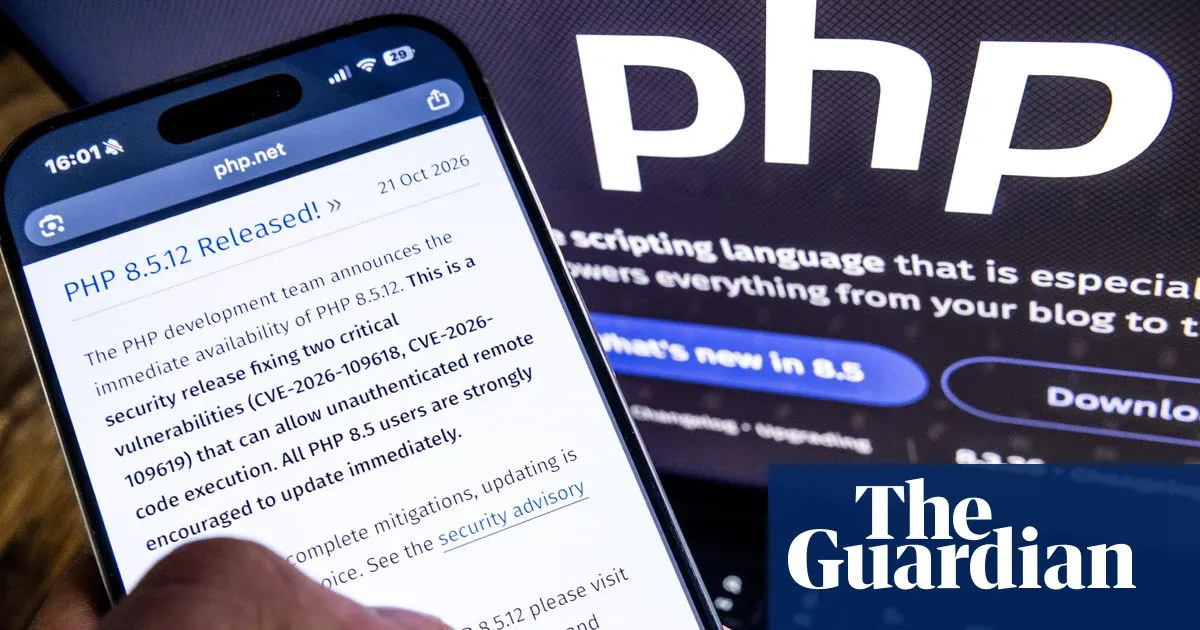
A flaw in PHP just forced governments to pull their own sites offline
European agencies from Belgium to Germany took websites dark to patch a critical weakness in the language behind almost 70% of the web, and the blast radius extends far beyond government portals.

BioWare shuts down, Mass Effect 5 dead after $55B EA buyout
The legendary RPG studio's closure lands months after a $55 billion investment group buyout of EA, raising tough questions for gaming's biggest acquirers.
Musk weighs Tesla-SpaceX mega-merger as boards form review panels
Special committees at both companies will examine a tie-up that could fuse electric vehicles and space launch, forcing a fresh look at governance and valuation.