
8BitDo adds a built-in screen to its all-button Arcade Controller Pro
Customization moves on-device with no app needed, while the Pro keeps its leverless precision and adds an extra button.
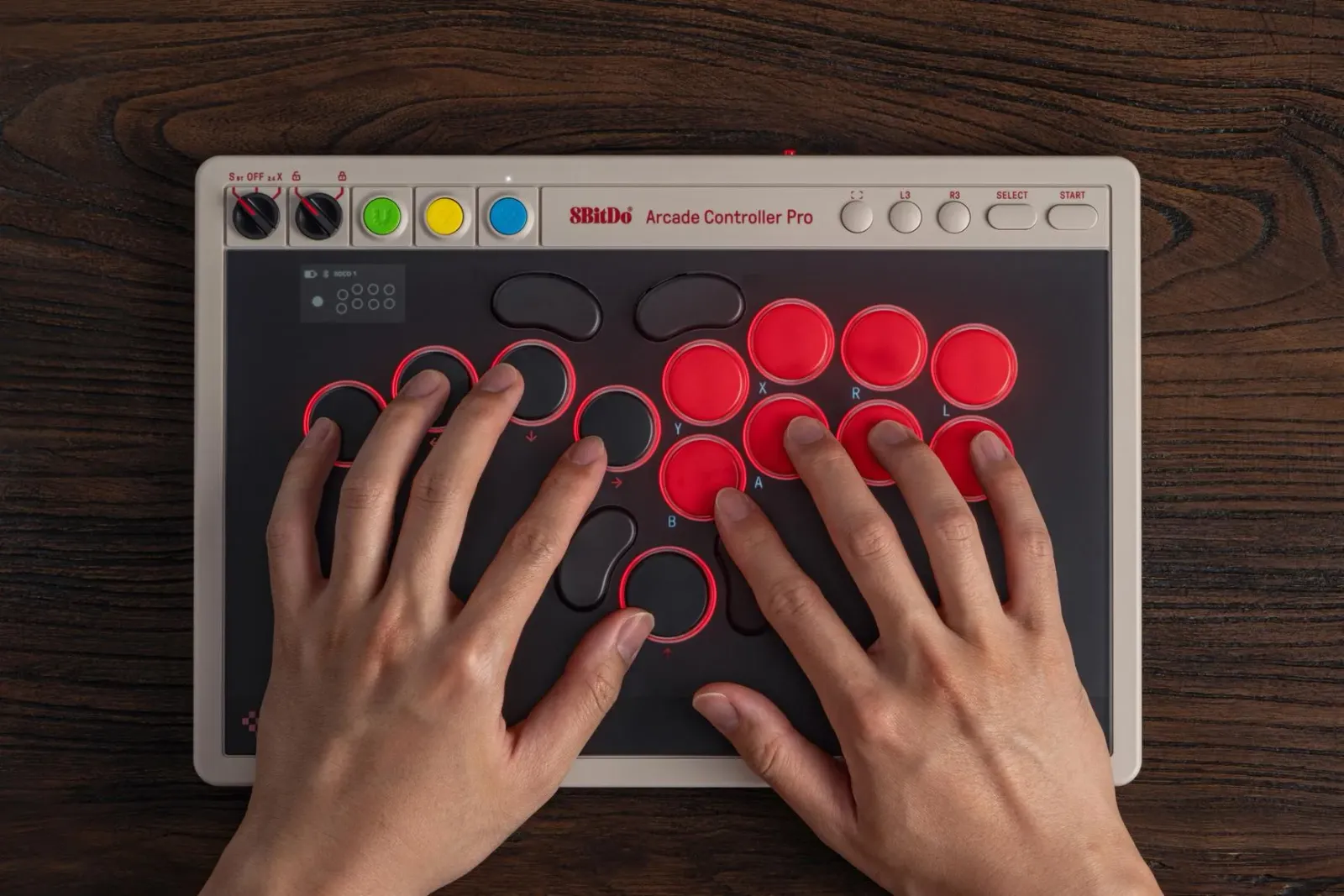
8BitDo announced the Arcade Controller Pro, an upgraded version of its all-button leverless Arcade Controller that debuted a little over a year ago. The Pro adds a thinner 16mm design, an additional programmable button, and a small screen for button mapping and settings without using 8BitDo's Ultimate Software V2 app.
8BitDo just gave its all-button Arcade Controller a practical upgrade: the Arcade Controller Pro now includes a small screen so players can customize button mapping and other settings directly on the controller, without opening 8BitDo's Ultimate Software V2 app on another device. That is the headline feature, and it matters because it changes who the product is for. If you have ever tried to configure a controller and then decided it was not worth the hassle, the Pro is built to remove that friction in the moment.
The controller also keeps the leverless, or Hitbox, style that swaps joysticks for buttons to improve precision and responsiveness. The Pro version looks similar to 8BitDo's original, but it adds a thinner 16mm design, another programmable button, and the onboard display. In other words, 8BitDo did not just tack on a gimmick screen. It bundled it with the core “no joystick, faster inputs” promise and then expanded the configuration surface area by letting you change mappings and settings on the fly.
To understand why this kind of upgrade is a big deal in consumer hardware, zoom out one layer. Controllers are not just input devices anymore. They are customization platforms. Players increasingly expect to tailor controls to games, preferences, or muscle memory, and they expect that tailoring to be quick. If you need a separate app running on a phone, tablet, or PC every time you want to adjust anything, you get drop-off. Even when the software is solid, the workflow can feel like homework. By putting a small screen on the controller, 8BitDo is effectively turning configuration into a first-class user action: you can tweak without switching devices, without launching software, and without managing cables or app permissions mid-session.
That workflow shift is also a stealth product-market signal. Many controller makers compete on feel, responsiveness, and layout, but fewer compete on the experience around setup and ongoing tuning. 8BitDo is addressing the “day two” problem: the moment after you buy it, when you realize you want different button mapping, different settings, or just want to correct a mistake. The Arcade Controller Pro is designed so the configuration step happens where the decision is actually made, in-hand. And crucially, 8BitDo is not removing the app. The company says onboard customization works without the Ultimate Software V2 app, and it is supported even when that app is used.
There is also an ecosystem angle that matters to executives watching this space. When customization lives in an app, the app becomes a dependency. Dependencies create lock-in, but they also create support burdens. You have to maintain the software, keep it compatible, and handle user confusion when something does not work. A built-in screen reduces that dependency for the common tasks: mapping and settings adjustments. That does not eliminate software entirely, but it can lower the number of users who must rely on it for routine changes. For a company like 8BitDo, that can translate into fewer support tickets and less “can you help me set this up” churn, even if the Ultimate Software V2 app remains part of the value proposition.
From a product strategy standpoint, the Pro version’s additions are tightly aligned. The leverless, Hitbox-style layout improves precision and responsiveness, and the additional programmable button expands what players can bind. The thinner 16mm design suggests 8BitDo is also optimizing the physical profile, which can matter for comfort during long sessions and for how the controller fits into a setup. Then the screen comes in to support the expanded control surface by making the mapping and settings changes accessible in the same device context where the inputs happen. Put together, the Pro reads like a cohesive “play-first” refresh, not a scattershot feature list.
Second-order implications for boards and operators are straightforward: differentiation is shifting from only hardware layout to the combination of layout, physical ergonomics, and configuration UX. Competitors in the controller market typically chase latency, switch quality, and platform compatibility, but 8BitDo is leaning into something adjacent that influences adoption. If the controller is easier to configure, more buyers may actually use it the way they intended on day one, and more current owners may experiment with remapping rather than leaving settings untouched.
The other strategic reality is that pricing, availability, and preorder timing for the Arcade Controller Pro were not included in the portion of the announcement described here. That means decision-makers still need to wait for the commercial details to judge market impact. But the direction is clear: 8BitDo is trying to reduce friction for customization while expanding control options and maintaining the precision-focused leverless design. For anyone building, investing in, or scaling gaming accessories, the takeaway is that “customization without pain” is becoming a must-have, and onboard tooling is an effective way to deliver it.
This story's Key Insights and Take-aways are locked.
Create a free account to unlock Executive Actions for one credit.
Register to UnlockAlways free for Executives Club members. Join the Club
More in Technology

Nvidia's $89B data center quarter: the 9 companies cashing in
The AI buildout is minting fortunes beyond GPUs, and memory, cloud, and cooling suppliers are riding the same wave.

Google quietly links your phone number to every Android account on your SIM
Adding a SIM now ties your phone number to all Google accounts - and future accounts inherit it. Here's the security and privacy stakes.

Hijacker AI 'Skynet mode' runs 100,000 attack steps against exposed models
Symantec caught a criminal AI agent that borrows other models, steals data, and mines crypto; the only relief is no confirmed victims yet.