
Aaron Lewis says his MAGA album cover was used as Taylor Swift merch packaging
A shredded CD booklet from Aaron Lewis' unreleased album turns up inside Taylor Swift merch packing paper.
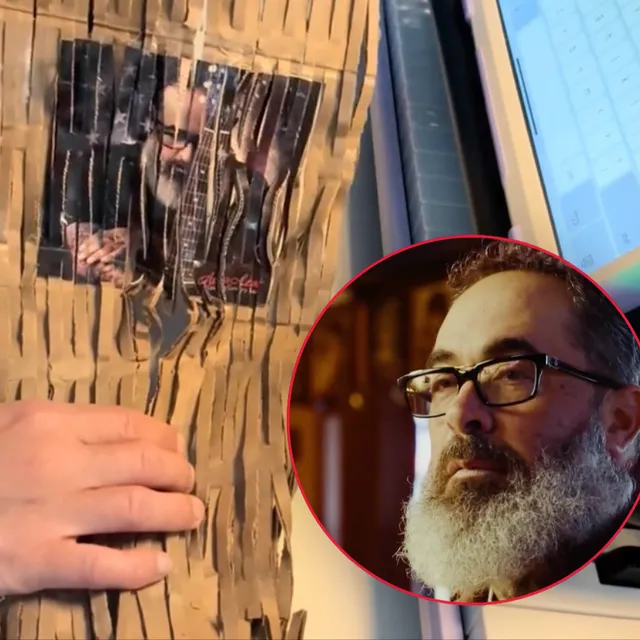
Aaron Lewis reacted after a Taylor Swift fan found a shredded image from his MAGA-themed country album, Give My Country Back, inside Toy Story 5 merch packaging. The incident is a packaging mix-up with real reputational and operational stakes for brands and distributors.
Earlier this week, a Taylor Swift fan unpacking Toy Story 5 merch got a surprise that is funny in theory and messy in practice: among the recycled packing paper was a mysterious shredded image of a bearded man. That shard, according to the fan’s quick research, wasn’t random artwork. It matched the CD booklet for Aaron Lewis' forthcoming country album, Give My Country Back.
The crucial detail is that Give My Country Back “hasn't been released yet through UMG.” So this wasn’t just a stray photo. It was a pre-release piece of packaging material tied to an artist project that, at least by that distribution timeline, should not have been circulating in the merch ecosystem associated with Taylor Swift. In other words, the fan did the correct investigative work, and the paper trail led straight back to Aaron Lewis.
From there, the story turns into a familiar modern problem: supply chain chaos hitting culture at the exact wrong moment. Merch packaging is not typically treated like a “creative” product. It is treated like logistics, compliance, and cost control. But merch is also a physical touchpoint. When something out of place lands in a customer’s hands, the emotional reaction bypasses all the usual explanations. The customer sees a headline-ready contradiction immediately: “I bought Taylor Swift merch, why am I seeing Aaron Lewis?” That’s not a minor confusion. It is brand contamination, even if the contamination is accidental.
Now add the specific twist. The shredded image is described as Aaron Lewis’ MAGA album cover. That matters because political branding is uniquely high-volatility. Even when a mix-up is unintended, the content is inherently interpretable, and audiences will interpret. The fan’s discovery was fast enough to connect it to the CD booklet for the unreleased album. That speed is part of why these incidents can escalate. In the old days, a wrong insert might have stayed local. Today, a photo plus a quick Google search can move it into public visibility before anyone at a company has finished writing a ticket.
For executives and boards, the core issue is not “who is to blame.” It’s how control systems fail in high-volume, multi-vendor operations. Merch fulfillment commonly involves multiple partners: rights holders, manufacturing, packaging suppliers, warehousing, and fulfillment platforms. Each handoff is another chance for mismatched materials to end up in the wrong box. And when the out-of-place material is from an unreleased album, the stakes get higher, because the mix-up touches something that is supposed to remain gated by release timing, distribution agreements, and brand strategy.
There is also a regulatory and governance dimension, even if this story itself doesn’t mention regulators directly. Pre-release materials, licensing boundaries, and distribution channels are governed by contracts and policies, often under broader compliance frameworks. If an unreleased album’s physical materials appear in a different merch context, it highlights gaps in internal controls and partner oversight. It can raise questions like: Were the packaging components handled under the correct instructions? Were rejects and remainders segregated properly? Were different runs clearly labeled and constrained to their intended orders? Executives know the uncomfortable truth: when something like this happens, people stop thinking about intent and start thinking about process.
The “MGAs album cover used as Taylor Swift merch packaging” angle is also a reminder of how brand adjacency works in the real world. Companies spend enormous amounts on protecting brand meaning, but the physical supply chain can undermine those efforts instantly. If the packing paper carries an identifiable image from a different campaign, that becomes a cross-contamination event. And because the incident is visible to consumers, it can generate scrutiny across marketing, operations, customer service, and legal. Even if the outcome is resolved quickly, the organization has absorbed reputational risk.
So what does this mean for other decision-makers? It’s a case study in how quickly a simple logistics error can become an editorial narrative. The Stereogum post notes that the fan found the shredded CD booklet and connected it to Give My Country Back, which has not been released through UMG yet. That is the specific fact pattern that makes the story stick: the mix-up is not just random debris; it is evidence of a boundary crossing between separate release and distribution contexts. Executives at merch-driven companies and labels should treat this as a signal, not because it proves wrongdoing, but because it shows how thin the margin can be between “warehouse error” and “public brand incident.”
This story's Key Insights and Take-aways are locked.
Create a free account to unlock Executive Actions for one credit.
Register to UnlockAlways free for Executives Club members. Join the Club
More in Entertainment

Russell Brand's accuser 'bewildered and confused' as he denies 7 sex charges
The criminal case against the comedian is a live test of how media companies manage talent risk when serious allegations go public.

'It's a Magic Trick': Ballet Experts Say Rosalía's SNL Pose Is Impossible
Three ballet experts tell Rolling Stone Rosalía's gravity-defying SNL stillness shouldn't be possible - and why the debate is now part of the show.

Activision CMO: GTA 6 Will Boost Call of Duty, Not Bury It
Activision's top marketer says Rockstar's blockbuster will drive players back to consoles and into Modern Warfare 4, even as the company admits its recent strategy failed.