

Bangkok bar fire death toll hits 30 as 24 people remain in critical condition
Victims are being identified while investigators probe alleged negligence, raising scrutiny for venue safety and compliance.
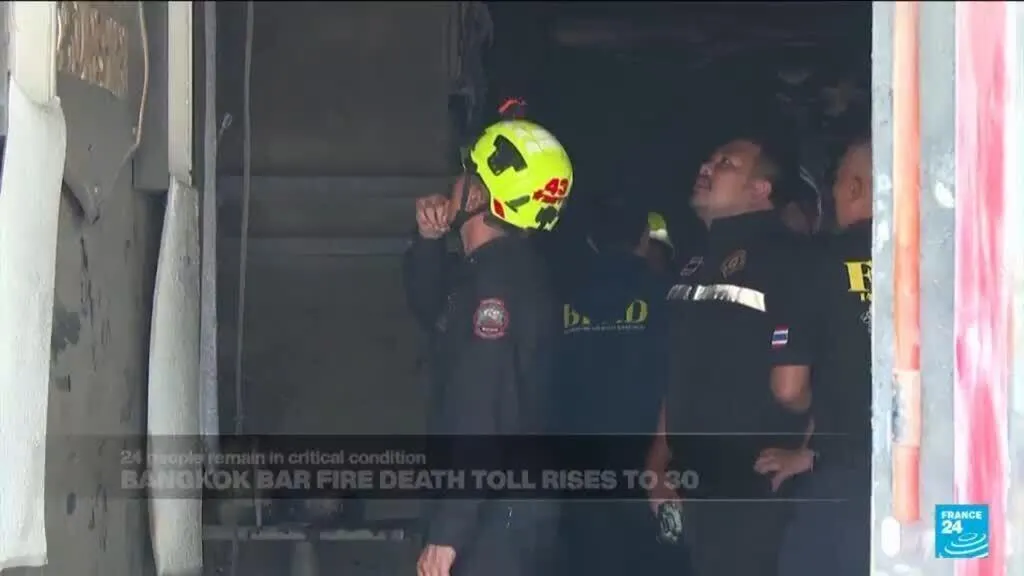
A blaze engulfed a bar in northern Bangkok in the early hours of Monday morning, with at least 30 deaths confirmed and 24 people in critical condition. Authorities have formally identified 27 victims, and forensic investigators are working to establish the cause as the bar agrees to comply with an investigation into alleged negligence.
At least 30 people have been confirmed dead after a blaze engulfed a bar in northern Bangkok in the early hours of Monday morning. The toll also includes 24 people who remain in critical condition, a grim signal that the worst of the harm may not be over even as officials announce the confirmed fatalities.
Authorities say 27 victims have been formally identified, while work continues to confirm the identities of the remaining three. In parallel, forensic investigators are seeking to establish the cause of the blaze, and the bar has agreed to comply with an investigation into alleged negligence. Put simply: the incident is moving from emergency response into the slower, evidence-driven phase where responsibility is tested.
For executives and boards, this is a reminder of how quickly a workplace event can escalate into a governance event. Fires do not just produce casualties; they trigger investigations, claims, and reputational damage that can follow an organization for years. Even when a company is not the direct operator of every element that contributed, leadership often ends up responsible for demonstrating that it had systems in place to prevent foreseeable risks. Here, that “systems” question is already framed by the bar agreeing to comply with an investigation into alleged negligence.
The identification process matters for more than closure. When officials confirm 27 victims and then continue with the remaining three, that timeline affects legal and administrative steps. Families may need documentation for benefits and next-of-kin procedures, and authorities may refine what they learn from evidence as identifications complete. Meanwhile, the 24 people still in critical condition keep the situation in a high-uncertainty zone. In many real-world disasters, that medical uncertainty can influence how investigators interpret injuries, timelines, and whether certain hypotheses about how the fire spread hold up.
From a regulatory and compliance perspective, the phrase “investigation into alleged negligence” is a key hinge. It tells you the incident is not only being treated as an accident, but as a potential failure of duty. In practice, these investigations typically look for gaps in safety preparedness: whether risk controls were in place, whether staff could respond effectively, whether relevant safety standards were met, and whether prior warnings or maintenance issues were addressed. The bar’s agreement to comply signals that the evidence trail is likely to be formalized, which often increases the pressure on surrounding parties too, including property owners, contractors, and anyone involved in fire safety maintenance or approvals.
There is also a second-order business impact executives should pay attention to: the “compliance clock.” Once an incident becomes the subject of an investigation, the organization shifts from business-as-usual to evidence collection, document preservation, and internal reviews. That can pull management attention away from revenue and operations and toward legal risk management. Even if an organization believes it was not at fault, the administrative burden and reputational wear can be immediate. And with 30 confirmed deaths already on the record, the stakes are not theoretical.
Industry-wide, this kind of incident tends to reverberate beyond one location. Hospitality and entertainment venues often share similar vulnerabilities: high occupancy, complex layouts, reliance on certain electrical and ventilation systems, and the need for clear evacuation routes. When investigators seek to establish the cause and assess alleged negligence, regulators and insurers in the broader market often become more focused on whether venues can prove that safety practices are not “paper compliance,” but operational reality. For peers, that means safety audits, staff training records, and incident response plans can move from background tasks to urgent board-level topics.
Finally, the strategic stakes are clear: when a fire produces a confirmed death toll of at least 30 and leaves 24 people in critical condition, leadership is judged not only by what happened in the moment, but by what was done beforehand to prevent and mitigate harm. In this case, the story is still unfolding as forensics work to establish the cause and as identification efforts continue for the three remaining victims. But the trajectory is already visible: evidence will be gathered, alleged negligence will be tested, and the eventual findings will shape how this bar, and potentially others, are held accountable.
This story's Key Insights and Take-aways are locked.
Create a free account to unlock Executive Actions for one credit.
Register to UnlockAlways free for Executives Club members. Join the Club
More in Politics

LA County: DOJ's 20,000 'noncitizen' voter list is 'unreliable,' includes U.S.-born
Preliminary review by Los Angeles County election officials finds errors in the federal list, raising the stakes for voter roll integrity ahead of November.

Trump's $1.5B Pentagon chip investment lands in North Carolina
A $1.5 billion defense infusion for North Carolina chipmaking signals a new era of Pentagon-backed reshoring - here's what it means for the industry.

Nigeria confirms first Ebola case in Abuja, a woman just off a Uganda flight
Health Minister Muhammad Ali Pate says the patient flew in from Uganda, putting Africa's latest outbreak on Nigeria's doorstep.