
Buzz Aldrin sells Apollo 11 felt-tip pen for $857,600 at Sotheby's
A $857,600 marker and switch beat the usual “collectible junk” logic, even if the sale didn’t set records.
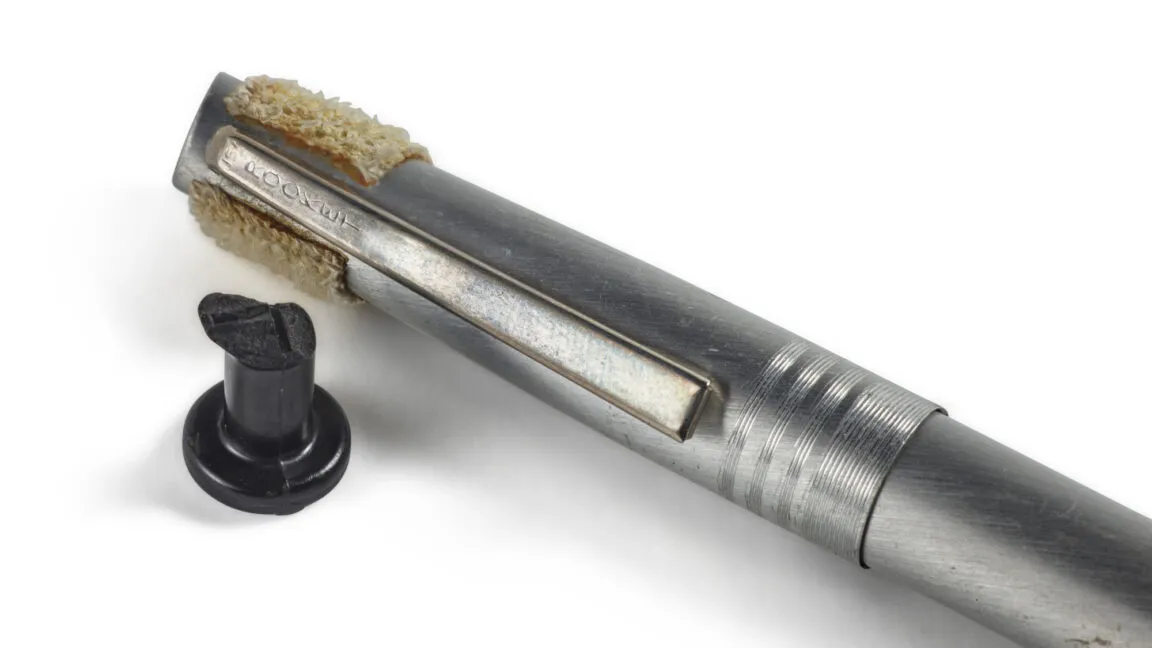
Buzz Aldrin sold a dried-out felt-tip marker and a snapped-off piece of molded black plastic associated with Apollo 11 at a Sotheby's auction on Wednesday. The sale hit $857,600, powered by the items' role in solving a lunar-surface crisis nearly 57 years ago.
Buzz Aldrin’s Apollo 11 memorabilia just cashed out big time. At a Sotheby's auction on Wednesday, a dried-out felt-tip marker and a snapped-off piece of molded black plastic sold for $857,600, despite being, in ordinary terms, exactly the kind of dried-out, broken bits that collectors usually ignore.
The hook is that this was not random ephemera. Those items were with the astronauts 57 years ago during NASA’s Apollo 11 mission, the first crewed landing on the Moon. More than the “where it came from” prestige, one of the two pieces ties directly to a problem that almost stranded Neil Armstrong and Buzz Aldrin on the lunar surface, while the other was the simple solution that kept their ascent engine and return to Earth on track.
Here is the operational moment the source points to. After realizing that either Armstrong or Aldrin had inadvertently broken off the top of the circuit breaker switch that would enable their ascent engine to ignite, Aldrin contacted Mission Control. The log includes Aldrin radioing, "Houston, Tranquility. Do you have a way of showing the configuration of the engine arm circuit breaker?" He then added, "The reason I'm asking is because the end of it appears to be broken off. I think we can push it back in again. I'm not sure we could pull it out if we pushed it in, though." That exchange matters because a circuit breaker, in plain English, is the safety on/off control that needs to be correctly positioned for power to go where it must. In a mission context, “almost stranded” is not dramatic language. It is the difference between returning home and not.
So why does a felt-tip marker sell like a life-or-death component? The source’s framing is clear: these weren’t just shipped along as souvenirs. The items were physically present around the mission’s real, time-critical fix. In collectible markets, authenticity is only step one. Provenance is step two. But in elite auctions, provenance is only valuable when it maps to a story that is both specific and legible. “Apollo 11” is a headline, but “the felt-tip marker and the broken circuit breaker switch related to the near-astronaut-stuck problem” is the kind of narrative precision that bids turn into money.
Now, let’s talk about what executives and boards should notice, because this is more than museum trivia. Markets for high-end collectibles can look detached from “business fundamentals,” but they are still rule-driven markets with their own versions of due diligence. Sotheby's auction process is not a garage sale. When items tied to historic spaceflight can reach $857,600, it signals that buyers are underwriting risk in exchange for scarcity and verified historical connection.
Importantly, the source notes that while the sale was impressive, the pen and switch did not break records. That detail is more than trivia. It implies the market is strong, but not euphoric. In other words, it is possible for high-profile Apollo-linked artifacts to fetch major sums without permanently resetting price expectations. For decision-makers overseeing investments, sponsorships, or alternative asset exposures, that distinction matters. A “big auction” does not automatically mean “everything related will keep climbing.” It often means a specific story hit the right buyers at the right time.
There is also a second-order implication for any organization dealing with historical assets, archives, or mission-critical hardware. The items in this case are, on their face, low-tech. Yet they mattered because they were part of the problem-solving loop during a mission’s most unforgiving environment. Boards that oversee technology stewardship can take the broader lesson: the value of an asset is not always in its materials. It can be in the role it played in decisions, contingencies, and outcomes. The “switch configuration” question and the attempt to push the broken end back in point to a mindset that is operational, not symbolic. Markets eventually reward that operational truth when it can be tied to an artifact.
Finally, this sale is a reminder that Apollo 11 artifacts still function like financial instruments, with stories as the collateral. The moment Aldrin described, the near-surface failure mode, and the fact that one of the sold items maps to the mission fix all strengthen buyer confidence. For executives across media, consumer brands, and investment platforms that touch cultural and technical heritage, it’s a live example of how history monetizes. Not via hype. Via documented connection to pivotal events. The strategic stakes are simple: if you manage assets or narratives, you are managing future bid behavior, not just present attention.
This story's Key Insights and Take-aways are locked.
Create a free account to unlock Executive Actions for one credit.
Register to UnlockAlways free for Executives Club members. Join the Club
More in Technology

Google quietly links your phone number to every Android account on your SIM
Adding a SIM now ties your phone number to all Google accounts - and future accounts inherit it. Here's the security and privacy stakes.

Hijacker AI 'Skynet mode' runs 100,000 attack steps against exposed models
Symantec caught a criminal AI agent that borrows other models, steals data, and mines crypto; the only relief is no confirmed victims yet.

Nvidia's AI-financier shift faces its first big test as neoclouds stumble
A rout in neocloud stocks is forcing investors to weigh Nvidia's hidden exposure as both supplier and lender to the AI buildout.