
Chris Williams suits up for June 30 spacewalk to fix Canadarm2 wrist joint
NASA astronaut Chris Williams and Jessica Meir will repair a malfunctioning Canadarm2 wrist joint outside the ISS on June 30.
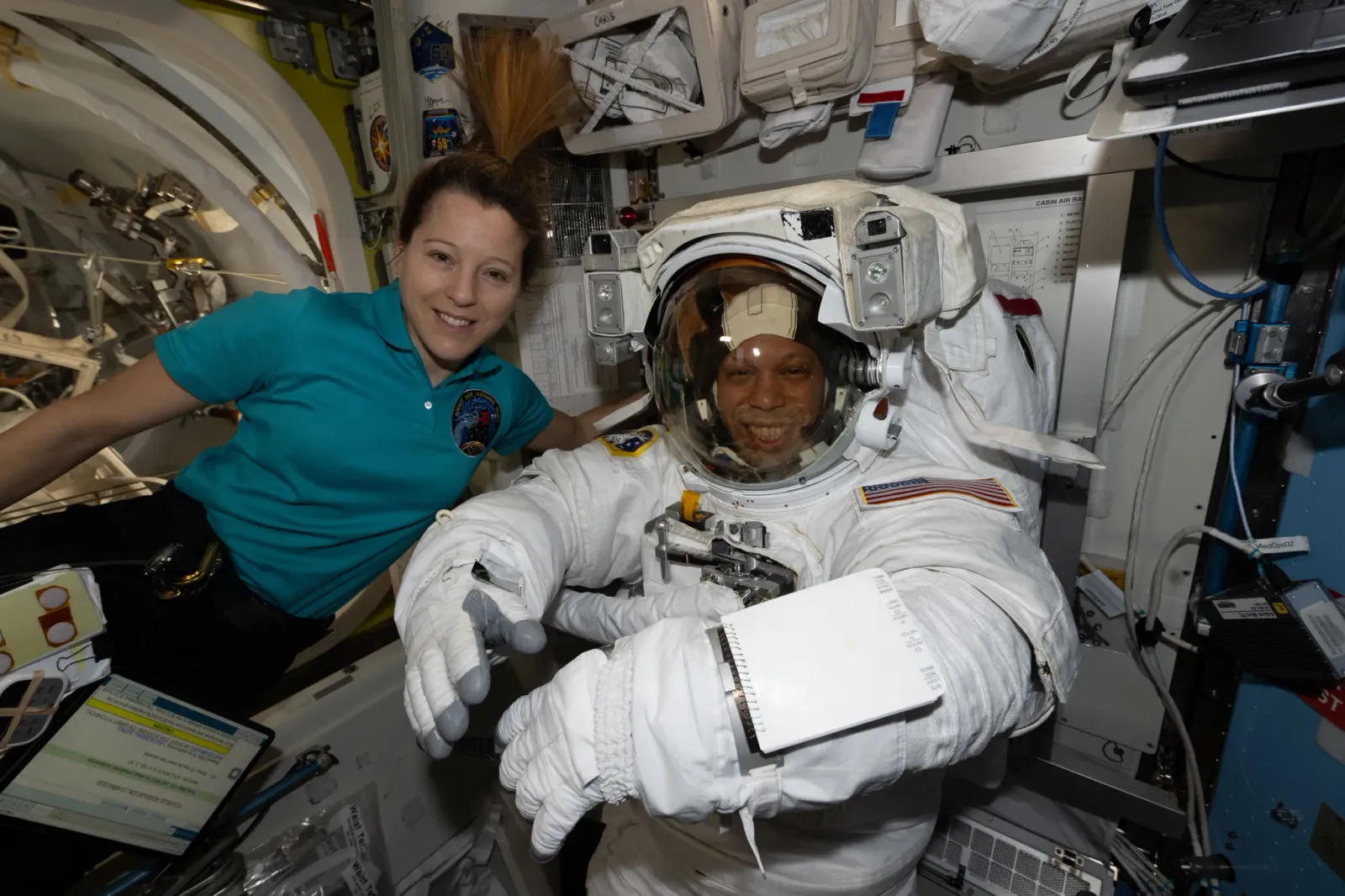
NASA flight engineer Chris Williams is preparing inside the ISS Quest airlock with ESA flight engineer Sophie Adenot’s help, testing his spacesuit systems ahead of a June 30 spacewalk with NASA astronaut Jessica Meir. The mission aims to replace a malfunctioning wrist joint on Canadarm2, with direct implications for ISS operations and downstream mission planning.
NASA flight engineer Chris Williams is gearing up for a spacewalk on June 30, and it is already getting very real inside the International Space Station’s Quest airlock. On June 23, 2026, ESA flight engineer Sophie Adenot helped Williams try on his spacesuit, specifically checking comfort and mobility as well as communications and life support systems while still on station. That detail matters more than it sounds: before anyone touches a robotic arm in space, the crew has to be confident the suit can keep someone functional, connected, and alive for the duration of the work.
Williams will then head outside on June 30 with fellow NASA astronaut Jessica Meir to replace a malfunctioning wrist joint on the Canadarm2 robotic arm. Canadarm2 is not just “a robot with hands.” It is a core piece of how the ISS handles tasks that would otherwise be slower, riskier, or simply more complex. When a component like a wrist joint misbehaves, it can ripple into scheduling, available capabilities, and how much risk operators are willing to accept while planning future activities. In that sense, this EVA is both a hands-on fix and an operational reset.
Adenot’s role during the suit check also highlights how international ISS work gets executed in practice. The story may be about two NASA astronauts going outside, but the preparation is a system. Adenot, an ESA flight engineer, is helping Williams evaluate comfort, mobility, and life support, and she is doing it from inside the same station environment where mission teams coordinate complex, time-sensitive operations. For executives watching how high-reliability programs run, this is the visible tip of a disciplined process: validate the life-critical systems, validate the human-machine interface, then move to the hardware intervention. You do not skip steps when the cost of failure is measured in more than money.
The suit itself is the first line of “business continuity” in space. Comfort and mobility checks are about more than comfort. In an EVA, limited range of motion or awkward positioning can turn a routine task into an extended timeline, which in turn stresses other constraints like consumables and communications windows. Communications checks matter because the outside work depends on inside monitoring and guidance. Life support system verification matters because the EVA is, at bottom, an extension of station systems into a hostile environment. In other words: this is not merely getting dressed. It is running a pre-mission systems acceptance test on the person doing the work.
Then there is the hardware problem itself: a malfunctioning wrist joint on Canadarm2. The planned fix is straightforward in description, but it is still a high-stakes repair. Wrist joints are precision components, and robotic arm operations often require fine control. When a wrist joint is malfunctioning, it can interfere with the arm’s ability to position payloads, support maintenance tasks, or perform other planned operations that rely on the arm’s dexterity. That is why the decision to replace the joint through an EVA is strategically important. It reduces the need to design around the degraded capability and it can shrink the operational uncertainty that follows hardware trouble.
This is also a classic example of how ISS missions are managed as interlocking schedules. An EVA does not happen in a vacuum. It is an input into the wider station plan, which includes time windows, crew availability, and coordination across agencies. Meir and Williams going together is not just tradition. Pairing astronauts can improve task coverage during the repair and provide redundancy in how work is executed outside. The station then absorbs the resulting capability restoration, which can support subsequent activities without relying on the reduced performance of a partially impaired robotic arm.
Second-order for leaders in aerospace and other regulated, high-reliability sectors: the critical work is not only the “fix,” it is the verification choreography that prevents the fix from becoming a new incident. The suit try-on on June 23, 2026, is a visible milestone that maps to a deeper governance mindset: confirm readiness before committing to the external task. That kind of rigor is how complex programs maintain trust with oversight, protect costly assets, and keep mission throughput stable over time.
For peers managing similar programs, this EVA is a reminder that operations resilience often comes down to component-level execution under real constraints. When a robotic arm wrist joint fails, it tests both technical capability and program discipline. Williams and Meir will go outside on June 30 to replace the malfunctioning joint, but the success of that moment has already started inside Quest on June 23, where Adenot helped validate the suit’s comfort, mobility, communications, and life support systems. If you run anything where safety, uptime, and precision are non-negotiable, that sequence is the playbook to remember.
This story's Key Insights and Take-aways are locked.
Create a free account to unlock Executive Actions for one credit.
Register to UnlockAlways free for Executives Club members. Join the Club
More in Science

Alaska's 1,580-foot tsunami had warning signs. Scientists just found them.
Rapid glacier retreat, heavy rainfall, and thousands of tiny tremors preceded Alaska's 1,580-foot tsunami, a warning for every coastal community in a warming world.

The rare mutation that lets high-risk brains dodge Alzheimer's
Scientists found a natural defense against protein buildup, opening a new path to preventive treatments.

3,000 steps a day may halve Alzheimer's decline, study finds
New research links a modest daily walk to less tau buildup and nearly half the cognitive and functional decline, even for those with early signs.