
June 30 Pegasus XL launch will grapple NASA Swift with private LINK, not thrusters
A $30M, air-launched rescue mission uses robotic arms and ion propulsion to pull Swift back from dying low orbit.
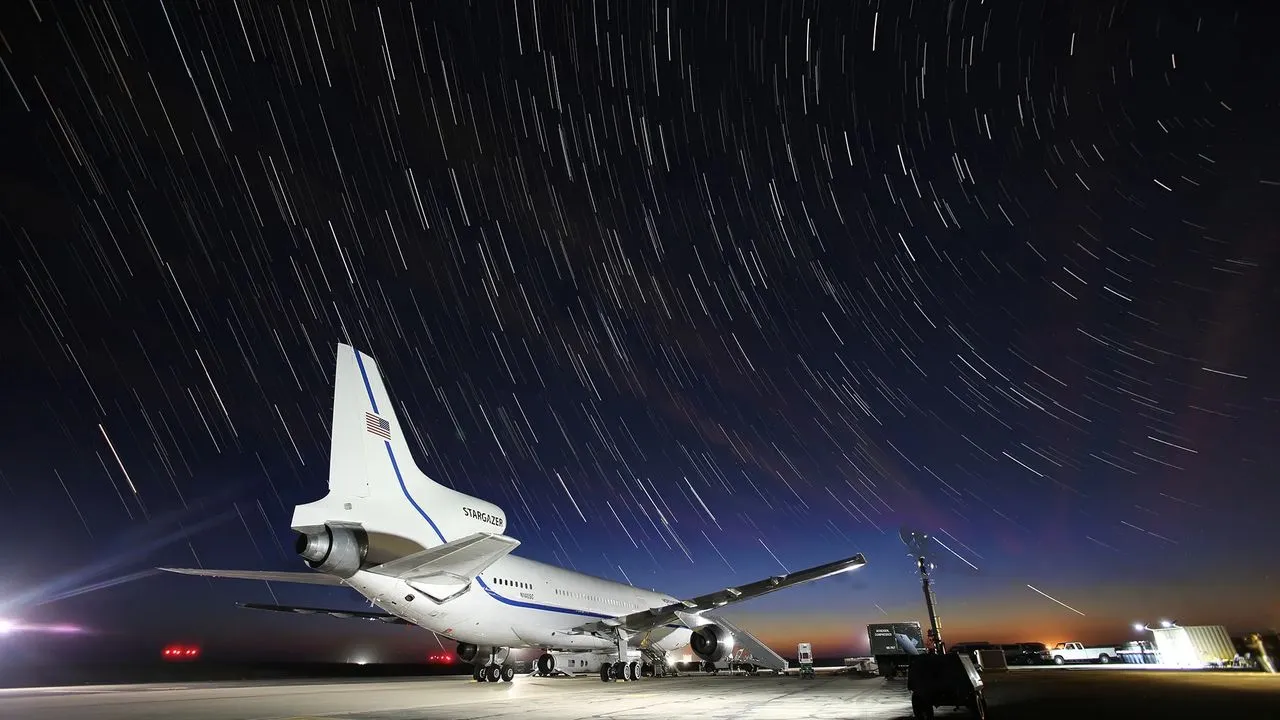
Northrop Grumman's air-launched Pegasus XL will carry Katalyst Space Technologies' LINK spacecraft on June 30 to rendezvous with NASA's Neil Gehrels Swift Observatory and tow it to a stable orbit. For decision-makers, it is a rare near-term, private servicing play with a clear financial and technical test behind it.
NASA is sending a private robotic spacecraft to save the Neil Gehrels Swift Observatory from a fate that is both mundane and brutal: burning up in Earth's atmosphere.
On June 30, Northrop Grumman will fly the Pegasus XL rocket for the very last time early Tuesday morning, launching the Swift Boost mission on a schedule set for 6:23 a.m. EDT (1023 GMT). The mission’s entire purpose is blunt. Swift’s orbit has begun to dip dangerously low, and recent solar activity has increased atmospheric drag at higher low-earth orbit altitudes, pushing the spacecraft toward impending destruction. Since Swift was not designed to be serviced and lacks the thrusters needed to raise its own orbit, NASA is betting on a workaround that is different from anything that typically happens in orbit: capture it with a robotic arm system and gently tow it back.
LINK, built by Arizona-based Katalyst Space Technologies, will take off from Bucholz Army Airfield at Kwajalein Atoll in the Marshall Islands, secured to Northrop Grumman’s L-1011 Stargazer jet. The procedure is almost like sending a rocket to the sky using an airplane as the runway. The Pegasus rocket will be released once Stargazer reaches about 39,000 feet (12,000 meters), traveling at Mach 0.82. Five seconds later, the engine will ignite and Pegasus will ascend. Pegasus is a three-stage, solid rocket-propelled launch vehicle, 55 feet in length (16.9 meters), with the capacity to deliver up to 1,000 pounds (454 kg) into low-earth orbit. After separation, the rocket’s stages ignite in sequence to reach its intended altitude in about 10 minutes.
The choice of Pegasus is not just a logistics quirk. It is also a time and access story. NASA is effectively running out of margin for Swift. Swift’s $500 million observatory was launched in November 2004 to study gamma-ray bursts and other high-energy events, and while it has operated for more than 20 years, it still provides scientific value. But orbit mechanics do not care about mission history. As atmospheric drag rises, the path towards loss accelerates at the edges of higher LEO. NASA chose Pegasus for this mission in part because its air-launched deployment gives flexibility to enter hard-to-reach orbital inclinations that some major spaceports cannot support as easily. For this rescue, that matters: LINK is being targeted to reach Swift’s low 20.6-degree inclination relative to Earth’s equator.
Once Pegasus releases LINK into space, the Katalyst spacecraft has to do the hard part: find Swift, then grapple it. After release from Pegasus’ payload bay and initial system checkouts, LINK will begin a long course to rendezvous with the observatory. Before any grab is attempted, LINK will spend two to three weeks performing observations of Swift to assess optimal grapple points. That observation window is a quiet but important reminder of why this is not a quick cinematic grab-and-go. Robotic servicing, especially when the target is an uncrewed U.S. government satellite that was never built for servicing, requires planning, alignment, and careful capture choices.
LINK is about 4.9 feet (1.5 m) tall and equipped with three robotic arms built to capture Swift, which stretches about 12.7 feet (3.9 m). After Swift is secured, LINK will fire a set of gentle ion thrusters that slowly raise the pair’s orbit over the next several months. The operational goal is to return Swift to its original altitude of about 373 miles (600 km). NASA’s expectation is that this will extend the observatory’s life expectancy by a number of years, assuming its systems continue to operate as designed.
This mission is also a budget signal and a capability test. Even with urgency and relatively short notice, the entire Swift rescue mission and launch only cost NASA $30 million. NASA frames the logic on the Swift Boost mission page: while NASA could have allowed Swift to re-enter the atmosphere, the situation presented an opportunity to demonstrate a key capability for the future of space exploration. NASA also says this daring approach extends Swift’s scientific lifetime and is more affordable than replacing the observatory’s unique capabilities.
Finally, the selection and timing underscore how unusual this is. NASA selected Katalyst for the task in September 2025, with less than a year to carry out LINK’s design, manufacture, and testing. LINK is also poised to be the first private spacecraft to attempt to capture an uncrewed U.S. government satellite. That “first” matters beyond the mission timeline. It is an executable reference point for how public agencies and private providers might handle life extension, orbital risk, and on-orbit servicing when the original hardware cannot do anything to save itself.
This story's Key Insights and Take-aways are locked.
Create a free account to unlock Executive Actions for one credit.
Register to UnlockAlways free for Executives Club members. Join the Club
More in Science

Alaska's 1,580-foot tsunami had warning signs. Scientists just found them.
Rapid glacier retreat, heavy rainfall, and thousands of tiny tremors preceded Alaska's 1,580-foot tsunami, a warning for every coastal community in a warming world.

The rare mutation that lets high-risk brains dodge Alzheimer's
Scientists found a natural defense against protein buildup, opening a new path to preventive treatments.

3,000 steps a day may halve Alzheimer's decline, study finds
New research links a modest daily walk to less tau buildup and nearly half the cognitive and functional decline, even for those with early signs.