

Curiosity crushes a Martian rock on May 30, 2024, revealing sulfur crystals for first time
NASA's rover found the Red Planet's first observed sulfur crystals, and a Science paper traces them to deep magma activity 3 billion years ago.
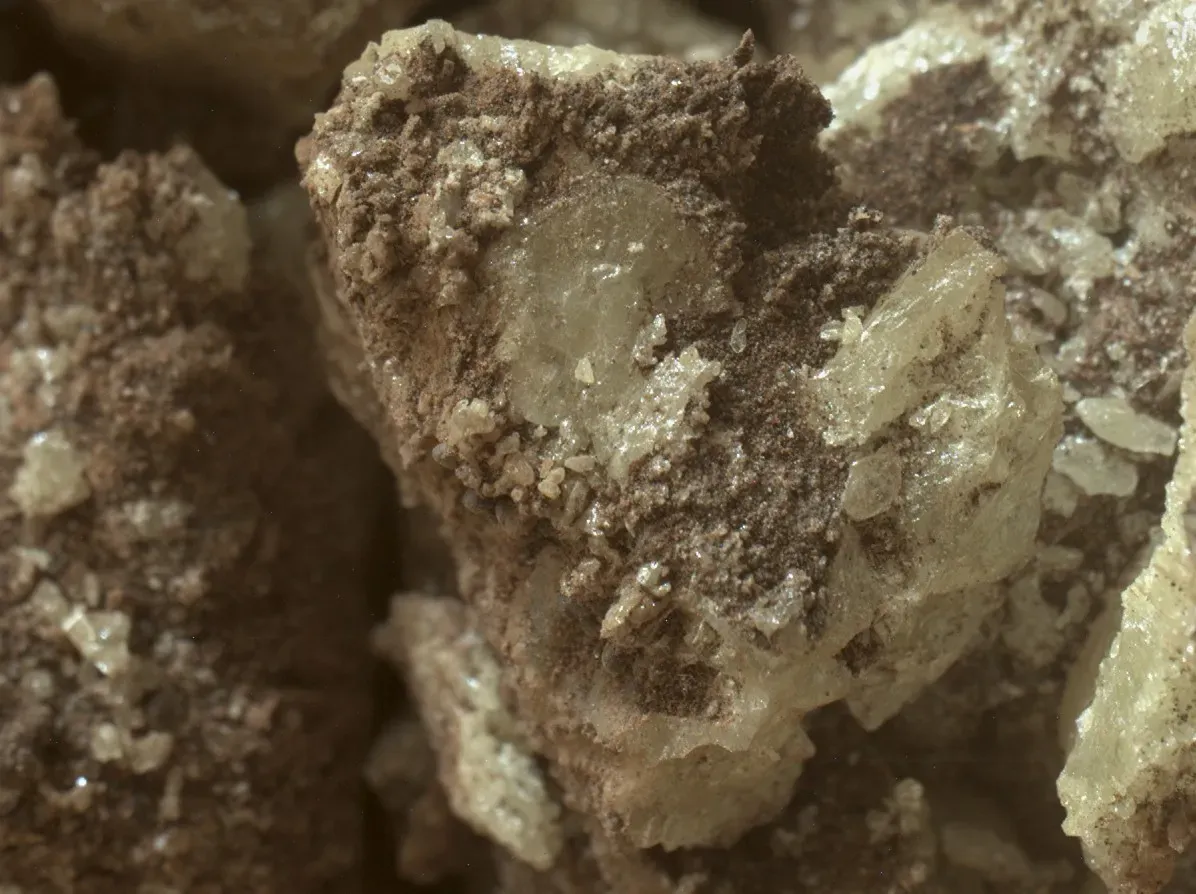
NASA's Curiosity Mars rover revealed fragments of sulfur crystals after it drove over and crushed a rock on May 30, 2024. A recent Science paper links the sulfur to magma deep below the surface depositing it about 3 billion years ago.
NASA’s Curiosity Mars rover got what looks like a “whoops” moment on May 30, 2024: it drove over a rock and crushed it. A few days later, Curiosity’s robotic-arm camera captured a close-up showing fragments of sulfur crystals, reported as the first ever seen on the Red Planet.
That detail matters more than the novelty of “sulfur on Mars.” In the first full view of what’s actually there, the rover effectively turned an accidental breakage into an evidence win, because sulfur crystals are a geochemical fingerprint. Several days after the crush, Curiosity took the image using a camera on the end of its robotic arm. The chain from May 30 to the close-up is clean and specific, and it is exactly the kind of observation that makes planetary science move from speculation to constraints.
Here’s what the Science paper says that turns the crystals from a neat snapshot into a time-and-process story. The research suggests the sulfur formed when magma deep below the surface released fluids or gases. Those materials then deposited sulfur on the Martian surface about 3 billion years ago. Put plainly: this was not sulfur arriving by accident, like dust carried on a distant wind. It was sulfur produced by chemical activity tied to deep underground magmatic processes, then laid down on the surface roughly 3 billion years in the past.
If you lead a mission, build instrumentation, or invest in space tech, this is a reminder that “first ever” observations are strategic assets. Curiosity is not a lab with infinite samples. It is a rover with limited chances to get the right exposure of the right materials in the right context. A rock gets crushed. A camera sees crystals. A paper follows. That is a pipeline for knowledge, and each link controls credibility, not vibes. When NASA reports a first detection, it also sets a benchmark other teams must beat, verify, or refine.
There is also a governance and accountability angle, even for executives who never touch Mars directly. NASA and its partners operate in a world where claims need to withstand scrutiny because future decisions depend on them. In practice, that means clean chain-of-custody for observations, clear imaging documentation, and peer-reviewed follow-through. The source here notes that “a recent paper in Science suggests” the deep-magmatic origin and the about 3 billion years ago timing. That combination, an observational “first ever” plus a peer-reviewed formation hypothesis, is how space agencies reduce the risk that a single interpretation will run away with the narrative.
Now zoom out to second-order implications. In Earth science, sulfur chemistry often ties back to volcanic activity and the release of gases and fluids that can alter mineral surfaces. On Mars, the same principle helps constrain what Mars could have been like when it was young and geologically active. If magma-related fluids or gases deposited sulfur about 3 billion years ago, it reinforces that the planet was not just geologically quiet in its early history. For decision-makers in adjacent fields like resource mapping, climate modeling, or planetary protection planning, that kind of constraint changes what hypotheses remain on the table and what risks get re-evaluated.
There is also a competitive and collaboration effect. When one mission makes a first-of-its-kind detection, it changes what other missions aim their instruments at, what targets become high priority, and what questions get funding. Even if you are not measuring Martian sulfur yourself, you are competing for attention, for schedules, and for the right to be the next mission that turns “interesting” into “decisive.” A rover accidentally crushing a rock is not a strategy. But building systems that can capitalize on accidents, then produce publishable, checkable evidence, is a strategy.
So what’s the stake for people running boards or budgets in the space ecosystem? Curiosity’s sulfur discovery is a case study in how observation quality drives downstream interpretation, and how downstream interpretation drives mission priorities and scientific credibility. The sulfur crystals were first seen after the May 30, 2024 rock crush, and the formation mechanism in the recent Science paper ties them to magma deep below the surface and deposition about 3 billion years ago. That is a complete loop from moment of evidence to geological explanation, and it is exactly the loop that separates “cool images” from the kind of findings that reshape the roadmap.
This story's Key Insights and Take-aways are locked.
Create a free account to unlock Executive Actions for one credit.
Register to UnlockAlways free for Executives Club members. Join the Club
More in Business

AstraZeneca $27B wipeout as Wainua late trial misses cardiovascular target
A failed late-stage heart study triggered a swift market punishment, forcing investors and boards to reset timelines and risk.

Comcast shares jump 25% as it plans to split NBCUniversal and Sky
The tax-free spin-off could reshape focus, funding, and competition across media and tech for years.

Bungie cuts most Destiny 2 staff as Sony says Marathon still matters
Herman Hulst confirms layoffs affecting most Destiny and some Marathon teams after Bungie admits Destiny fell short.