
Din Tai Fung's $27.4M stores beat the dumpling bottleneck. Brooklyn is next
Albert Yang says training programs, not family labor, now power America's top-grossing chain, and the next constraint is 20,000 square feet in prime cities.
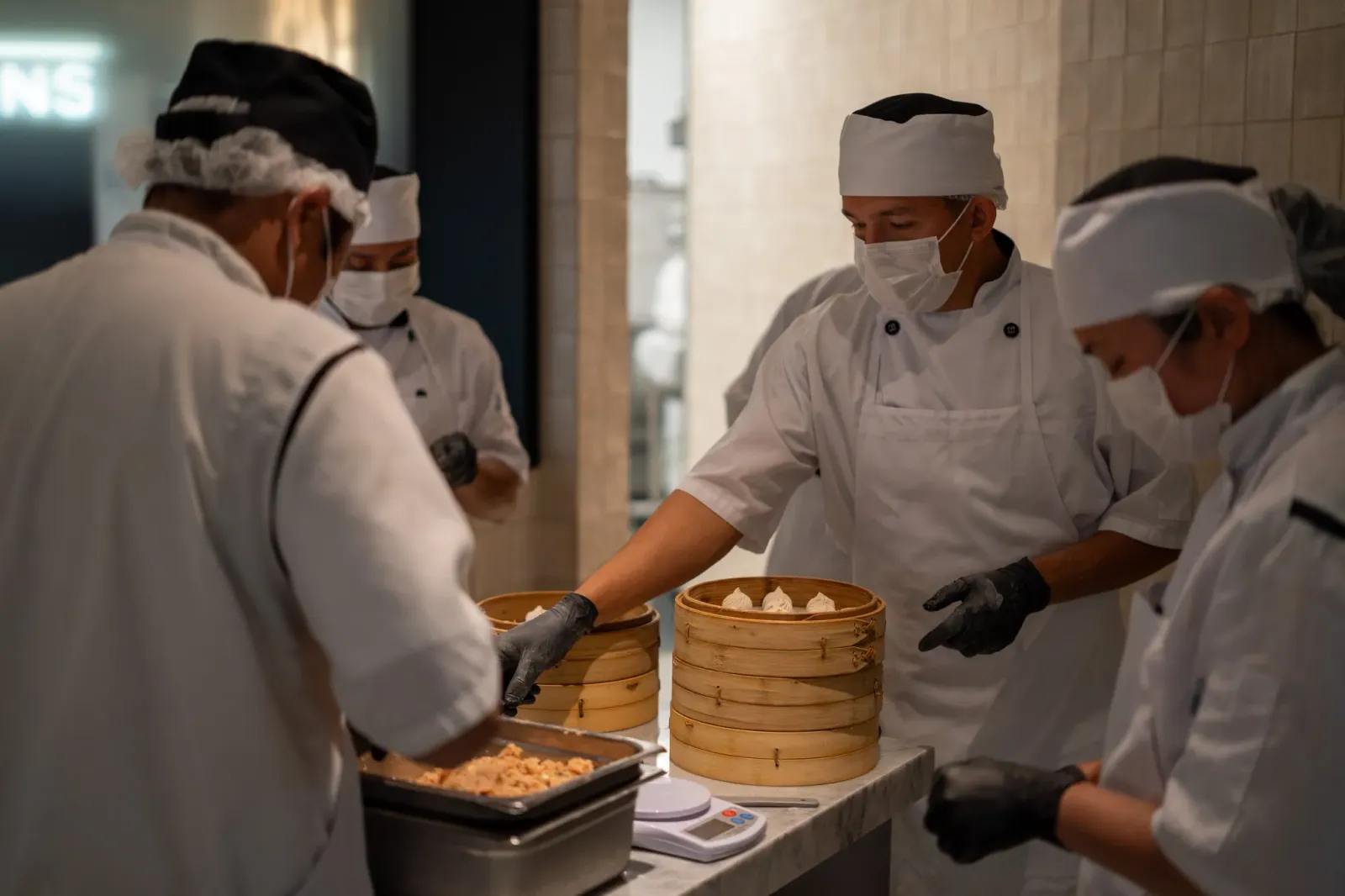
Din Tai Fung North America CEO Albert Yang says a 12-week training program has largely solved the dumpling-folding talent shortage that once capped growth, helping the chain average $27.4 million per U.S. store in 2024, nearly double the next-closest chain. For operators, the lesson is that systematized craft, not family labor, is now the moat, and that real estate and self-imposed quality standards are the constraints that follow.
Din Tai Fung's U.S. restaurants averaged $27.4 million in sales in 2024, nearly double the next-closest chain, according to Technomic data reported by Restaurant Business. That is the highest per-store sales of any restaurant chain in America. And according to Albert Yang, CEO of Din Tai Fung North America, the thing that used to cap that growth was a labor shortage of a very specific kind. "The bottleneck used to be dumpling-folding talent," Yang told Fortune by email. "But through continuous improvements to our training programs, we've largely overcome that challenge."
The fix was to turn a craft into a corporate job track. Din Tai Fung runs a 12-week training program and staffs a dumpling training manager in every U.S. restaurant, Yang told the Los Angeles Times in 2023. Even so, he said then, it still takes six months and up to a year to get up to speed. Entry-level hourly jobs started at $20 an hour, with managers at $100,000. The output is unforgiving: each restaurant turns out about 10,000 dumplings a day with roughly 30 chefs on rotation, every dumpling held to 18 folds and 21 grams. Kan Kuang-Ming, the chain's head chef in Taiwan, put the learning curve bluntly to the Times: "You have to fail about 1,400 times before you can make one that is beautiful."
For most of the time Chinese food has been sold in America, the people folding it were family: the owner, the spouse, the kids and, as Lucas Sin, chef at the New York chain Junzi Kitchen, put it in a 2020 Fortune roundtable, "a cousin of a cousin of a cousin from Fujian." That model had two ends, cheap labor at the start and a ready buyer at the end. "You could always hand it off to the next wave of immigrants. Toisan to Hong Kong to Taiwan to Fujian," said Jennifer 8. Lee, author of The Fortune Cookie Chronicles, at the same roundtable. "But now it's pretty good in China. Why go into debt coming to America and buying a restaurant?" Foreign Policy reported in 2019 that the waves of migrants from rural Fujian who staffed takeout kitchens in the 1980s and 1990s had died down as living conditions in China improved, and that wages for takeout cooks had climbed from about $1,500 a month in the 1980s to close to $4,000. The family side ran out too: a 2019 New York Times analysis of Yelp data found Chinese restaurants fell from 7.3% to 6.5% of all restaurants across the 20 largest U.S. metro areas over five years, about 1,200 fewer places, as owners retired and their college-educated kids took other jobs. "There was no succession plan, because success was seen as not having to do it anymore," said Jason Wang, cofounder of Xi'an Famous Foods.
The chains that scaled are the ones that replaced family labor with process early. Panda Express is the loudest proof. Andrew Cherng's family opened Panda Inn in Pasadena in 1973, and business was so slow at first that his mother would sprinkle salt on the threshold to chase off evil spirits, he said at Nation's Restaurant News' CREATE conference in July. His wife, Peggy Cherng, is an engineer by training, and when point-of-sale systems barely existed in the mid-1980s, she built one. "We had to develop it ourselves," she said. Panda now has more than 2,600 U.S. locations, more than $6 billion in annual sales, and its own Panda University for employees, ranking it 11th among U.S. chains. "Automation and central kitchens will take over," Wong of the culinary federation told Foreign Policy in 2019.
The newest arrivals come with systems already built. Chinese chains including HeyTea, Chagee, Luckin Coffee, Wallace and Haidilao, some with thousands of stores at home, have pushed into U.S. cities to escape a price war in a saturated home market, the Times reported in December 2025. "China's food service industry is suffering from severe oversupply," Bob Qing, founder of the restaurant investor Tomato Capital, told the paper. The demand is there: limited-service Asian and noodle chains grew U.S. sales 7.8% in 2025, faster than any other segment, according to Technomic data reported by Restaurant Business. The backdrop is not easy. In 2025, chain restaurant sales grew at their slowest pace outside the pandemic since the Great Recession, and Restaurant Business listed an immigration crackdown among the reasons, along with weak consumer confidence, weight-loss drugs and bad weather.
Yang tells the demand side through his own childhood. Many Americans, he said, first met Chinese food at cheap fast-food and fast-casual spots opened by immigrants who could not afford beautiful dining rooms. "They were focused on surviving, supporting their families, and building a future for the next generation," he said. His family's company now sells something closer to aspiration. "I remember growing up, my mom would pack me Chinese food for lunch, and other kids would sometimes make fun of me for it," he said. "Now, I hear from parents that their kids actually think it's cool when someone brings leftover Din Tai Fung to school for lunch." Din Tai Fung was inducted into the Asian Hall of Fame this month as a "Global Family Legacy" honoree; Albert and Aaron Yang accepted on behalf of the family at the Nov. 5 ceremony in Los Angeles.
The family business started the old way. Founder Bing-Yi Yang opened a cooking oil shop in Taipei in 1958, and later hired a Shanghai-born chef to make soup dumplings. When his son Frank opened the first U.S. location in Arcadia, Calif., in 2000, the grandsons worked the register. "We were running credit cards when we could barely even see over the counter," Aaron Yang told the LA Times. Albert Yang now says the system is far enough along to speed up. Din Tai Fung opened three U.S. restaurants this year, in Irvine and Brea, Calif., and Scottsdale, Ariz., and he credited years of spending on the company's people, leadership development, training programs, operational systems and production capabilities. Asked about a ceiling, he told Fortune: "I don't believe in setting an arbitrary limit."
The constraint he names now is the company's own standards. "Today, our bottleneck isn't necessarily a physical or operational constraint," he said. "It's a self-imposed one driven by the quality standards we're unwilling to compromise." The other is real estate: a Din Tai Fung typically needs 10,000 to 20,000 square feet, which he called "incredibly challenging" to find in a prime spot in Manhattan or Brooklyn. New Yorkers who waited years for the first location in the Broadway district, in the former Mars 2112 space, will not wait as long for number two. The next one is set for Downtown Brooklyn, where Din Tai Fung has signed for 20,000 square feet in The Brook, a 52-story tower at 567 Fulton St., scheduled to open in 2027, according to the Brooklyn Paper. The lesson for operators is blunt: the moat is no longer the recipe or the family name. It is the training manual, the real estate pipeline and the willingness to turn down growth that would break the standard.
This story's Key Insights and Take-aways are locked.
Create a free account to unlock Executive Actions for one credit.
Register to UnlockAlways free for Executives Club members. Join the Club
More in Business

GTA VI hauls $3.79bn in one day, out-earning every film ever made
Rockstar's own estimate covers a single Thursday plus a record 32.5m prerelease units, and it lands on every board weighing IP concentration, pricing power and launch risk.

FBI's crime database breached again, the second hack in months
CNN reports hackers hit the National Crime Information Center, the shared backbone of US policing, and the repeat timing is the part every security team should study.

S&P 500 Enters Correction, Down 10% From Its High on AI Worries
The index's slide past the 10 percent line is a symbolic verdict on investor mood, and the AI trade that powered the rally is now the thing testing it.