

Disney cruise revenue hit $3B as U.K. shell filings reveal 20.3% growth
The numbers Disney declines to break out land in a London filing, just as Disney commits $60B to add five ships.
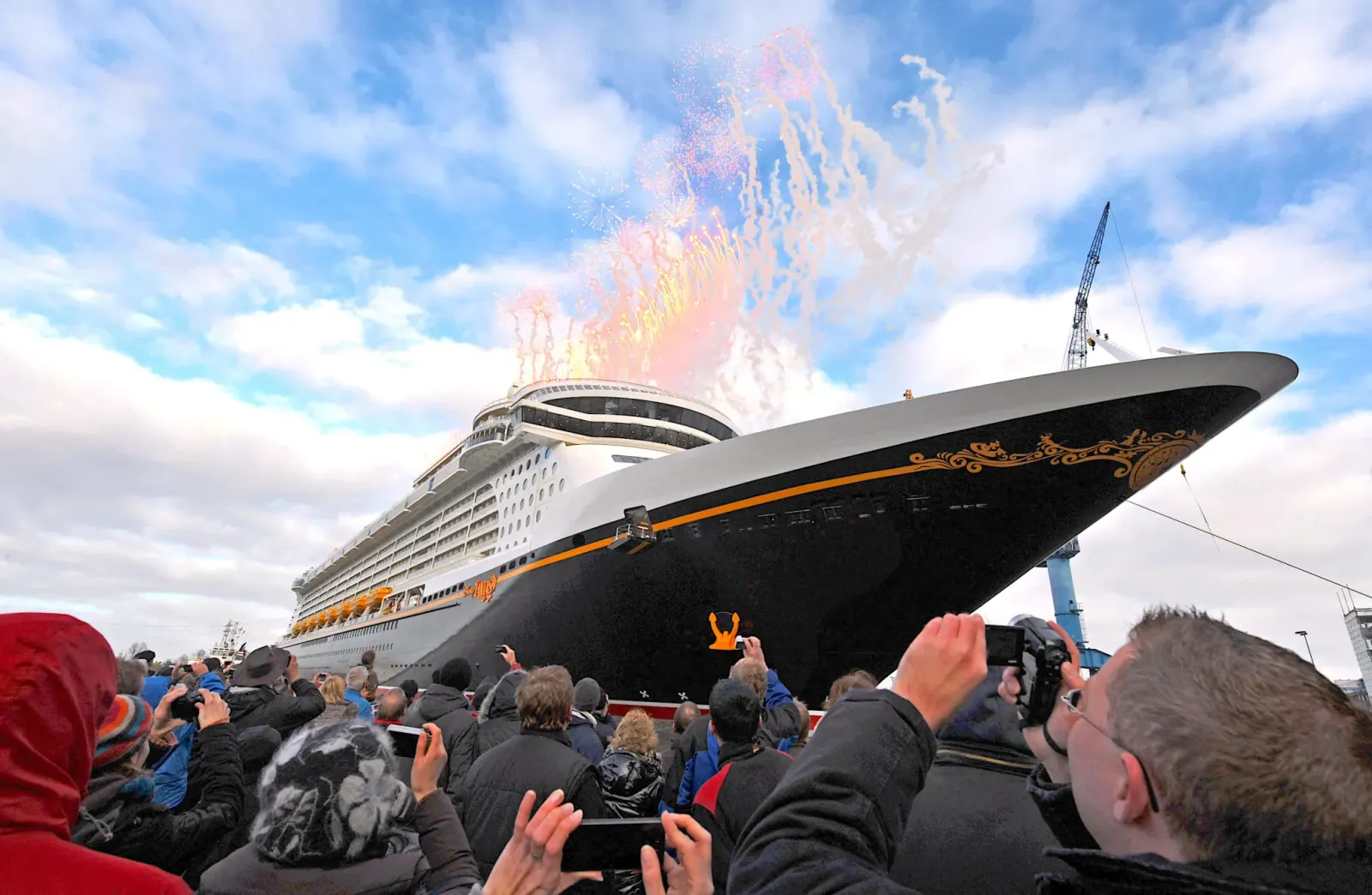
Disney CFO Hugh Johnston has said, “We don't break out cruise ships,” but U.K. filings for its London-based subsidiary show cruise revenue passed $3 billion last fiscal year. The disclosure matters because Disney is planning a major fleet expansion, and the financial shape of that bet is now visible to decision-makers.
Disney has historically refused to break out cruise ship revenues in the way investors typically expect, with CFO Hugh Johnston telling shareholders on a Q3 call last year, “We don't break out cruise ships.” But Fortune can reveal that in a U.K. filing for the company’s ships based for tax reasons, Disney’s cruise revenue passed $3 billion for the first time. For the year to September 27, 2025, the cruise line’s revenue surged 20.3% to $3 billion after the launch of its sixth ship, the Disney Treasure, in December 2024.
This matters because Disney is not treating cruising like a side quest. The same filings tie that performance to the next chapter of a $60 billion investment in Experiences, with 20% allocated to cruises, including plans to add five more ships by 2031. In other words: Disney is scaling fast, while U.S. disclosures stay high-level, and the real financial profile of the cruise business is showing up elsewhere.
Start with the basics: Disney’s cruise ships look less like typical liners and more like floating theme parks. They’re filled with cuddly characters, Broadway-caliber shows, and water slides with screens that tell Mickey Mouse stories as riders rocket past on rafts. The business sits inside Disney’s Experiences division, which also includes theme parks and is the company’s biggest cash cow. Experiences generated 57% of Disney’s $17.6 billion operating income in 2025 and nearly 40% of its $94.4 billion revenue. Yet Disney’s U.S. financial disclosures do not break out the cruise line; earnings calls have historically offered only general guidance.
So how did the $3 billion number surface? Through a U.K. subsidiary structure that Fortune describes as “mysteriously named” and “perhaps deliberately” without the “Disney” label. Disney’s ships are directly owned by a London subsidiary called “Magical Cruise Company.” Disney chose the U.K. for tax reasons, specifically the Tonnage Tax system. Under Tonnage Tax, qualifying cruise lines pay a fixed tax rate based on net tonnage of their fleet instead of standard corporate tax on actual income. For a high-margin business charging premiums for a unique experience, decoupling tax liability from earnings is a strategic incentive. There’s also a second layer: the U.K. is the historic home of global maritime law, finance, and insurance, including the well-known Lloyd’s of London, which can be seen in the industry as gold-standard counterparties.
The filings also help explain why the profit story is not a straight line. While revenue rose 20.3% to $3 billion, net profits sank 12.9% to $302.7 million. Part of that drag was the cost of adding capacity and preparing for additional ships. The statements show staff costs swelled 31.4% to $437.2 million due to hiring 1,765 employees, with the bulk of the new recruits being shipboard personnel. The company also incurred preparation costs for launching two additional ships, the Disney Destiny and Disney Adventure, both launched within six months of the financial statements being filed.
In the U.K. commentary, Jeff Swindell, senior vice president of finance at Disney Signature Experiences (the segment responsible for attractions outside the theme parks), said the company remained highly profitable during the fiscal year while managing various one-time costs tied to business growth initiatives, including pre-operational expenses for upcoming fleet additions. Swindell’s framing is consistent with what executives usually have to manage in capital expansion cycles: revenue ramps, but the expense line can surge first, especially when ships are staffed, staged, and brought online.
The fleet expansion itself is now visible in multiple threads of planning. Disney’s recent launches bring the fleet to eight ships, but five more are coming by 2031 as part of the $60 billion Experiences investment. The filings note that one of the new ships will be fully financed, owned and operated in Japan under license by Oriental Land Company (OLC). If the first Japan ship succeeds, OLC forecasts that operating multiple ships should follow. OLC also forecasts that in the first few years one ship would generate annual net sales of $650 million (¥100 billion), with an approximate operating margin of 26.7%, yielding profits of around $174 million.
Disney’s own filings are similarly confident about maintaining profitability. Swindell said the company expects to maintain strong profitability in financial year 2026, supported by capacity growth from the Disney Treasure, the Disney Destiny and the Disney Adventure. The caveat for cruise executives, of course, is scale. The filings don’t disclose passenger counts for 2025, but CruiseMarketWatch put Disney at 1 million passengers, or 3.1% of the market. That’s small compared to Carnival’s 6.8 million passengers, meaning Disney can expand aggressively while still being a relative minnow in the industry.
For peers and boards, the second-order implication is blunt: Disney’s U.S. reporting stays non-specific on cruises, but U.K. shell filings can still force clarity. If you’re an operator watching the economics of themed cruising, or an investor assessing whether a consumer brand can scale a capital-heavy experience business, this is a real lesson in where the numbers actually hide. Disney may be adding ships on a glossy timeline, but the financial reality is already telling a more complicated story: $3 billion in cruise revenue, 20.3% growth, and profit pressure from staffing and pre-operational costs as the expansion ramps.
This story's Key Insights and Take-aways are locked.
Create a free account to unlock Executive Actions for one credit.
Register to UnlockAlways free for Executives Club members. Join the Club
More in Business

Epic and Google drop settlement bid, forcing rival Android app stores by July 22
Google told the court it is ready to carry third-party app stores starting Wednesday, July 22.

SK Hynix opens at $170, raises $26.5B, and tops foreign IPO records
In Friday's Wall Street debut, SK Hynix turns AI RAM demand into a $26.5B fundraising moment that rewrites comps.

China lands a reusable Long March booster, a first that matches SpaceX and Blue Origin
A barge landing and net-based recovery move China from theory to proof, reshaping the reusability race and satellite ambitions.