

Dogs pass the bouba-kiki test. The finding rewrites how brains link sound and shape.
A new study shows dogs spontaneously match 'bouba' to round shapes and 'kiki' to spiky ones, suggesting sound symbolism is a shared brain mechanism, not a language-specific quirk.

Eleonora Biffi at the University of Parma and colleagues found that pet dogs, like humans, associate the nonsense word 'bouba' with rounded shapes and 'kiki' with spiky shapes. The result suggests sound symbolism stems from general brain mechanisms shared across species, with implications for how we understand language, perception, and even product design.
Dogs are officially on the bouba-kiki bandwagon. In a study published in Proceedings of the Royal Society (DOI: 10.1098/rspb.2026.1209), researchers led by Eleonora Biffi at the University of Parma tested 51 pet dogs. Owners sat with their adult dogs, holding them during the experiment, with a rounded shape displayed on a panel on one side of the room and a spiky shape on the other. When the dogs heard 'bouba,' 56 percent lingered on the round shape; when they heard 'kiki,' 63 percent concentrated their gaze on the spiky shape. That is the same sound-shape matching that humans across cultures have shown since the effect was first documented in 2001.
The finding matters because it suggests the connection between certain sounds and shapes is not a byproduct of human language, but a more general principle of how brains integrate information from different senses. Biffi and her team repeated the experiment with owners wearing headphones playing music so they could not hear the words, and the outcome was the same, with a slightly stronger bias toward round shapes for 'bouba.' That rules out the possibility that owners were unconsciously cueing their dogs.
The bouba-kiki effect has been a staple of cognitive science for over two decades. Since 2001, studies have shown that people from diverse cultures are much more likely to give the made-up name 'bouba' to a curved shape and 'kiki' to a spiky shape. The effect has recently been shown in chicks and possibly macaques, suggesting it is not unique to humans or even to primates. Now dogs join the list, and the researchers are already expanding their scope.
The open question is whether this behavior comes from dogs' long history of co-evolution with humans, or from a more fundamental perceptual mechanism. Biffi notes that it is unclear to what extent the effect depends on dogs having experience of listening to human speech, or the fact that dogs have co-evolved with humans for thousands of years. To investigate, her team is now collecting data on puppies and wild canids, including foxes, and also wants to see if the effect exists in cats. If cats show it too, Biffi says, that would provide further evidence that sound symbolism reflects general perceptual mechanisms, rather than adaptations specifically related to dogs' cooperation and communication with humans.
Attila Andics at Eötvös Loránd University in Hungary says the study suggests the matching of speech sounds to shapes relies on general mechanisms rather than complex linguistic representations. 'An exciting next question is to what extent [these links] in dogs arise through statistical learning or more hardwired expectations,' he says. That question has implications beyond canine cognition: if sound-shape associations are hardwired, they could shape everything from brand naming to voice interface design.
For executives and founders, the study is a reminder that sensory associations are not arbitrary. The bouba-kiki effect has been documented across human cultures for two decades, and now across species, suggesting it is a fundamental feature of perception. That raises the stakes for how sound is used in branding, product design, and user interfaces: a name that sounds 'round' or 'spiky' may tap into a response that is wired into the brain, not just learned from culture.
The research also highlights the growing interest in cross-species cognition. If sound symbolism is a general property of nervous systems, it could help explain why certain words feel more natural than others, and why some sounds are universally associated with certain meanings. The team's next steps, testing puppies and wild canids, will help separate learned associations from innate ones. And if cats show the effect, that would further undermine the idea that language is the root of all symbolic thinking.
For now, the takeaway is that the bouba-kiki effect is not just a human quirk. It is a shared perceptual phenomenon that may reflect how brains across species map sound to shape. As Biffi puts it, 'If animals without human-like language also spontaneously associate sounds with shapes, this suggests that at least some of the mechanisms underlying sound symbolism may not be specific to language. Instead, they may reflect more general principles of how the brain integrates information from different senses.' That is a useful reminder for anyone who creates, names, or designs things that people experience through sound: the connection between what we hear and what we see may be more fundamental than we think.
This story's Key Insights and Take-aways are locked.
Create a free account to unlock Executive Actions for one credit.
Register to UnlockAlways free for Executives Club members. Join the Club
More in Science
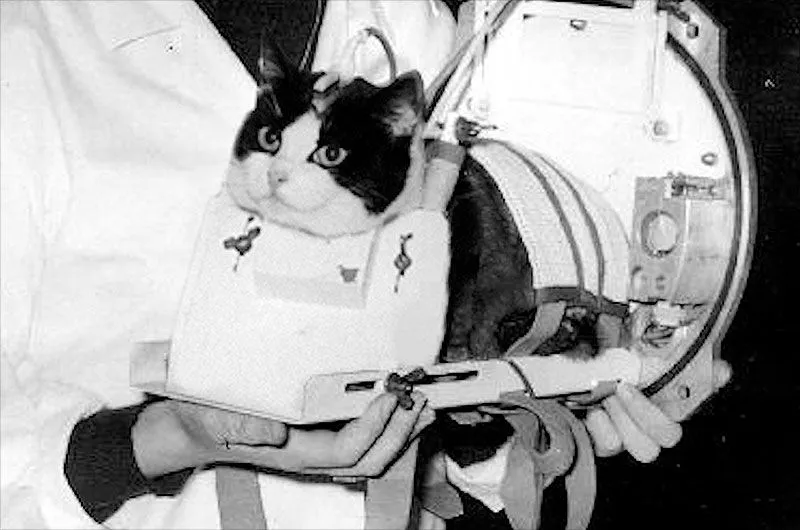
France euthanized Félicette, the first cat in space, two months after her flight
Félicette's 1963 flight made France a space-race player, but her euthanasia and a crowdfunded statue reveal how high-risk programs are remembered.

Ultracold atoms just created a 'fractional Fermi sea' that breaks quantum rules
A new quantum state challenges decades of theory and hints at 'super-Fermions,' with real stakes for quantum computing and materials science.

Bangladesh's 202,000 measles cases are a 'real warning' to other nations
The world's worst measles outbreak is spreading as routine vaccination falters. Here is why every country's immunization program should pay attention.