
ESCAPADE snaps Earth and Moon in visible and thermal IR, July 3 calibration check
NASA’s Mars-bound ESCAPADE uses Earth and the Moon to verify its cameras, then turns to Martian aurora and heat signatures.
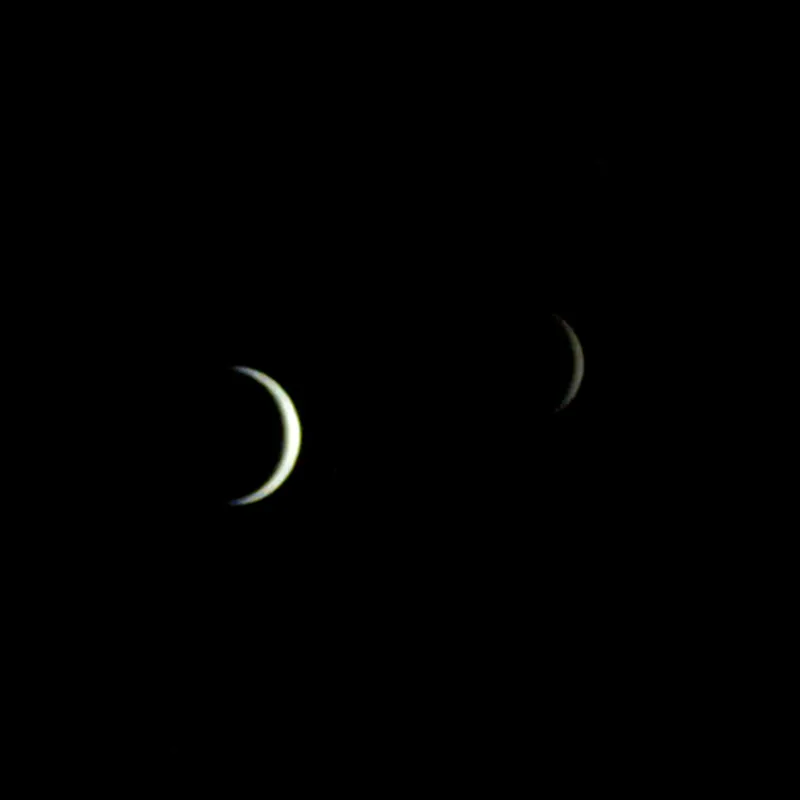
NASA’s ESCAPADE mission captured photos of Earth and the Moon on July 3 using its Visible and Infrared Observation System cameras. The images double as an important calibration check for ESCAPADE as the spacecraft loiters near Lagrange point 2 and prepares for an Earth gravity assist in November 2026.
On July 3, one of NASA’s two Mars-destined ESCAPADE spacecraft snapped a “family portrait” of Earth and the Moon in both visible light and thermal infrared. At that moment, ESCAPADE was 363,250 miles (584,600 kilometers) from Earth and 115,600 miles (186,100 kilometers) from the Moon, so the Moon looked relatively large. The visible-light view shows both bodies as crescents because the Sun was only partly illuminating them. Only around 8% of each face was sunlit, turning the rest of each world into dark shapes.
But the thermal infrared image flips the script. Instead of looking just dark, the shadowed hemisphere of Earth glows due to heat stored and emitted by both the atmosphere and surface, ranging from minus 10 to minus 44 degrees Fahrenheit (250 to 280 kelvins). The Moon, by comparison, has far less insulating coverage. Without oceans and atmospheres, its far side stays much colder at minus 280 degrees Fahrenheit (100 kelvins). In other words: the camera isn’t just taking pretty pictures, it is capturing the physical reason temperature behaves differently across planets and moons. That is exactly why NASA points to these “well-known targets” as a calibration check for ESCAPADE’s cameras.
ESCAPADE is built to investigate Mars, specifically visible Martian aurora and the planet’s thermal properties, meaning how heat is distributed across the Martian surface and atmosphere. To do that, the mission relies on the Visible and Infrared Observation System cameras, provided by Northern Arizona University in Flagstaff. Seeing Earth and the Moon at known targets and known illumination conditions is the practical way to confirm the system is measuring what it is supposed to measure. The mission can compare emitted energy in thermal infrared and reflected light in visible wavelengths against expectations, then carry that confidence forward when it turns its instruments toward the Red Planet.
The camera images also reflect where ESCAPADE is in its journey. The spacecraft are currently in a “loiter” orbit around Lagrange point 2, a location in space about a million miles from Earth. Being far enough out and positioned for long-duration operations matters for two reasons. First, it supports stable observation planning as the mission checks and refines instrument performance. Second, it sets up the next major maneuver: in November 2026, ESCAPADE will fly by Earth to use the planet’s gravity to slingshot the spacecraft toward Mars.
Timing and mission architecture matter because ESCAPADE is designed for a later big question. When the spacecraft arrive in September 2027, they will study how solar wind interacts with the Martian environment and how that drives atmospheric loss at Mars. Solar wind is described as a “million-mile-per-hour stream of material flowing from the Sun.” The key is that space weather is not a metaphor here. It is a measurable driver of how atmospheres erode, especially for planets where atmospheric shielding and magnetic interactions determine how much is retained versus stripped away. So the calibration check on July 3 is not a side quest. It is upstream quality control for the mission’s ability to interpret thermal patterns and aurora-related observations once it reaches Mars.
From a governance and funding standpoint, ESCAPADE is also a useful case study in how NASA organizes risk. The mission is funded by NASA’s Heliophysics Division and is part of the NASA Small Innovative Missions for Planetary Exploration program. Those labels matter because they tell you what NASA is optimizing for: credible science and instrument performance, delivered through smaller, faster programs. The UC Berkeley’s Space Sciences Laboratory leads the mission, with key partners including Rocket Lab, NASA’s Goddard Space Flight Center in Greenbelt, Maryland, Embry-Riddle Aeronautical University, Advanced Space, and Blue Origin. That partnership map matters because it spreads responsibilities across camera provision, spacecraft building, mission integration, and technical execution. In practical terms, it means calibration and systems validation are team sports, not just a single lab’s job.
There is also a human logic to why NASA bothered to image Earth and the Moon at this specific time. In the source, Rob Lillis, the mission’s principal investigator at the University of California, Berkeley, says NASA is “thrilled” the ESCAPADE mission could accommodate “excellent space-qualified cameras” that will search for visible Martian aurora and investigate thermal properties of the Martian surface and atmosphere. Since Earth and the Moon are “well-known targets,” imaging them provides an “important calibration check” for ESCAPADE’s cameras. That sentence is the whole thesis in two lines: the team wanted confidence in instrument behavior before chasing more complex targets.
For executives and board-level readers, the second-order takeaway is simple: missions that involve thermal infrared and visible observations do not get to “wing it” when the hard targets arrive. Calibration confidence is a prerequisite for credible science and for program credibility with stakeholders funding the work. ESCAPADE is moving through a real timeline: loitering near Lagrange point 2, then an Earth flyby in November 2026, then Mars operations in September 2027. The July 3 Earth-Moon images are an early checkpoint that reduces uncertainty later, which is exactly the kind of operational discipline that investors, regulators, and customers expect when a program’s value depends on measurement integrity, not just launch success.
This story's Key Insights and Take-aways are locked.
Create a free account to unlock Executive Actions for one credit.
Register to UnlockAlways free for Executives Club members. Join the Club
More in Science

Alaska's 1,580-foot tsunami had warning signs. Scientists just found them.
Rapid glacier retreat, heavy rainfall, and thousands of tiny tremors preceded Alaska's 1,580-foot tsunami, a warning for every coastal community in a warming world.

The rare mutation that lets high-risk brains dodge Alzheimer's
Scientists found a natural defense against protein buildup, opening a new path to preventive treatments.

3,000 steps a day may halve Alzheimer's decline, study finds
New research links a modest daily walk to less tau buildup and nearly half the cognitive and functional decline, even for those with early signs.