
Europe lacks heavy rockets, and satellite warfare is already accelerating above it
Ariane 6 can do about 10 launches a year, while the US averages 15 per month, leaving Europe scrambling.

Andøya Space chief executive Ketil Olsen says Europe needs launch capability for strategic autonomy, with satellites now central to military power. The gap is stark: limited heavy-launch capacity across Europe clashes with a rapidly expanding US, China, and Russia space-battlefield.
On the northwest coast of Norway’s mountainous Arctic island of Andøya, rocket launches are starting to look less like engineering milestones and more like national security infrastructure. Ketil Olsen, chief executive officer of Andøya Space and formerly a Norwegian vice admiral, frames the stakes bluntly: launching satellites into orbit is a capability “important for Norway, for the EU, for Europe,” and the point is strategic autonomy, sovereignty, and European independence. The problem is that Europe is still waiting. Satellites for observation, communications, and precise geolocation have been military necessities for years, and new weapons like orbital interceptors and inspection systems are heading that way. But Europe’s “catch-up” race is constrained by one missing ingredient: enough heavy launchers to make scores of trips to orbit each year.
That missing volume shows up in the hard math. China’s Long March 5 and Russia’s Proton-M and Angara A5 launchers can each take about 25,000 kilograms to orbit. SpaceX’s Falcon Heavy can carry almost 64,000 kg. France-based Arianespace’s Ariane 6, by payload, can carry about 22,000 kg. Yet booster production and infrastructure limit it to about 10 launches per year. The contrast is brutal: in 2025, the US averaged more than 15 launches per month, led by SpaceX. If Europe is trying to avoid dependence on a foreign company while also competing in a militarized space environment, the scarcity is not a theoretical gap. It is the difference between fielding more satellites, replacing assets, and keeping up with adversaries’ pace.
To make that race more complicated, Europe’s most visible startup bets are not built for immediate military usefulness in the way bigger launchers are. European startups are racing to create an alternative to the US, but there have been only a handful of launches. Their focus is on speed, reusability, and homegrown security rather than payload, limiting their military utility. One of Europe’s major hopes is Isar Aerospace SE of Germany. It has scrubbed its planned “Onward and Upward” mission multiple times and has yet to set a new date. Its first launch attempt a year ago, the only time an orbital launch has been tried from continental Europe, flew for about 30 seconds before crashing. Its Spectrum rocket is expected to have a payload of only 1,000 kilograms. Daniel Metzler, chief executive officer and co-founder, says scrubs “are part of rocket industry,” and that experience is learned each time, adding: “There is no question that we will reach orbit and demonstrate reliable access to space.” The credibility is there, but the timeline and payload capacity are the issue.
Why does payload and launch rate matter so much? Because the orbital arms race is not just about putting things up there. It is about what happens after launch. China, Russia, and the US are pouring more than $200 billion into space military efforts, putting hundreds of satellites in orbit over the last half-decade while testing weapons on Earth and in space. Although nuclear weapons are prohibited by treaty from being deployed in orbit, other military activity is not. Data compiled by astrophysicist Jonathan McDowell shows more than 600 overhead satellites, beginning with early military deployments in the late 1950s. The Cold War’s “expensive dead ends” are returning, but with modern sensors and better maneuvering.
The shape of today’s threat is also changing. India, China, and Russia have tested anti-satellite missiles launched from the ground. The US last conducted such a test in 2008, destroying a satellite with a ship-launched SM-3 Block IIA missile, and has since declared a self-imposed moratorium on such exercises. In 2021, China launched an object into orbit that later appeared to deploy or launch another object that fell back to Earth. Analysts said it was most likely a type of fractional orbital bombardment system, or FOBS, designed to put a nuclear warhead into an orbit that allows an unpredictable strike from changing direction and timing. China’s test added a hypersonic glide vehicle to the warhead so it could maneuver as it approached the target. No other country has attempted such a test, though Russia deployed a short-lived FOBS during the Cold War before abandoning it because other weapons like submarine-launched ballistic missiles could accomplish the same outcome.
Then there is the “inspection” era of proximity operations. The US, China, and Russia have deployed satellites that can maneuver in space to conduct close passes, document other systems, or manipulate them. Others float slowly just below geostationary orbit to listen to signals from communications and early warning satellites stationed there. In April, orbital data showed a coordinated dance of inspections involving all three countries. A Russian satellite sidled up to geostationary orbit tens of thousands of miles above Earth and positioned itself among three Chinese commercial and military satellites close enough to eavesdrop or collect images. A US satellite then moved into an orbit that brought it as close as 13 kilometers from the Russian satellite twice every 24 hours, ensuring good lighting for pictures or video. Finally, a presumed Chinese inspection satellite parked itself in the cluster near another US military communications satellite. The maneuvers did not show indications of impacts or tampering, but they reveal how the world’s three leading space powers are spending resources and maneuvering fuel to keep close tabs. For other nations, this is not a spectator sport. Germany, for example, witnessed interference to Bundeswehr systems by two Russian Luch-Olymp intelligence-gathering satellites last fall, according to Defense Minister Boris Pistorius. Pistorius said both Moscow and Beijing have the ability to “disrupt, blind, manipulate or kinetically destroy satellites.”
Europe’s pain is not limited to bandwidth and signal quality. On the eve of Putin’s invasion of Ukraine in early 2022, a Russian cyberattack on Viasat Inc.’s satellite network disabled modems across Europe and disrupted wide swaths of communications, knocking out thousands of wind turbines in Germany. Berlin has since pledged to invest €35 billion in defensive and offensive capabilities in space by 2030. Pistorius also warned in September that “Satellite networks today are an Achilles heel of modern society,” and that conflicts of the future will not be confined to Earth, but carried out in orbit. That’s where Europe’s rocket shortage becomes a corporate and board-level issue, not just a defense ministry priority. Launch is the entry ticket. Without enough heavy-launch access, Europe risks being structurally slower at replacement and expansion, even if the intentions are clear.
And there is a chilling strategic logic driving the urgency. A US Congressman Mike Turner said two years ago that Russia was experimenting with a plan to put nuclear anti-satellite weapons in orbit. The concept, as described in the source, was to create a network of such devices that could be detonated to destroy or disable everything in a certain orbital band if a major war broke out. Jeffrey Lewis, director of the East Asia Nonproliferation Program at the Middlebury Institute of International Studies at Monterey, said the claim was repeated by NATO Secretary General Mark Rutte. Lewis’ explanation of the logic is stark: “Launch is cheap so you destroy everything and just replace it. And it’s better than losing the war.” From a European perspective, launches are neither cheap nor plentiful. That mismatch is the strategic trap. Europe is building ambition and defenses, but without scale in heavy launch capacity, it may keep discovering that autonomy in space is won on a countdown clock that does not care about plans.
This story's Key Insights and Take-aways are locked.
Create a free account to unlock Executive Actions for one credit.
Register to UnlockAlways free for Executives Club members. Join the Club
More in Business

SK Hynix opens at $170, raises $26.5B, and tops foreign IPO records
In Friday's Wall Street debut, SK Hynix turns AI RAM demand into a $26.5B fundraising moment that rewrites comps.
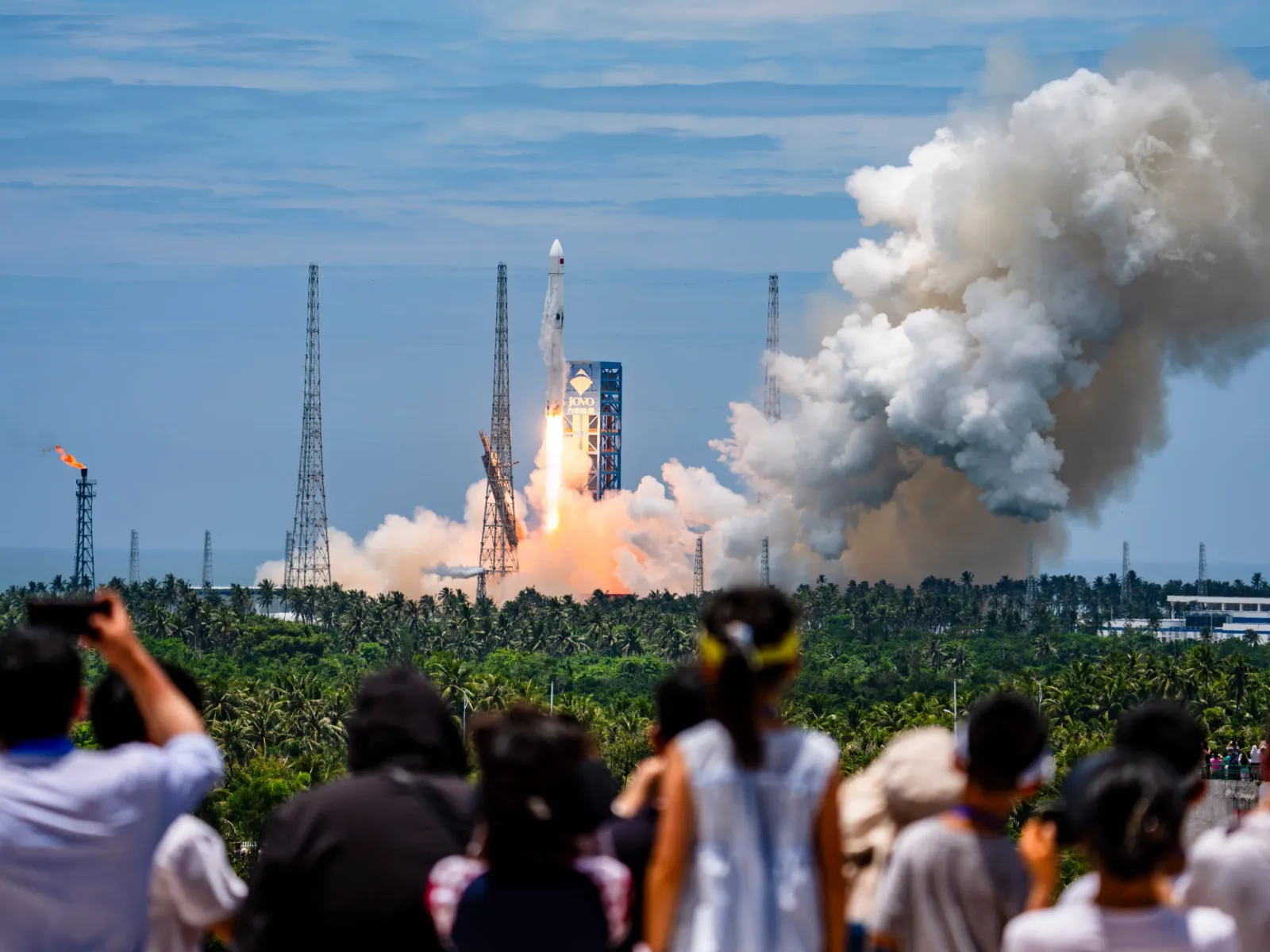
China lands a reusable Long March booster, a first that matches SpaceX and Blue Origin
A barge landing and net-based recovery move China from theory to proof, reshaping the reusability race and satellite ambitions.

AstraZeneca $27B wipeout as Wainua late trial misses cardiovascular target
A failed late-stage heart study triggered a swift market punishment, forcing investors and boards to reset timelines and risk.