
First microblazar found: a cosmic jet aimed straight at Earth
Astronomers catch the first microblazar, a black hole jet aimed at Earth, and it may explain cosmic rays.
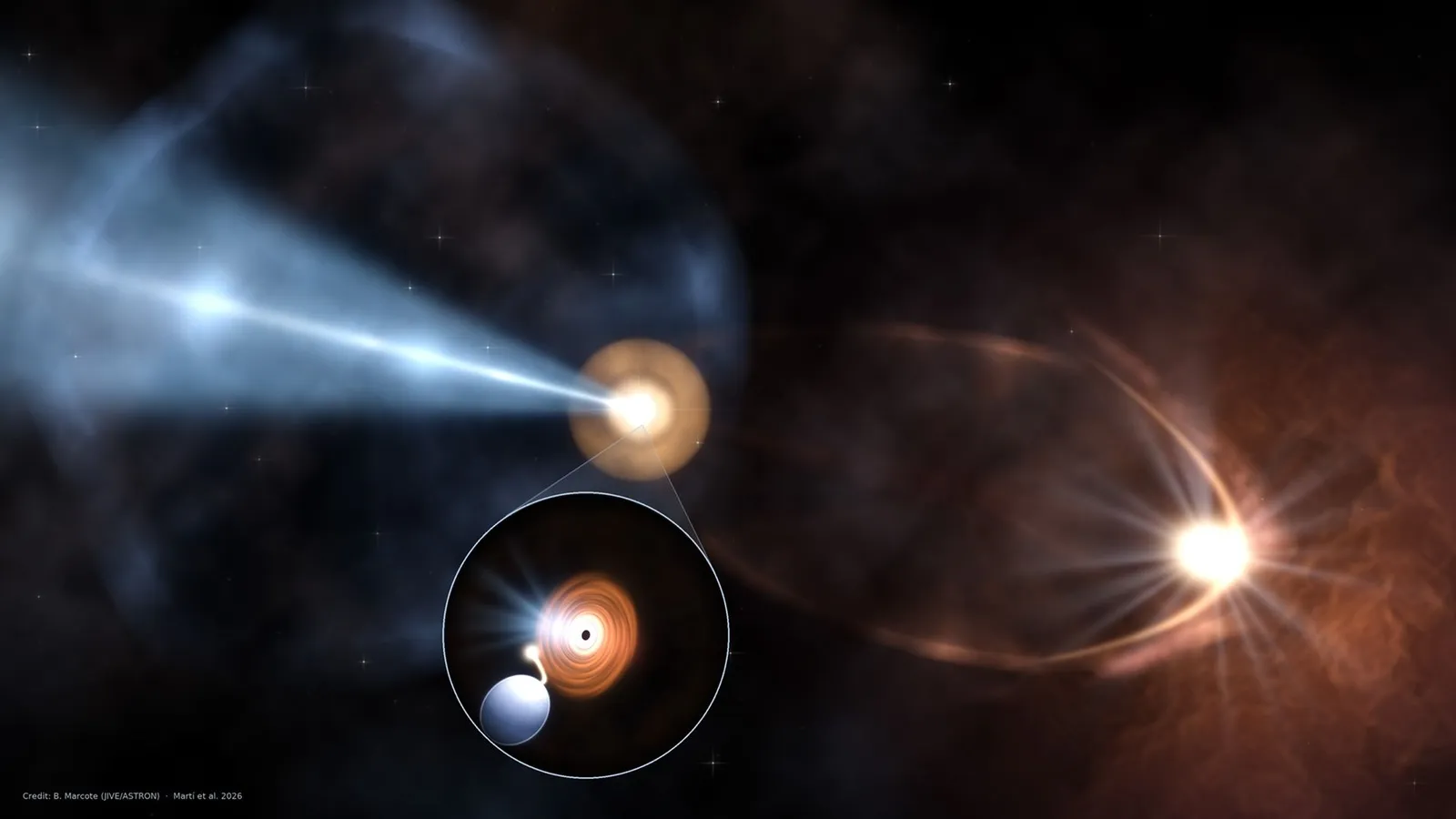
An international team led by Josep Martí of the University of Jaén has identified IRAS 18293-0941, the first serious microblazar candidate, a binary system with a black hole whose jet flares toward Earth. For decision-makers, this opens a new window into black hole physics and the origin of ultra-high-energy cosmic rays, with implications for astrophysics funding and space science priorities.
Astronomers have found the first serious candidate for a microblazar, a long-theorized object that fires a jet of particles directly at Earth. The object, named IRAS 18293-0941, sits about 12,000 light-years away in our own galaxy, hidden behind a veil of dust, and it is a binary system where a black hole orbits a hot, gigantic star every 11 days. One of its two opposing jets flares toward us, making it the closest thing yet to a 'microblazar' - a smaller cousin of the blazing quasars that rank among the most energetic objects in the universe.
The discovery, led by Josep Martí of the University of Jaén in Spain and accepted for publication in Astronomy and Astrophysics, is the payoff of a decades-old prediction. Astronomers had already found microquasars, the scaled-down versions of quasars, but a microblazar - one whose jet happens to point at Earth - had never been spotted. 'It is the first time that we have a serious candidate,' Martí told Live Science. The team used the Calar Alto Astronomical Observatory in Spain, the European VLBI Network, the MeerKAT array in South Africa, and archival data from the Very Large Array in New Mexico to confirm that IRAS 18293-0941 has nearly all the expected microblazar signatures.
Blazars are quasars with a jet pointed at Earth. Quasars are powered by supermassive black holes that strip material from their host galaxy and eject some of it in opposing jets at near-light speed. When one of those jets points directly at us, the object is called a blazar, and its brightness is amplified by Doppler boosting. Microquasars are the smaller, stellar-mass black hole versions, and theorists long predicted that microblazars must exist too. The catch is timing: the microquasar phase is short in stellar evolution terms, so catching one with a jet aimed our way is rare. That is why this candidate is so valuable - it gives astronomers a nearby, relatively small black hole system to study the same physics that powers the most luminous objects in the universe.
IRAS 18293-0941 shows powerful emissions across the electromagnetic spectrum, a hotspot behind it where the opposing jet heats the interstellar medium, and a jet that flares toward Earth. The one expected feature it lacks is rapid variability - the quick brightness changes that Doppler boosting should produce. Martí and colleagues think the dense gas cloud surrounding the system smooths out those fluctuations, which would explain the missing signal. The team is now investigating whether the area behind the microblazar is indeed a hotspot, co-author Pedro Luque-Escamilla told Live Science. If confirmed, that would close the last gap between prediction and observation.
Independent experts are cautiously impressed. Kinwah Wu, a theoretical astrophysicist at University College London, said the claims are 'sensible' with 'no questionable hidden assumptions,' and noted the source shows signatures of jet-ambient interactions that naturally lead to particle acceleration. Svetlana Jorstad of Boston University called the study 'very interesting, important and comprehensive.' Itumeleng Monageng of the University of Cape Town said the observations reveal 'a previously overlooked mechanism for generating some of the highest energy emissions observed.' The external validation matters because the field has been burned before by single-object claims; this one appears to hold up.
The bigger prize is understanding ultra-high-energy cosmic rays. Microblazars 'may power some of the universe's most energetic processes,' Monageng said. Because they are much closer than their supermassive counterparts, they offer a natural laboratory for studying how black holes accelerate particles to extreme energies. That could reshape models of cosmic ray production and inform future space-based observatories and neutrino detectors. For executives in aerospace, defense, and data analytics, the discovery is a reminder that fundamental science often creates unexpected downstream demand for high-performance computing, imaging, and sensor technology. The same instruments used to catch this microblazar - radio arrays, optical telescopes, and archival data pipelines - are the building blocks of tomorrow's commercial space and surveillance systems.
For research leaders and funding bodies, the finding validates a line of inquiry that had been theoretical for decades. It also highlights the value of multi-instrument collaboration: the team combined ground-based optical, radio, and archival data to catch an object that is literally in our galactic backyard yet hidden by dust. The next step is to confirm the hotspot and monitor for variability, which could turn IRAS 18293-0941 from a strong candidate into the first confirmed microblazar. That would give astronomers a front-row seat to black hole jet physics - and a new tool for decoding the most energetic particles in the cosmos. For now, the object stands as the best evidence yet that microblazars are real, and that the universe has been aiming one at us all along.
This story's Key Insights and Take-aways are locked.
Create a free account to unlock Executive Actions for one credit.
Register to UnlockAlways free for Executives Club members. Join the Club
More in Science

France euthanized Félicette, the first cat in space, two months after her flight
Félicette's 1963 flight made France a space-race player, but her euthanasia and a crowdfunded statue reveal how high-risk programs are remembered.
Ultracold atoms just created a 'fractional Fermi sea' that breaks quantum rules
A new quantum state challenges decades of theory and hints at 'super-Fermions,' with real stakes for quantum computing and materials science.

Bangladesh's 202,000 measles cases are a 'real warning' to other nations
The world's worst measles outbreak is spreading as routine vaccination falters. Here is why every country's immunization program should pay attention.