
Fontainebleau wildfire scorches 800 hectares, forces A6 partial closures and two aircraft
A fast-moving blaze south of Paris burns 800 hectares and disrupts a key highway during a heatwave, tested by firefighting capacity.
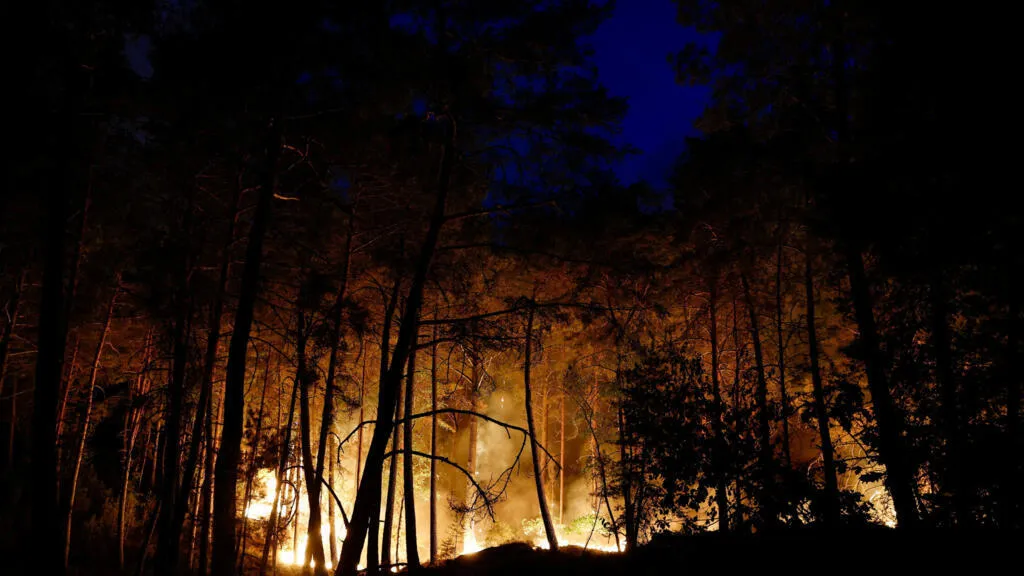
A wildfire in the Fontainebleau forest south of Paris scorched about 800 hectares, according to officials on Monday, prompting France to deploy two firefighting aircraft. For decision-makers, the incident is a real-time stress test of emergency response, critical infrastructure continuity, and heatwave risk.
A fast-moving wildfire south of Paris has scorched about 800 hectares of the Fontainebleau forest, and France has responded by deploying two firefighting aircraft, officials said on Monday. The fire also forced partial closures of the A6 motorway, hitting movement during a busy summer holiday weekend. And this is not happening in mild conditions. The blaze is unfolding amid an intense heatwave, the kind of weather that turns “a fire somewhere” into “a system under pressure” for the region.
Those first facts matter because they tell you where the operational load landed. Roughly 800 hectares is not a backyard incident; it is an area large enough to threaten multiple lines of response at once: ground crews, air support, and traffic flow on major routes. The decision to send two firefighting aircraft signals that officials judged the situation to be moving too quickly for ground-only tactics. In parallel, the partial closures of the A6 motorway show the second-order reality that even when a fire is in a forest, its footprint shows up on transportation planning and public disruption.
For executives and operators who think in terms of resilience, this is a live example of how extreme weather cascades. A6 is a major artery, and partial closures during a holiday weekend do not just inconvenience travelers. They can affect supply chains, logistics scheduling, staffing attendance, and nearby service economies. When traffic management has to be tightened for safety, it reshapes timing across businesses that rely on predictable movement, from retail and hospitality to maintenance and emergency services. The incident is local in geography, but systemic in effect.
It is also a reminder that wildfire risk is increasingly tied to broader climate and heatwave dynamics. Heat waves raise ambient temperatures, dry vegetation, and reduce the margin for error in firefighting. That does not mean every heatwave produces a major fire, but it does mean officials often face less time to act and harder conditions while they act. In practice, that can shift decision-making toward faster mobilization of resources like aircraft, even if those resources are limited or need careful deployment to avoid wasting sorties.
There is a policy and governance angle too. In France, wildfire response typically involves coordination between state firefighting capabilities and on-the-ground local units, with air assets used when conditions and spread rates justify it. While the source does not list the specific agencies, it does confirm the core fact: officials deployed two firefighting aircraft and crews worked to contain the blaze. In board terms, that is a signal that command and coordination structures were activated at scale. When those structures perform under heatwave conditions, they determine whether an event stays “contained” or escalates into something larger and longer-lasting.
This matters beyond France in a practical way for any executive managing continuity during extreme events. Fires are not only environmental. They are operational threats, and the operational threat is amplified when transport corridors have to be modified. Partial motorway closures show a government balancing safety against mobility, which is exactly the kind of tradeoff businesses also face. If your operations depend on weekend travel patterns, service visits, field teams, or time-sensitive deliveries, you need planning assumptions that account for abrupt route constraints when authorities close roads in response to active hazards.
Finally, there is the strategic lens for peers: how do you plan for “surge conditions” where standard resources can be overwhelmed? The source provides a clean datapoint, even if it is just one incident: about 800 hectares burned, two firefighting aircraft deployed, and partial A6 closures during an intense heatwave. That combination describes an environment where response capacity and infrastructure management both get tested at the same time. For executives, the takeaway is not to predict the next fire. It is to treat wildfire and heatwave response as a continuity variable, just like storms or grid disruptions, with clear trigger points for escalating protocols and communicating impacts to customers and teams.
In short: Fontainebleau is burning, roughly 800 hectares are already affected, two aircraft have been brought in, and the A6 motorway has seen partial closures during a busy weekend. The details may sound like a local bulletin, but the implications read like a template for how extreme weather stresses public systems and the businesses that depend on them.
This story's Key Insights and Take-aways are locked.
Create a free account to unlock Executive Actions for one credit.
Register to UnlockAlways free for Executives Club members. Join the Club
More in Politics

Glacial collapse, not rain, killed 180 in Nepal's Himalayan flood
The Himalaya's extreme geography hid the true cause of Nepal's catastrophic flood, a glacial collapse that turned a geological battleground into a mass-casualty zone.

Iran’s Esmail Baghaei says Oman talks start shipping via Hormuz, not US talks yet
Temporary route plans with Oman aim to restart commerce while Tehran says Washington dialogue is not on the table.

Standards watchdog opens probe into Reform UK deputy leader Richard Tice over interests
The parliamentary standards commissioner says it began an investigation on 28 July into a possible undeclared interest.