

Glacier cliffs can calve 3x faster than predicted - but not in a runaway
New satellite data on 100-meter ice cliffs slashes the worst-case sea-level tail risk, yet Thwaites still holds a deep-bed hazard.
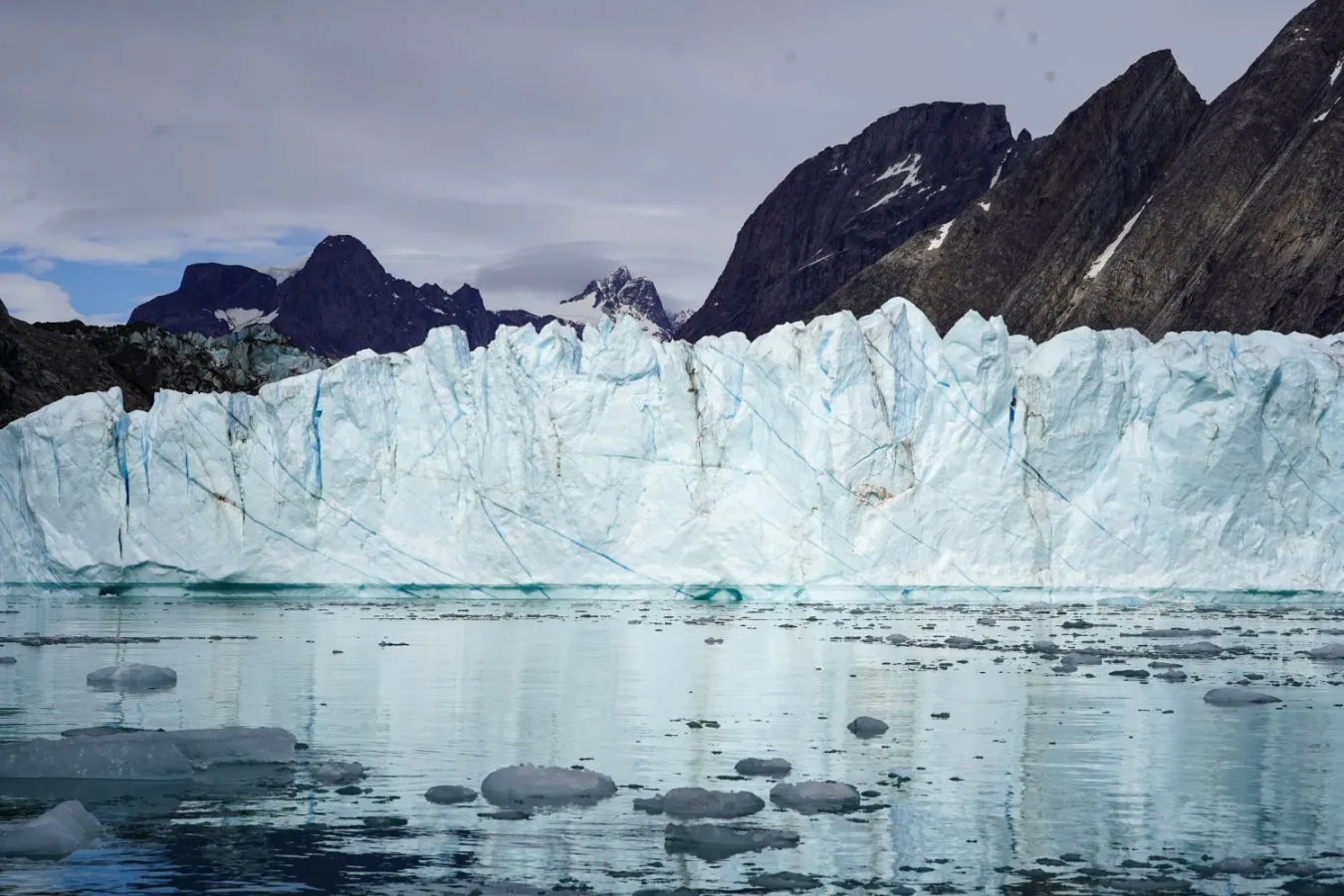
Caroline Needell of the MIT-WHOI Joint Program led a satellite study finding that the world's tallest glacier cliffs can retreat up to three times faster than current models predict, yet none underwent unstable collapse. Decision-makers should update coastal risk models toward episodic, burst-like retreat rather than a steady worst-case acceleration.
The world's thickest glaciers may calve icebergs up to three times faster than current models project, but new satellite observations show that rapid retreat does not necessarily cascade into runaway collapse. Instead, the tallest ice cliffs on Earth - including the front of Antarctica's Thwaites glacier - appear to fail in bursts, separated by periods of stability. The finding comes from Caroline Needell of the MIT-Woods Hole Oceanographic Institution Joint Program, who led the first large-scale study of real ice-cliff behavior using satellite data, published in Science.
For decision-makers, the numbers matter because the tail risk was enormous. An Intergovernmental Panel on Climate Change report had warned that runaway cliff collapse could potentially double the amount of sea level rise expected over the next 100 years. That scenario assumed each collapse exposes a taller, even less stable cliff, creating a self-accelerating loop. Needell's study does not eliminate the possibility, but it provides the first empirical evidence that the loop is not inevitable - the glaciers she observed retreated far faster than models predicted, yet none underwent unstable retreat.
The physics behind the relief is subtle. Marine-based glaciers extend out to sea with their bases resting on the sea floor, and their leading edges can form cliffs towering 100 meters above the ocean. For years, researchers feared these cliffs might be inherently unstable. But Needell's team found that the risk of runaway collapse depends on two competing factors: how steeply the sea floor deepens beneath the ice, and how quickly the ice flows seaward. Imagine an up-ended jar of thick honey spilling onto a plate; it doesn't stay tall and stable but thins out at the edges. Similarly, if the ice flows fast enough, it thins the glacier's edge, lowering the cliff and preventing the runaway feedback.
That idea had been suggested by idealized mathematical models, but never systematically measured in real glaciers until now. "None of the glaciers we observed underwent unstable retreat, even though they did retreat much faster than our current models predict," says Needell. In other words, the models are too pessimistic on speed but also too pessimistic on instability. The two errors partially cancel out, but not cleanly.
Thwaites glacier - widely nicknamed the "doomsday glacier" - remains the key watch item. Most of the glaciers in the study are buttressed by sea-floor features, and Thwaites is currently stabilized by a series of underwater ridges. Douglas Benn at the University of St Andrews in the UK describes what happens next as almost like "tripping" downhill: "Over the next decades, it's going to jump from one pinning ridge to another." Eventually, those ridges disappear. "The bed then begins to get real deep," says Benn. At that point, which the glacier may reach within this century, "the whole structural integrity of the ice becomes unviable."
That is when runaway collapse becomes a real - but not certain - possibility. In a deeper bed, ice flows faster, and faster flow can thin the cliff face, potentially restabilizing the glacier. The key question, says Needell, is whether thinning can outcompete rapid ice loss. Her study suggests it might, but the question remains open. Robert Larter at the British Antarctic Survey notes that we have never directly observed runaway cliff collapse, though one study suggests it may have happened near Thwaites roughly 12,000 years ago. "The problem is, nobody was around to take observations at the time," he says. "It's a possibility we have to keep our eye on."
For coastal planners, insurers, and infrastructure investors, the practical takeaway is a shift in scenario design. The linear worst-case projection - steady, accelerating cliff collapse - now looks less probable. The more likely risk profile is episodic: long quiet periods punctuated by sudden multi-year surges of calving and retreat. That changes how stress tests should be built. A portfolio of coastal real estate or a 30-year infrastructure bond needs to tolerate abrupt jumps in sea-level contribution, not just a smooth upward slope.
The same satellite technique that produced this study also provides a monitoring tool. Executives with exposure to Greenland or Antarctic sea-level projections - which means any long-dated asset on a coastline - should track this research line closely. The science is moving from idealized models to direct observation, and the next few years will likely refine both the 3x speed estimate and the stability question. The window to adjust risk models is now, before the next data release rewrites the odds again.
This story's Key Insights and Take-aways are locked.
Create a free account to unlock Executive Actions for one credit.
Register to UnlockAlways free for Executives Club members. Join the Club
More in Science

France euthanized Félicette, the first cat in space, two months after her flight
Félicette's 1963 flight made France a space-race player, but her euthanasia and a crowdfunded statue reveal how high-risk programs are remembered.

Ultracold atoms just created a 'fractional Fermi sea' that breaks quantum rules
A new quantum state challenges decades of theory and hints at 'super-Fermions,' with real stakes for quantum computing and materials science.

Bangladesh's 202,000 measles cases are a 'real warning' to other nations
The world's worst measles outbreak is spreading as routine vaccination falters. Here is why every country's immunization program should pay attention.