
Goldman says the AI unwind has spiraled. Its 3 bottom signals are still unlit
The S&P 500 just logged its longest losing streak since 2020 and Nvidia has shed $2.7 trillion since October, yet Goldman's three conditions for a bottom remain unmet while ETF and mutual fund buyers keep adding.
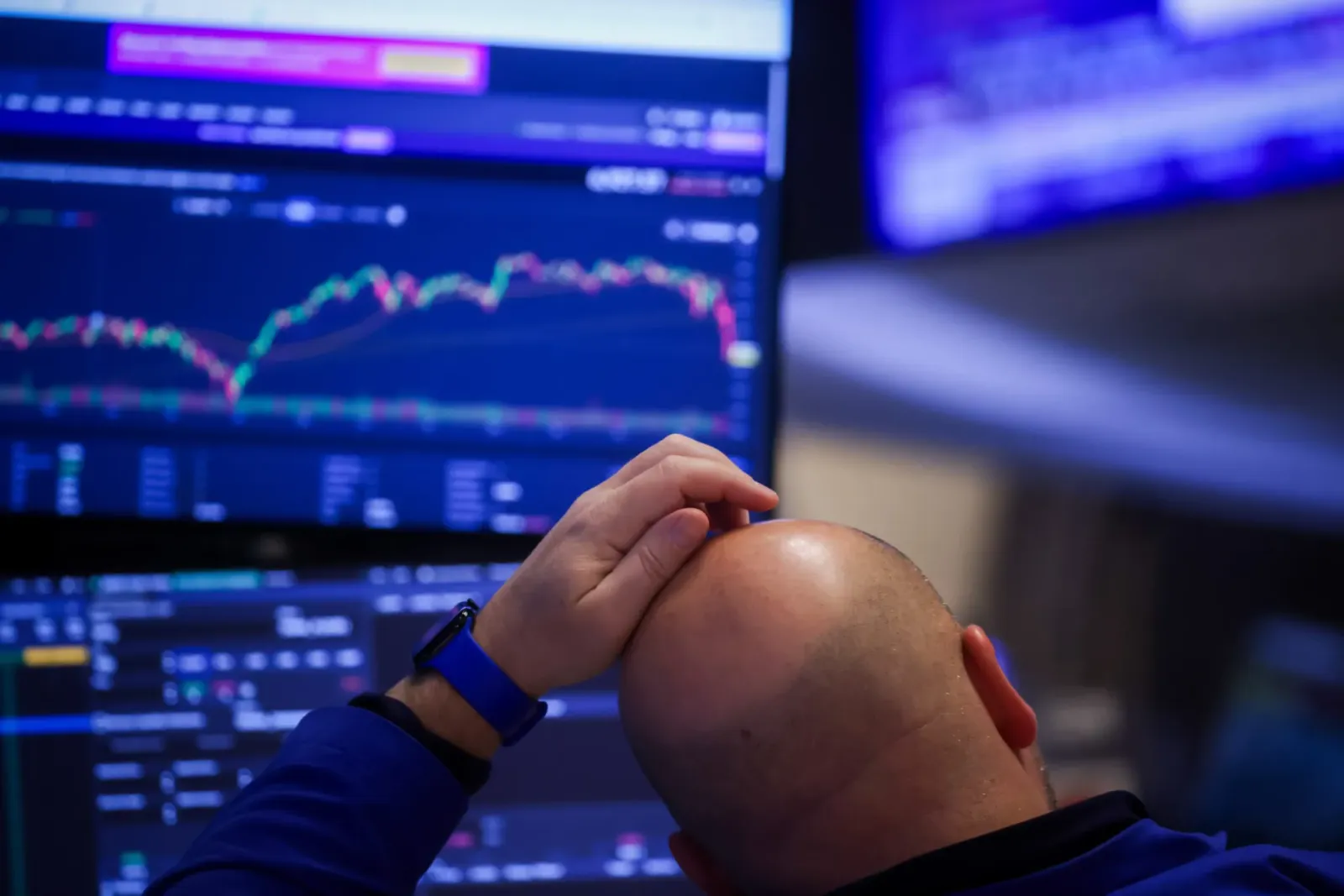
Goldman Sachs strategist Ben Snider told clients the sell-off has 'expanded this week from an AI unwind to a broader growth downgrade,' with the firm's AI stock basket down 32% since Oct. 6. None of Goldman's three bottom conditions has been met, which means allocators still overweight AI are underwriting a recovery the data does not yet support.
The S&P 500 closed Friday at 6,918.45, down 3.59% and in a correction, its seventh straight loss and the longest losing streak since February 2020. The Nasdaq Composite fell 5.28% and is now down more than 2% for the year, and Goldman Sachs notes the index sits 12% below its Oct. 6 record. Goldman strategist Ben Snider had already told clients the sell-off 'expanded this week from an AI unwind to a broader growth downgrade,' and the firm's checklist for calling a bottom has three items: news that raises confidence in AI earnings, a dovish Fed signal, or a big drop in investor positioning. Any one of the three would support a bottom and a recovery. As of Friday's close, not one has arrived.
The damage is concentrated and measurable. Goldman's AI stock basket is down 32% since Oct. 6, while the S&P 500 excluding AI held up until this week and is now 6% below its high. Cyclical stocks have lagged defensives by 5 percentage points over the past 10 days, the signature of investors cutting growth rather than rotating within it. One caveat matters: the note was written before Friday's rout was fully in its data. Its exhibits are priced as of Nov. 19 and the hedge fund data run through that date. Friday may have supplied what the note was looking for, or it may have made the situation worse than Goldman acknowledged.
Condition one is AI earnings, and this is the fight the market is actually having. Investor Dan Niles told CNBC that a price war between Anthropic and OpenAI is hurting both: their combined sequential revenue growth fell from 75% in the second quarter to 48% in the third, while combined losses rose from $7.9 billion to about $8.4 billion. Reuters cited a valuation of roughly 40 times trailing sales for Anthropic, which a US Bank Asset Management executive said 'assumes years of rapid growth.' Goldman's own outlook concedes the AI picture for 2028 and beyond 'is highly uncertain.' Translation for anyone still holding the trade: revenue growth is decelerating at exactly the moment the spending line is not.
Anthropic's IPO was billed as the moment the AI trade would prove itself to public markets. It raised $93.5 billion after underwriters exercised an option, passing SpaceX's $85.7 billion as the largest IPO on record. The shares jumped 17% on Thursday, then gave most of it back Friday to close at $88.91, barely above the $83 offer price. 'Anthropic faded relatively quickly,' said Dakota Wealth's Robert Pavlik. 'I don't think investors believe there's something inherently wrong with the company... I think they're just skeptical of this market.' Morgan Stanley, the underwriter tasked with stabilizing the stock, closed its support position, removing a potential pillar. UBS said the debate has shifted from whether AI investment will continue to whether it can generate enough revenue and returns for shareholders. Capital Economics noted that the IPO's success while other AI names fell shows parts of the ecosystem 'no longer move as one.'
The chips tell the same story with more force. Nvidia fell 14% Friday, its worst day in almost two years. It lost 22.9% on the week and is down 47.5% since Oct. 6, a loss of $2.7 trillion in market value. Jensen Huang resigned as CEO on Nov. 12, and CFO Colette Kress is interim CEO. Broadcom, Micron and AMD fell roughly 12% to 14%. The VIX, Wall Street's fear gauge, closed at 35.89, its highest in 19 months. 'It's a meltdown right now,' said CFRA Research's Arun Sundaram. JPMorgan Asset Management's David Kelly took the other side: 'This is not a fatal illness. It's not even the flu.'
Condition two is the Fed, and it looks further away than the AI earnings question. Futures put the odds of a December hike at about 95%, and the Fed meets Dec. 9. Goldman's economists expect hikes in December and March, taking the federal funds rate to a peak of 4.25% to 4.5%. Philadelphia Fed President Anna Paulson said Thursday the Fed will need to raise rates again because inflation is too high, and the 10-year Treasury yield is near 5%. Treasuries did rally sharply Friday as investors hunted safety, but a flight to quality is not a pivot. Anyone waiting on a dovish signal to rescue the multiple is waiting on a calendar nobody has scheduled.
Condition three is positioning, and here the picture is genuinely mixed. Goldman says hedge funds have already cut back, with net leverage the lowest since April 2025. Their most popular longs were crowded into AI and have lagged the S&P 500 by 14 percentage points over six months, among the worst stretches in that basket's 20-year history. The note called the situation 'bruised and broadening.' But Goldman's broader Sentiment Indicator is still above average. US equity mutual funds and ETFs have taken in nearly $170 billion in the fourth quarter, and asset managers' net equity futures positions sit in the 82nd percentile of the past 10 years. The fast money has moved. The slow money has not.
That leaves the arithmetic. Goldman's equity strategists estimate the AI boom has lifted S&P 500 earnings 25% above trend, and Goldman Research says AI capital spending produced 'about half' of this year's earnings growth. The firm's Nov. 17 outlook, written before the drop, forecast 8,700 by the end of 2027. The Nov. 20 note gives a range of roughly 5,800 to 8,100, depending on whether investors regain confidence in earnings. From Friday's close that is roughly 16% downside and 17% upside, by Fortune's math rather than Goldman's. History is only mildly comforting: after the 22 S&P 500 corrections since 1980, the index averaged a 4% return over the next three months and rose in 17 of them. E*Trade's research is less reassuring. Of the 14 times since 1983 the index first closed 10% or more below a record, five became bear markets.
This story's Key Insights and Take-aways are locked.
Create a free account to unlock Executive Actions for one credit.
Register to UnlockAlways free for Executives Club members. Join the Club
More in Business

GTA VI hauls $3.79bn in one day, out-earning every film ever made
Rockstar's own estimate covers a single Thursday plus a record 32.5m prerelease units, and it lands on every board weighing IP concentration, pricing power and launch risk.
FBI's crime database breached again, the second hack in months
CNN reports hackers hit the National Crime Information Center, the shared backbone of US policing, and the repeat timing is the part every security team should study.

S&P 500 Enters Correction, Down 10% From Its High on AI Worries
The index's slide past the 10 percent line is a symbolic verdict on investor mood, and the AI trade that powered the rally is now the thing testing it.