
Hayabusa2 risks a 1 km flyby of Torifune July 5
Japan's probe hunts answers on a 450-meter asteroid while testing rapid reconnaissance for planetary defense.
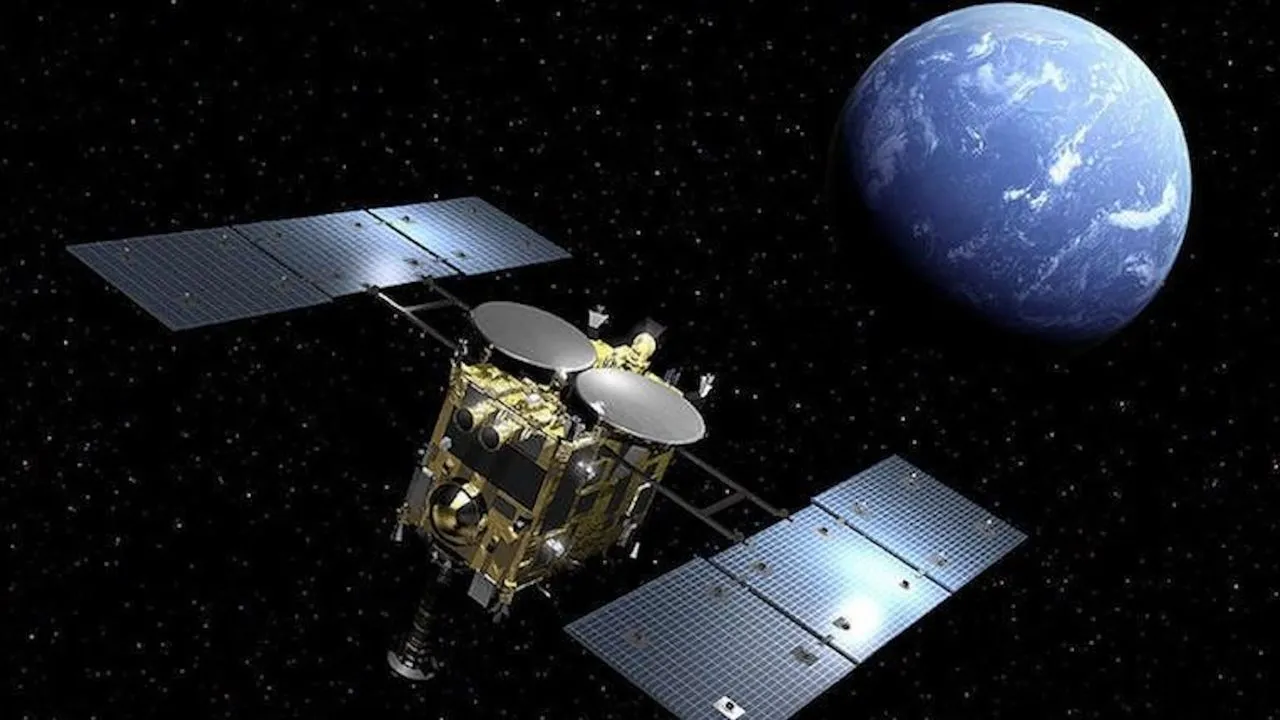
Japan's Hayabusa2 sample-return spacecraft is set to fly by the near-Earth asteroid Torifune on July 5, after already delivering samples from Ryugu to Earth in 2020. The maneuver, described by JAXA's Satoshi Tanaka as among the closest ever attempted by a mission of its class, will sharpen understanding of potentially uncertain asteroid shapes and help validate fast reconnaissance techniques for future defense.
Japan's Hayabusa2 sample-return spacecraft is about to thread the needle. On July 5, it will execute an ultra-close flyby of the near-Earth asteroid Torifune, coming within about 1 to 10 kilometers (0.62 to 6.2 miles) while moving at 5.3 kilometers per second (3.3 miles per second). JAXA's Satoshi Tanaka said the goal is a flyby distance of only about 1 kilometer, which he framed as one of the closest asteroid encounters ever attempted by a mission of this class.
This is happening because Hayabusa2 is not done just because it already succeeded once. The spacecraft launched in December 2014 and rendezvoused with Ryugu four years later. It collected samples and delivered them to Earth in 2020, completing its primary objectives. But the extended mission is still in play, and Torifune is the next stop in a campaign designed to squeeze more science out of a spacecraft that is already aging in deep space.
The stakes are real, even if the drama is quiet. Tanaka said Hayabusa2 has been operating well, though it briefly entered a protective safe mode last year. That matters for decision-makers watching complex, multi-year programs, because safe modes are not brand-new surprises. They are signals that systems can degrade, environments can differ from expectations, or operations can run into constraints late in a mission. Still, the spacecraft is now moving into another high-precision phase.
The Torifune flyby will use Hayabusa2's instrument suite to study an asteroid roughly 450 meters (1,476 feet) wide. The encounter speed creates a time crunch: there will be limited time to collect images and other data as the spacecraft whizzes past. That compression is why this is also being treated as an engineering and navigation test, not only a science mission. The flyby relies on advanced navigation techniques to guide and control the spacecraft for a rapid reconnaissance concept that could be used to determine an asteroid's physical properties quickly.
And here is where it gets especially interesting for anyone responsible for programs, risk, or governance: the mission did not originally plan for this. Patrick Michel, principal investigator for ESA's Hera asteroid mission and part of the Hayabusa2 science team, told Space.com that it is still a risky operation because they had not planned for this. He also pointed to a high uncertainty on the size of the object, explaining that the dimensions are unknown. If you are thinking in terms of mission planning, requirements, and margins, uncertainty is not a footnote. It is what turns “possible” into “prove it on the day.”
Michel raised a concrete example of why uncertainty is dangerous for interpretation: Torifune could be a contact binary, meaning two separate bodies came together at low velocities. He connected this to known contact binary small bodies like Arrokoth, imaged by NASA's New Horizons, and comet 67P/Churyumov-Gerasimenko, described as a "rubber duck" when visited by ESA's Rosetta spacecraft. In plain terms, the flyby has to be fast enough to capture useful data while the scientists are simultaneously trying to figure out what exactly they are looking at. That is not just a science headache; it is also a systems challenge because navigation, pointing, and data return have to be good enough under pressure.
Michel also gave the mission its storyline: "We're going to discover what it looks like. And each time we have seen a new asteroid, we've been surprised. We're going to discover another beast to put in the zoo of asteroids." That line lands because it is backed by the operational reality. The asteroid was first given the designation 2001 CC21 before being named for a deity from Japanese mythology. Tanaka says Torifune is somewhat similar to Itokawa, the target of Japan's first Hayabusa mission, but little is known for sure about Torifune. So the flyby is a reckoning between expectation and reality, one that tries to convert unknowns into measured evidence.
From a planetary defense perspective, the value is amplified. Michel and Tanaka describe the encounter as useful for planetary defense testing and planetary science, especially because rapid reconnaissance could provide vital information before intercepting a threatening asteroid with a kinetic impact. NASA's DART mission in 2022 demonstrated that kind of kinetic impact approach. If a future threat emerges, the question will not be whether action is possible, but whether decision-makers can get the right physical properties fast enough to support a safe and effective intercept plan.
Even outside defense, Hayabusa2's extended mission is already demonstrating how a spacecraft’s time in space becomes a portfolio of experiments. Tanaka said it has been busy during its deep space cruise phase, including making observations of the zodiacal light and exoplanets. The Torifune flyby, he said, hopefully will not be its final act. The ultimate goal of the Hayabusa2 extended mission is to visit the tiny asteroid 1998 KY26 in 2031, which would be the smallest asteroid ever visited. The spacecraft could even attempt a land on the miniscule world, just 11 meters (36 feet) wide.
For executives and board-level stakeholders in adjacent sectors, the message is bigger than one flyby. Hayabusa2 is showing how extended missions can turn legacy success into continuing capability building: tighter navigation, better decision loops under uncertainty, and faster reconnaissance concepts that could matter when timelines get short. July 5 is a specific date, but it is also a live test of whether complex deep-space systems can keep paying dividends after the original mission win is already banked.
This story's Key Insights and Take-aways are locked.
Create a free account to unlock Executive Actions for one credit.
Register to UnlockAlways free for Executives Club members. Join the Club
More in Science

Alaska's 1,580-foot tsunami had warning signs. Scientists just found them.
Rapid glacier retreat, heavy rainfall, and thousands of tiny tremors preceded Alaska's 1,580-foot tsunami, a warning for every coastal community in a warming world.

The rare mutation that lets high-risk brains dodge Alzheimer's
Scientists found a natural defense against protein buildup, opening a new path to preventive treatments.

3,000 steps a day may halve Alzheimer's decline, study finds
New research links a modest daily walk to less tau buildup and nearly half the cognitive and functional decline, even for those with early signs.