

Inflation, leverage squeeze, and the cycle: why Bitcoin stays bearish, says analysts
Three forces keep pressing BTC down, even as one strategist targets $100,000 by year-end.
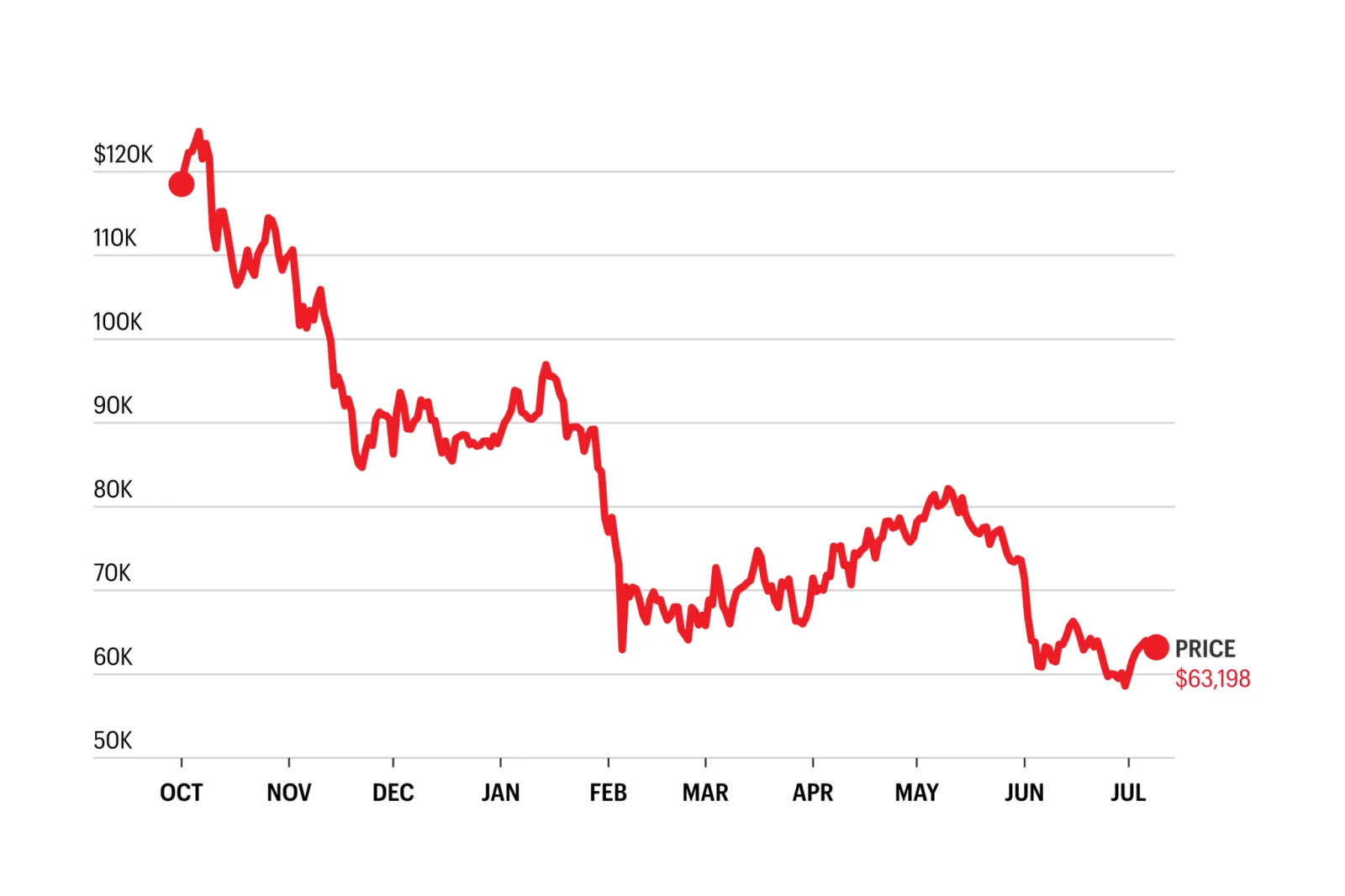
Fortune highlights three bear-market drivers for Bitcoin, quoting Bitwise's Matt Hougan, Grayscale's Zach Pandl, and CryptoQuant's Julio Moreno, plus 21Shares' Adrian Fritz. The implications for decision-makers: rate expectations, leverage unwind risk, and timing signals could matter more than headlines or token-specific news.
Bitcoin is stuck in a bear market for a simple reason: the forces that used to lift it are now working in reverse. Even after October’s plunge, Bitcoin still trades at around half of its all-time high of $126,000, with brief upward moves that fade into a long grind lower. Fortune notes the last time BTC suffered a similarly prolonged drop was 2022, when several major crypto players collapsed, including the crypto exchange FTX, dragging the broader market with them. Back then, Bitcoin plunged 76% from its 2021 all-time high of $16,000.
This time the backdrop is different, and that’s exactly why executives should care about the “why,” not just the price. In 2026, President Donald Trump has become one of the industry’s biggest boosters, and Wall Street heavyweights like BlackRock and JPMorgan Chase are announcing blockchain-based products. So why is Bitcoin still tanking? Fortune lays out three reasons analysts point to: the repeating four-year cycle, rising inflation that pressures risk assets, and excess leverage getting squeezed out.
First is the four-year cycle, a pattern investors have learned to watch. Over a decade, Bitcoin has tended to see three years of meaningful price appreciation followed by one year of decline. Fortune connects prior downturns to sector-specific shocks, including the 2018 decline after the boom and bust of initial coin offerings, and the 2014 drop after the catastrophic collapse of Mt. Gox. According to Matt Hougan, chief investment officer at Bitwise, investors are conditioned to expect the cycle, and he specifically points to investor psychology as one of the “primary reasons” for it. Hougan also describes a timing shift: as the tail-end of 2025 approached, long-term Bitcoin holders began to “lighten up” on positions. That matters because it turns the cycle from abstract history into market behavior: if sellers anticipate weakness, they often arrive early.
Second is rising inflation, which changes the incentives for traditional capital. This bear market is not being driven by the collapse of an exchange, Fortune says. Instead, it’s macro conditions. Zach Pandl, head of research at Grayscale, points to U.S. inflation rising year-over-year to 4.1% in June, with oil prices increasing amid the U.S. conflict with Iran, according to the U.S. Commerce Department. That rate is more than double the Federal Reserve’s long-term target of 2%. Higher inflation tends to keep interest rates higher for longer, and higher rates are typically bad for Bitcoin because crypto is a riskier asset. In Fortune’s account, institutions like Bank of America have predicted that Fed chairman Kevin Warsh will raise interest rates later this year, and Grayscale’s Pandl frames how this plays out: when the Federal Reserve cut interest rates to zero in COVID, Bitcoin’s price increased; when rates were sharply raised, Bitcoin’s price declined. The second-order effect for boards and treasury operators is that macro can overwhelm crypto-specific catalysts. Even if adoption headlines improve, capital allocation still chases yield and safety.
Third is excess leverage, and it’s the most “plumbing” of the three reasons. Crypto markets, by their nature, attract risk-taking. In bull markets, leverage builds: investors borrow against positions to buy more. Fortune gives a concrete example: Strategy, the world’s largest digital asset treasury, increased purchases in 2024 and 2025 to accumulate about 4% of Bitcoin’s total supply, financing that buying spree with new equity and debt issuances. The company’s Bitcoin funding approach, Fortune says, seeded similar playbooks across the market, as other firms raised capital to build their own digital asset stockpiles.
But as Bitcoin’s price declined, the leverage model came under pressure. Since October, Strategy’s stock price has fallen by 75%. Hougan explains the dynamic bluntly: leverage is getting “squeezed out of the system now that we’re in a bear market,” pointing to declining open interest in derivatives and a pullback in digital asset treasury companies. Julio Moreno, head of research at CryptoQuant, is also cited as part of the leverage-focused analysis. The stress shows up not just in trading metrics but in corporate balance-sheet moves. Fortune notes Strategy’s decision to sell part of its Bitcoin holdings, which likely further weakened demand for the asset. In plain English, when leveraged players scramble for liquidity, they can sell into weakness, making the bear case self-reinforcing.
Even with those pressures, some strategists think there is a timeline for relief. Fortune says that if Bitcoin returns to its 2025 highs, the outlook could get worse in the short term before it gets better, because multiple factors are weighing on near-term moves. Pandl projects a bottom of $58,000, even though the token has traded around $60,000 for the past month. He points to potential interest rate hikes, Strategy’s impact on investor confidence, and progress on a key crypto bill in the U.S. Senate as ingredients affecting short-term price action.
Adrian Fritz, chief investment strategist at 21Shares, expects Bitcoin to find a bottom sometime in the summer and projects a rebound toward $100,000 by year-end. Fortune includes his framing that the target may sound like a stretch, but once momentum builds, upside capture can happen quickly. For executives tracking crypto-linked strategies, the practical takeaway is not whether $100,000 “will” happen. It’s that the same macro and leverage dynamics that can push Bitcoin down can also flip faster than most models assume. Timing, capital structure, and liquidity planning become existential, especially for firms whose strategies depend on steady demand and repeat purchases.
This story's Key Insights and Take-aways are locked.
Create a free account to unlock Executive Actions for one credit.
Register to UnlockAlways free for Executives Club members. Join the Club
More in Business
SK Hynix opens at $170, raises $26.5B, and tops foreign IPO records
In Friday's Wall Street debut, SK Hynix turns AI RAM demand into a $26.5B fundraising moment that rewrites comps.

China lands a reusable Long March booster, a first that matches SpaceX and Blue Origin
A barge landing and net-based recovery move China from theory to proof, reshaping the reusability race and satellite ambitions.

AstraZeneca $27B wipeout as Wainua late trial misses cardiovascular target
A failed late-stage heart study triggered a swift market punishment, forcing investors and boards to reset timelines and risk.