
Joe Scarborough calls Republicans’ ‘lockstep’ election-fraud parroting ‘Orwellian’: ‘How sad’
On-air, the “Morning Joe” host reacts to Trump’s new claims and declassified documents about 2020 voting.
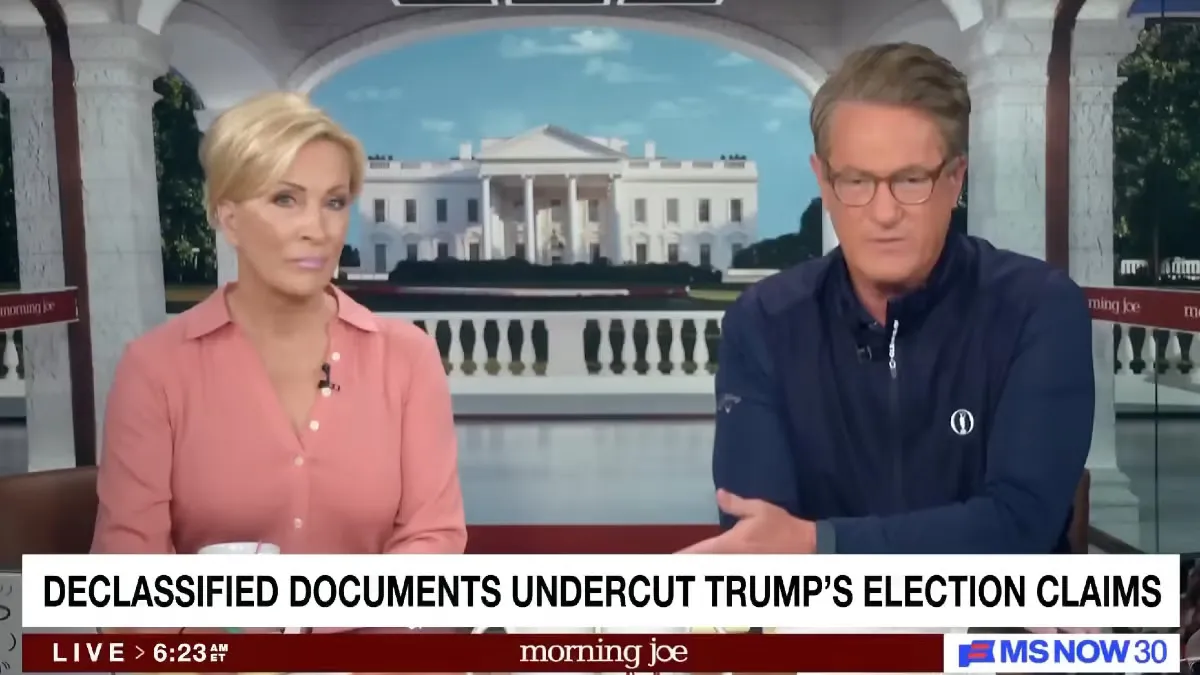
Joe Scarborough used “Morning Joe” to slam Republicans for repeating President Donald Trump’s ongoing election fraud claims tied to the 2020 presidential election. His criticism pointed to declassified documents released in connection with a Thursday primetime speech and warned about second-order political and trust damage.
Joe Scarborough did not mince words on “Morning Joe” Friday morning. The host slammed Republicans for falling into “lockstep” with President Donald Trump’s election fraud storyline, calling the alignment “Orwellian” and saying, “How sad that an entire party has gone lockstep.” He framed the issue as more than partisan messaging, arguing that repeating these claims without accountability is exactly what George Orwell warned about.
Scarborough’s trigger was the political flywheel turning again after Trump’s Thursday night primetime speech. Speaking to the American people, Trump said, “Our elections were left vulnerable to being rigged and stolen, and the trust of the American people was lost. This cannot be allowed to continue.” The Trump administration paired that speech with the release of declassified documents meant to support his allegations about the safety of U.S. voting systems and the idea that American elections have been compromised for years.
This is where Scarborough focused his attention, and where his anger got specific. He highlighted that one of the released documents suggests Trump was not merely repeating a narrative, but “parroting Russian-created narratives regarding election fraud and rigged voting.” In Scarborough’s telling, the document also indicates Russian figures tried to influence the 2020 U.S. presidential election in Trump’s favor. He quoted his interpretation of the document: “This document released by Donald Trump to prove that U.S. elections in 2020 were rigged says [Russia's] aim [was] to defeat former Vice President Joe Biden and to ensure President Trump's victory.” Scarborough responded incredulously, saying, “The incompetence is staggering. It's overwhelming.”
For executives and board members, the key point here is not whether every allegation is persuasive on its own. It is that the political system is now operating as a trust market, where the demand signal is “keep the narrative alive,” even when the supply is contested and the documentation is declassified for maximum political utility. When Scarborough says “This is where it leads you. It leads you down a pack of lies,” he is describing the risk of compounding misinformation with institutional reinforcement: parties repeat claims, media amplifies, and the claim becomes harder to dislodge because it has already been integrated into political identity.
Scarborough then pivoted from Trump to the party mechanics behind the speech. He said the most “sad” part was that “almost two-thirds of Republicans have just marched in lockstep” to say the 2020 election was rigged because Trump had repeated it so often. In other words, he was not only criticizing the president’s claims. He was criticizing the incentives for the rest of the coalition. If Republican leaders worry that breaking with Trump is an electoral liability, they may choose certainty over evidence, especially when the talking points are already built for rallies, cable segments, and fundraising emails.
He also pointed to timing as a separate kind of political calculation. Scarborough noted that some Republicans were “freaking out” on Thursday not because they disagreed with the contents of Trump’s speech, but because of when it would arrive. His explanation was blunt: they reportedly did not want him to give the speech because they knew it would steer attention toward election concerns instead of everyday economics. Scarborough said Americans would be concerned about “how much gas costs, how much their rent costs, how much their health care costs.” Then he added the line that ties politics to consumer reality: Trump gave the speech anyway, and “this is what happens.”
That observation matters beyond political theater. When election integrity narratives dominate the news cycle, it can crowd out other issues, elevate uncertainty, and change how stakeholders interpret institutions. For companies, that can show up as altered risk perception, more intense scrutiny of regulation and government contracts, and faster swings in public sentiment. For regulators and policy teams, it can complicate outreach and rulemaking because the public conversation becomes less about implementation details and more about legitimacy.
Scarborough’s closing message landed like a warning label. He mocked the credibility and momentum of the storyline, concluding with “Good luck with that.” In board terms, you can translate it into a more general risk: once an institution signals that it will follow the narrative, the cost of later corrections rises. And once a party moves “lockstep” on a contested claim, the question is no longer just “what did Trump say?” It becomes “what do allies do when the claim is politically convenient but institutionally corrosive?”
That is the stake Scarborough raised: not only political alignment, but the erosion of shared truth in the civic system. Whether you think the underlying election questions are resolved or not, the meta-story is that a major media platform and a major political coalition are amplifying the same claims, using declassified documents as fuel. And for executives watching political risk, the lesson is that trust can be treated like leverage, right up until it backfires.
This story's Key Insights and Take-aways are locked.
Create a free account to unlock Executive Actions for one credit.
Register to UnlockAlways free for Executives Club members. Join the Club
More in Politics

LA County: DOJ's 20,000 'noncitizen' voter list is 'unreliable,' includes U.S.-born
Preliminary review by Los Angeles County election officials finds errors in the federal list, raising the stakes for voter roll integrity ahead of November.

Trump's $1.5B Pentagon chip investment lands in North Carolina
A $1.5 billion defense infusion for North Carolina chipmaking signals a new era of Pentagon-backed reshoring - here's what it means for the industry.

Nigeria confirms first Ebola case in Abuja, a woman just off a Uganda flight
Health Minister Muhammad Ali Pate says the patient flew in from Uganda, putting Africa's latest outbreak on Nigeria's doorstep.