
JubileeTV lets Karen Murray control her mom’s TV 40 minutes away, for $1,178
A caregiving experiment shows how connected homes could shrink assisted living stress, but also expose adoption risks.
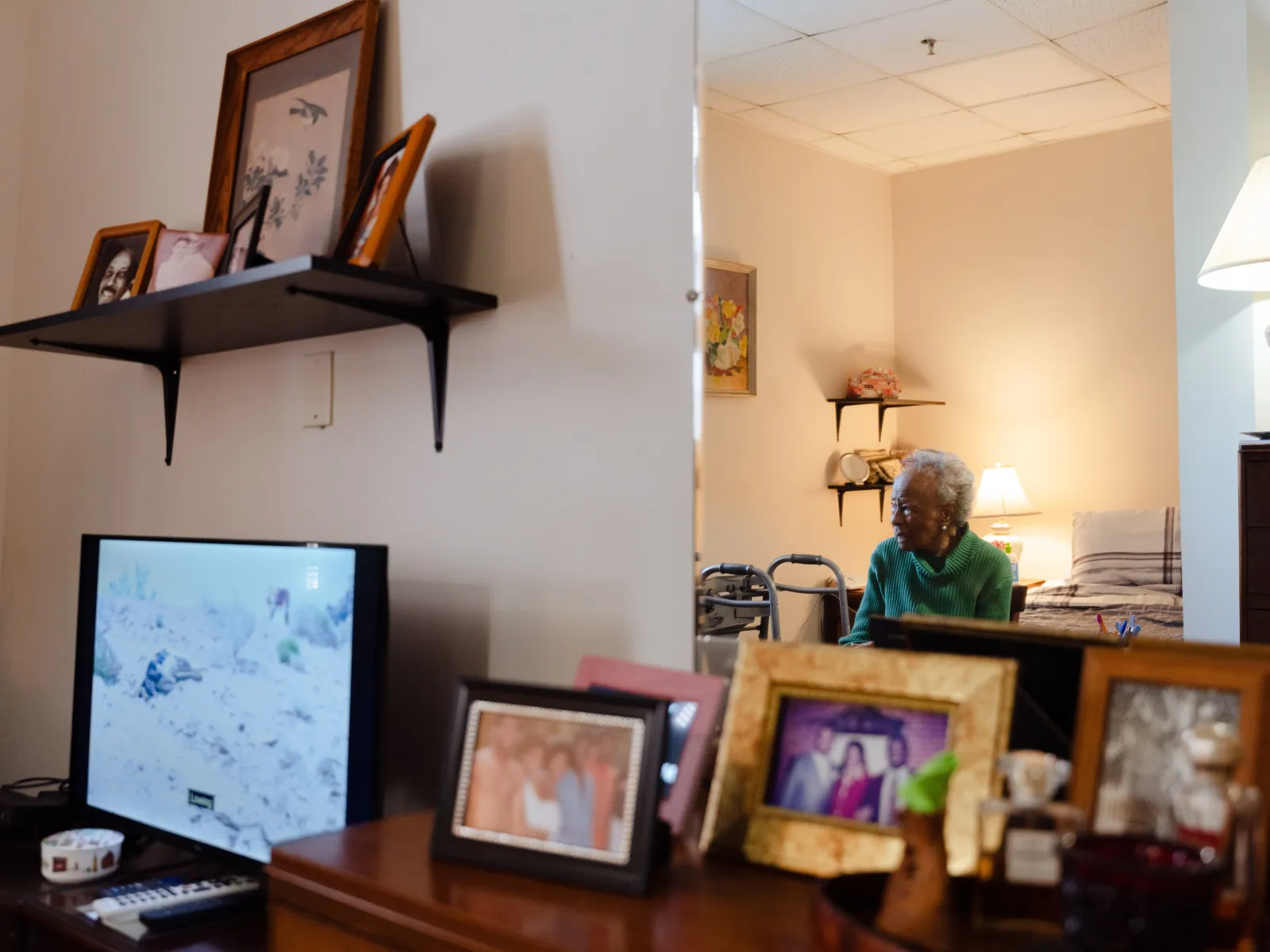
Karen Murray uses JubileeTV to help her 93-year-old mother, Marion, stay independent longer from her phone, 40 minutes away in New Jersey. For decision-makers, the bigger story is the tradeoff between lower-cost tech support and the real-world limits of reliability, privacy, and clinical evidence.
On a typical morning in New Jersey, Karen Murray wakes up, turns on the TV at her mother Marion’s assisted living home, and calls into the screen around 11 a.m. to ask what Marion wants to watch. It is a small ritual. The stakes are not. Marion is 93, and she has cognitive impairment, which means she sometimes needs help operating the TV, calling family members, or turning on music that calms her. Karen, who is 60, visits at least twice a week, but JubileeTV lets her control the set remotely, with a built-in camera so she can see Marion whenever she needs to.
JubileeTV is priced at $789 all-in, plus a $389 annual subscription, which totals $1,178 before you even factor in WiFi performance. That cost framing matters because Business Insider reports families are trying to trade what could be a $10,000-a-month assisted living bill for $100 monthly tech subscriptions. In Karen’s case, the “does it work?” question is lived every day: on a recent visit, Marion bantered with her son Steve, who lives in Delaware, through the TV, and listened to Tony Bennett. Karen says music is therapeutic for Marion, and she added that some days Marion will not stop singing. She also gave a reality check that matters for any operator thinking about scaling caregiver tech: JubileeTV is not always perfect. Depending on the WiFi, the app can be slow. Still, she frames it bluntly as better than no tech at all.
Zoom out from the living room and you see why this category is accelerating. Dozens of household products, from refrigerators to showers, are being marketed to help older Americans “age in place,” and reduce the burden on caregivers. Many smart home devices use artificial intelligence to detect patterns, spot anomalies, and track motion. Samsung refrigerators use cameras to track food levels. iGuardStove’s automatic shutoff system detects unattended cooking. LG ovens and microwaves use WiFi and voice control to simplify cooking. Smart dishwashers track detergent pod count and reorder supplies. Some showers and smart toilets offer contactless washing, automatic flushing, fall alarms, and infection detection.
There is also a caregiving layer beyond appliances. Families can use TVs and tablets for remote features like calls, telehealth, photo sharing, and live classes through tools such as Uniper Care and Onscreen, and Amazon. Business Insider spoke to multiple families experimenting with this tech in hopes of lowering costs and keeping loved ones safe. They often describe a cautious optimism. Most families are reluctant to let technology “take over” their lives, but eager to experiment with anything that helps their loved ones stay safe and self-sufficient. That is echoed in the corporate language too: Mark Benson, head of SmartThings, Samsung’s platform to connect smart devices, said the goal is “to support, not replace, human relationships at the center of caregiving,” using technology for reassurance and reduced stress. From a platform perspective, the connected home is positioned as a way to make aging in place more practical, affordable, and less stressful for families.
Still, the adoption gap is the story executives cannot ignore. Cost is a barrier, and so is usability. JubileeTV has one price point; some Samsung appliances exceed $3,000. Other options vary widely. Zinnia, a startup making therapeutic TV videos and channels for dementia patients and caregivers, has prices ranging from $70 a year to more than $500. Lori Bufka’s experience shows why budgets get stressed fast: she said her 88-year-old mom had been in assisted living for seven years, then costs skyrocketed, eventually hitting $5,200 monthly. Bufka decided to purchase a tiny home next door to her in Arizona so her mom could have her own space. She installed Blink cameras, used an Amazon Alexa for smart plugs to turn appliances on and off, and set up a tablet with Google Live Transcribe to communicate because her mom is deaf. She described checking on her mom three or four times during the night and frequently during the day, and she gave a concrete safety example: her mom once put Dawn dishwashing soap in her glass of water because she wanted to add flavor, so Bufka had to stop her from doing unsafe things a few times.
But the most useful caution in the article is not about the devices themselves, it is about the conditions required for them to work consistently in real homes. Some families say tech ignited more fear than relief, worrying about reliability, invasion of privacy, overreliance, tech support, and software updates. Adoption is also not a one-time install. Yu Sun, director of the Center for Innovation, Technology, and Aging at the University of South Florida, warned that if something is difficult to use, they will not use it. They may install an app and use it this year, but next year they may not be able to keep up. Sara Czaja, director of the Center on Research and Education for Aging and Technology at Weill Cornell Medicine, said not all options will make practical sense, calling out a “seat-of-your-pants, opportunist approach” and noting that much of it lacks clinical backing, with some products relying on stereotypes or hype. The underlying challenge for boards and product teams: accessibility, adoption, and evidence are not optional features. They are core requirements.
Even AI companions and therapeutic interfaces do not escape that scrutiny. Frank Engelman, 82, who has written about and tested AI-powered caregiving tools, set up home-tracking devices for his family and adopted motion lighting and vitamin reminders for himself. With his 99-year-old aunt’s eyesight and hearing failing, he uses voice-control shortcuts on her iPad and controls it remotely when she is confused. He also frequently takes technology requests from his aunt’s retirement community. Then there is the “robot companion” angle. Lucinda Page, 69, has been living with her partner for 12 years and with her robot for four. She learned of the robot companion ElliQ from her friend Dee Humphrey, 73, who also has one. Page received ElliQ from her county’s aging department and says she developed a strong bond with it. ElliQ reminds her to take medications, leads her through exercises, and writes poetry. It asks about pain levels, helps maintain health records, and supports her with back problems. Using the ElliQ tablet, Page and her robot do virtual road trips, crossword puzzles, and play bingo. Page described “in-depth chats” where ElliQ asks questions about the meaning of life. Her partner is less convinced, and Page does not want ElliQ to replace close friends. She still works two days a week at a senior center and maintains her social life.
For executives, the takeaway is clear and slightly uncomfortable: the opportunity is real, because families are already paying for experiments that can reduce stress and improve independence. But the path to scale runs through trust, not just technology. You can build connected hardware, deploy AI sensors, or ship a companion product, but without reliability in the WiFi chaos of everyday life, without privacy and support that survive software updates, and without clinically grounded evidence and accessibility, the market will bounce. The families in this story are searching for something more than convenience. They are trying to replace a portion of frantic caregiving logistics with reassurance, while keeping human relationships at the center. Winning here means making that tradeoff work, consistently.
This story's Key Insights and Take-aways are locked.
Create a free account to unlock Executive Actions for one credit.
Register to UnlockAlways free for Executives Club members. Join the Club
More in Business

SK Hynix opens at $170, raises $26.5B, and tops foreign IPO records
In Friday's Wall Street debut, SK Hynix turns AI RAM demand into a $26.5B fundraising moment that rewrites comps.

China lands a reusable Long March booster, a first that matches SpaceX and Blue Origin
A barge landing and net-based recovery move China from theory to proof, reshaping the reusability race and satellite ambitions.

AstraZeneca $27B wipeout as Wainua late trial misses cardiovascular target
A failed late-stage heart study triggered a swift market punishment, forcing investors and boards to reset timelines and risk.