
July 3 ESCAPADE snaps Earth-Moon infrared glow from L2, proving calibration before Mars sprint
NASA’s ESCAPADE mission used visible and thermal cameras to capture Earth and the Moon at specific distances, validating camera performance.
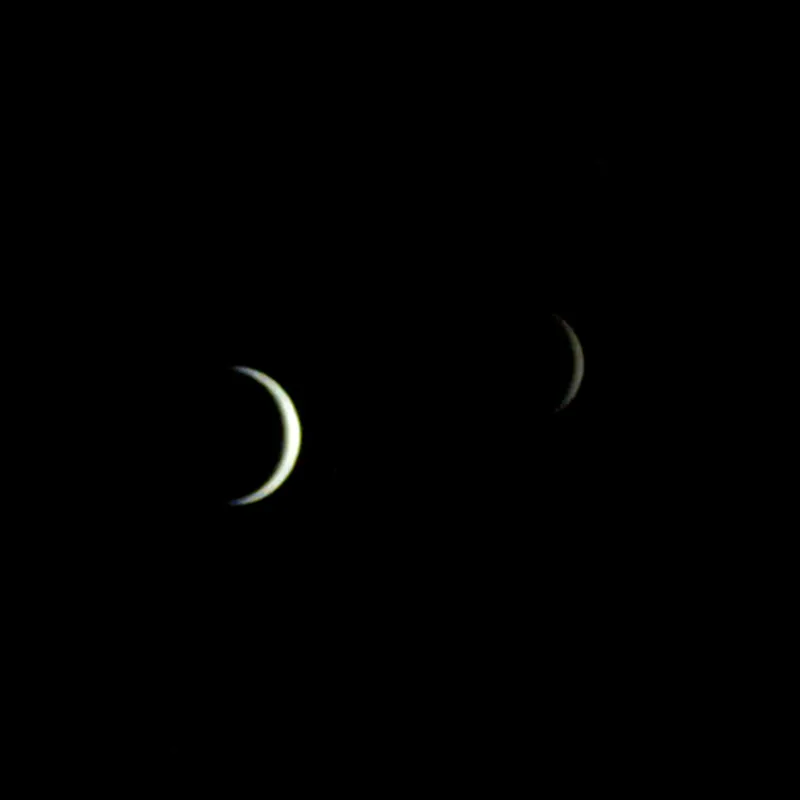
On July 3, NASA’s two Mars-destined ESCAPADE spacecraft captured photos of Earth and the Moon in visible and thermal infrared light using the Visible and Infrared Observation System cameras provided by Northern Arizona University. The images serve as a calibration check before an Earth gravity assist in November 2026 and Mars arrival in September 2027.
On July 3, one of NASA’s two Mars-destined ESCAPADE spacecraft used its visible and thermal infrared cameras to snap a “family portrait” of Earth and the Moon. The moment matters because ESCAPADE is not just collecting pretty space pictures, it is verifying that its eyes can correctly measure what matters for its Mars mission. At the time of the photo, the spacecraft was 363,250 miles (584,600 kilometers) from Earth and 115,600 miles (186,100 kilometers) from the Moon, letting the Moon appear relatively large in the frame. With the Sun only partly illuminating Earth and the Moon, the visible-light image shows both bodies as crescents with only around 8% of each face sunlit. Then the plot twist: in the thermal infrared image, the shadowed hemisphere of Earth is lit up by Earth’s own heat, glowing at minus 10 to minus 44 degrees Fahrenheit (250 to 280 kelvins). The Moon, by contrast, stays much cooler at around minus 280 degrees Fahrenheit (100 kelvins), especially on its far side.
If that sounds like a simple imaging test, that is exactly the point. NASA says imaging Earth and the Moon are well-known targets, and that these pictures provide an important calibration check for ESCAPADE’s cameras. In a quote from the mission’s principal investigator, Rob Lillis of the University of California, Berkeley, NASA said ESCAPADE is thrilled it could accommodate the “space-qualified cameras” that will search for visible Martian aurora and investigate thermal properties of the Martian surface and atmosphere. Translation for non-space brains: before the spacecraft heads into the messy unknown, it needs to prove that it can interpret both reflected sunlight (visible light) and self-emitted energy (thermal infrared). ESCAPADE’s cameras doing that on Earth and the Moon is the dry run.
Zoom out and the timing looks like good engineering discipline. ESCAPADE is currently in a “loiter” orbit around Lagrange point 2, a location in space about a million miles from Earth. This gives it time to operate and validate systems in the lead-up to its big move. In November 2026, the spacecraft will fly by Earth to use the planet’s gravity to slingshot toward Mars. Then, when the spacecraft arrive in September 2027, they will study how solar wind, a stream of material flowing from the Sun at about a million miles per hour, interacts with the Martian environment and how that drives atmospheric loss at the Red Planet. The calibration work on July 3 plugs directly into that mission goal, because you cannot confidently measure Mars thermal behavior or aurora signatures if the instrument response is off.
Now consider the specific imaging method. NASA describes the Visible and Infrared Observation System cameras as the source of the photos, provided by Northern Arizona University in Flagstaff. Those cameras are capturing both visible light reflected by the Sun and thermal infrared “emitted energy” from the bodies. The visible image emphasizes geometry, the crescent phases where only about 8% of each face is sunlit. The infrared image emphasizes thermophysics, Earth’s atmosphere and surface insulating and holding heat in the shadowed hemisphere, while the Moon’s far side, without oceans and atmospheres, remains much colder. NASA even notes that white rings were added in the thermal image to show the actual size of Earth and the Moon, underlining how the team is thinking in measurement terms, not just aesthetics.
This is where the bigger decision-maker angle kicks in. ESCAPADE sits inside NASA’s Heliophysics Division and is part of the NASA Small Innovative Missions for Planetary Exploration program. That matters because “small innovative” missions live and die by instrument readiness and schedule integrity. Boards, investors, and partners watching these programs typically care less about the beauty of the images and more about whether the system behaves predictably when it counts. Here, the “counts” are both scientific and operational. Scientific, because the mission will look for visible Martian aurora and investigate Martian thermal properties. Operational, because the spacecraft has to transition from loiter operations to an Earth gravity assist in November 2026 and then into Mars encounter science by September 2027.
The stakeholder map is also unusually clear. NASA says the UC Berkeley’s Space Sciences Laboratory leads the mission, with key partners including Rocket Lab, NASA’s Goddard Space Flight Center in Greenbelt, Maryland, Embry-Riddle Aeronautical University, Advanced Space, and Blue Origin. Rocket Lab built the ESCAPADE spacecraft. For operators and executives, that partner web is a supply-chain and accountability story: cameras from Northern Arizona University, spacecraft construction from Rocket Lab, integration and support across NASA centers and universities, and mission leadership from Berkeley. A calibration check that works is not glamorous, but it reduces the likelihood of expensive ambiguity later, when you cannot go back and rerun the physics.
Finally, the second-order implication for peers in similar roles: if ESCAPADE’s cameras can correctly capture the visible crescent geometry and the thermal contrast between Earth’s heated shadowed hemisphere and the Moon’s much colder far side, it strengthens confidence that the instruments will interpret Mars reality instead of instrument bias. That is the kind of evidence that can calm down a project at the management level, and it can sharpen confidence at the board level when timelines tighten. ESCAPADE’s July 3 images are therefore less like a postcard and more like a receipt, proving that the mission’s measurement toolkit is ready for the solar wind and atmospheric-loss questions awaiting it in September 2027.
This story's Key Insights and Take-aways are locked.
Create a free account to unlock Executive Actions for one credit.
Register to UnlockAlways free for Executives Club members. Join the Club
More in Science

ZWO’s Seestar S30 Pro stacks 10-second shots into 8.3MP deep-sky images from light pollution
A smartphone-controlled 3.6-lb smart telescope ships the hard part to software, plus an EQ mode upgrade path.

Scientists reverse disease-linked compound buildup, offering a credible path to tissue rejuvenation
A new enzyme approach targets the accumulation behind age-related diseases, raising real questions for regulators, investors, and boards.

Alive biodegradable textiles can host engineered microbes to change color and add UV protection
A new living-material approach could reshape how brands think about color, protection, and biodegradability in apparel.