

JWST spots XLSSC 122 at cosmic noon, setting the strong-lensing distance record
A galaxy cluster seen just 3.4 billion years after the Big Bang could force a rethink of early structure formation.
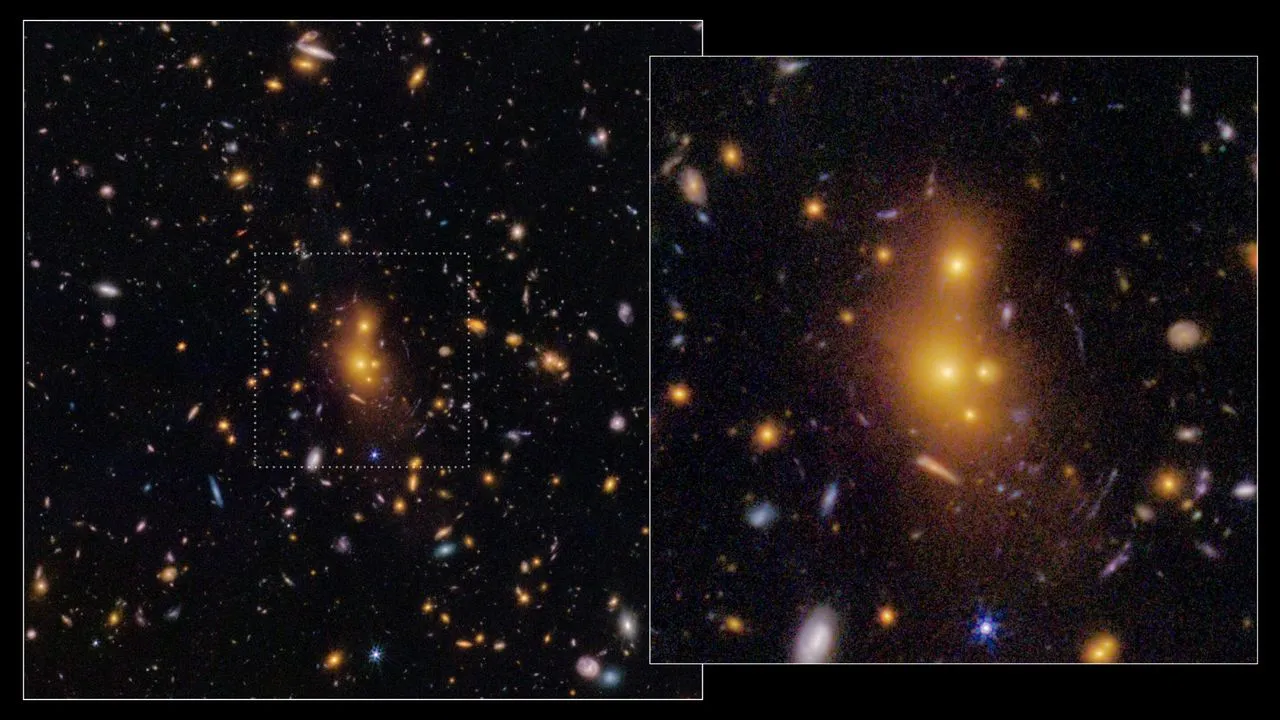
The James Webb Space Telescope has detected XLSSC 122, a massive, densely packed galaxy cluster at “cosmic noon,” showing strong gravitational lensing at record distance. The discovery, led by Caltech/IPAC team leader Kyle Finner, may reshape cosmology models and improve measurements of dark matter distribution.
The James Webb Space Telescope has just set a brand-new distance record for a “strong gravitational lens” galaxy cluster: XLSSC 122. The catch is how early the universe was doing this. XLSSC 122 is seen as it existed about 10.4 billion years ago, roughly 3.4 billion years after the Big Bang, a period when such highly evolved, massive structures were previously thought to have only just begun assembling.
When the team first got JWST images back, they immediately flagged something unusual: “wow, look at this, there’s strong lensing coming from this cluster!” Kyle Finner of the California Institute of Technology, team leader, said in a statement that XLSSC 122 now holds the record for the most distant galaxy cluster displaying strong lensing. That matters because strong lensing is not just a cool visual trick. It turns space into a natural telescope, amplifying light from even more distant galaxies so astronomers can study objects that would otherwise be too faint or blurred.
Here’s what XLSSC 122 is, and why it jumped out so fast. Designated XLSSC 122 and first seen in 2014, the cluster resembled galaxy clusters found much closer to the Milky Way. But JWST reveals it in an earlier cosmic era than those familiar nearby examples. The reported geometry is also key: XLSSC 122 is acting as a gravitational lens and is aligned with even more distant galaxies, amplifying their light and making those background targets easier to observe. In other words, the universe is doing both the heavy lifting and the focus knob.
To unpack why lensing is so powerful, you have to go back to Albert Einstein’s general relativity. In that framework, objects with mass warp the fabric of space and time. The “rubber sheet” analogy helps: place a heavy bowling ball on a stretched sheet and everything around it curves. Gravity is the curvature, and light follows the warped spacetime track. So when a massive object like XLSSC 122 sits between Earth and a more distant light source, the light doesn’t take a straight line. It swerves around the lensing mass. The paths can effectively differ in length and geometry, which is why light can arrive with different characteristics depending on how it traveled.
The result is a concrete observational win: gravitational lensing magnifies light from background sources and distorts them in a way that can be decoded. The source notes that the JWST team has used this effect “to great effect” in studying ancient galaxies. It also notes a capability gap with the Hubble Space Telescope: when Hubble previously studied XLSSC 122, it wasn’t able to capture images showing it was a strong gravitational lens. JWST’s observing power was what made the strong lensing evident, and this is part of the reason JWST-era discoveries can feel like step-changes rather than incremental improvements.
Now the second-order part, the part executives should care about even if they do not personally track astrophysics: lensing is a measurement tool for something that is otherwise invisible. Dark matter, the source explains, doesn’t interact with light, making it effectively invisible to direct imaging. But it does interact with gravity. In galaxy clusters like XLSSC 122, dark matter outweighs ordinary matter, with a ratio of five to one. That heavy gravitational presence dominates the lensing effect. So gravitational lensing becomes a way to infer dark matter’s distribution without “actually seeing the dark matter.”
This is where the stakes get bigger than a single object. The paper and presentation described in the source frame strong lensing as a way to test cosmological models by measuring dark matter. Finner is quoted saying: “Strong lensing is a way to measure the dark matter without actually seeing the dark matter. It gives us a sensitive probe of our cosmological models.” He adds that it is “still early in the JWST era,” and the path forward is scaling up: if astronomers can get data on tens or hundreds of lensing objects at this stage in the universe, they can more aggressively stress-test those models.
For decision-makers in adjacent spaces like research funding, science instrumentation, and data infrastructure, the business reality is simple: this kind of capability creates a new pipeline. Once you prove a method works at record distance and early cosmic time, the next question becomes throughput, not one-off wonder. The hunt for more lensing clusters like XLSSC 122 is now on. If similar objects are found so early in the universe’s history, the source warns that a “major revision of cosmology may be on the cards.” That doesn’t mean the universe is about to change tomorrow. It means the underlying assumptions that let scientists describe how structures grow may face tougher constraints when better observations arrive.
Finally, credibility markers: the team’s results were presented on June 17, 2026, at the 248th meeting of the American Astronomical Society. The research is available as a paper published in The Astrophysical Journal Letters. The message for anyone tracking how evidence tightens: JWST is not merely collecting prettier pictures. It is finding early, highly evolved structures that challenge expectations, and it is doing it in a way that turns dark matter from a guess into a measurable signal.
This story's Key Insights and Take-aways are locked.
Create a free account to unlock Executive Actions for one credit.
Register to UnlockAlways free for Executives Club members. Join the Club
More in Science

Alaska's 1,580-foot tsunami had warning signs. Scientists just found them.
Rapid glacier retreat, heavy rainfall, and thousands of tiny tremors preceded Alaska's 1,580-foot tsunami, a warning for every coastal community in a warming world.

The rare mutation that lets high-risk brains dodge Alzheimer's
Scientists found a natural defense against protein buildup, opening a new path to preventive treatments.

3,000 steps a day may halve Alzheimer's decline, study finds
New research links a modest daily walk to less tau buildup and nearly half the cognitive and functional decline, even for those with early signs.