

Mark Lamb survives Arizona House primary after nearly $2M Keenan push on sex scandal claims
In Arizona's deep-red 5th District, Trump-backed Mark Lamb denied allegations and fended off Daniel Keenan's money-heavy attack.
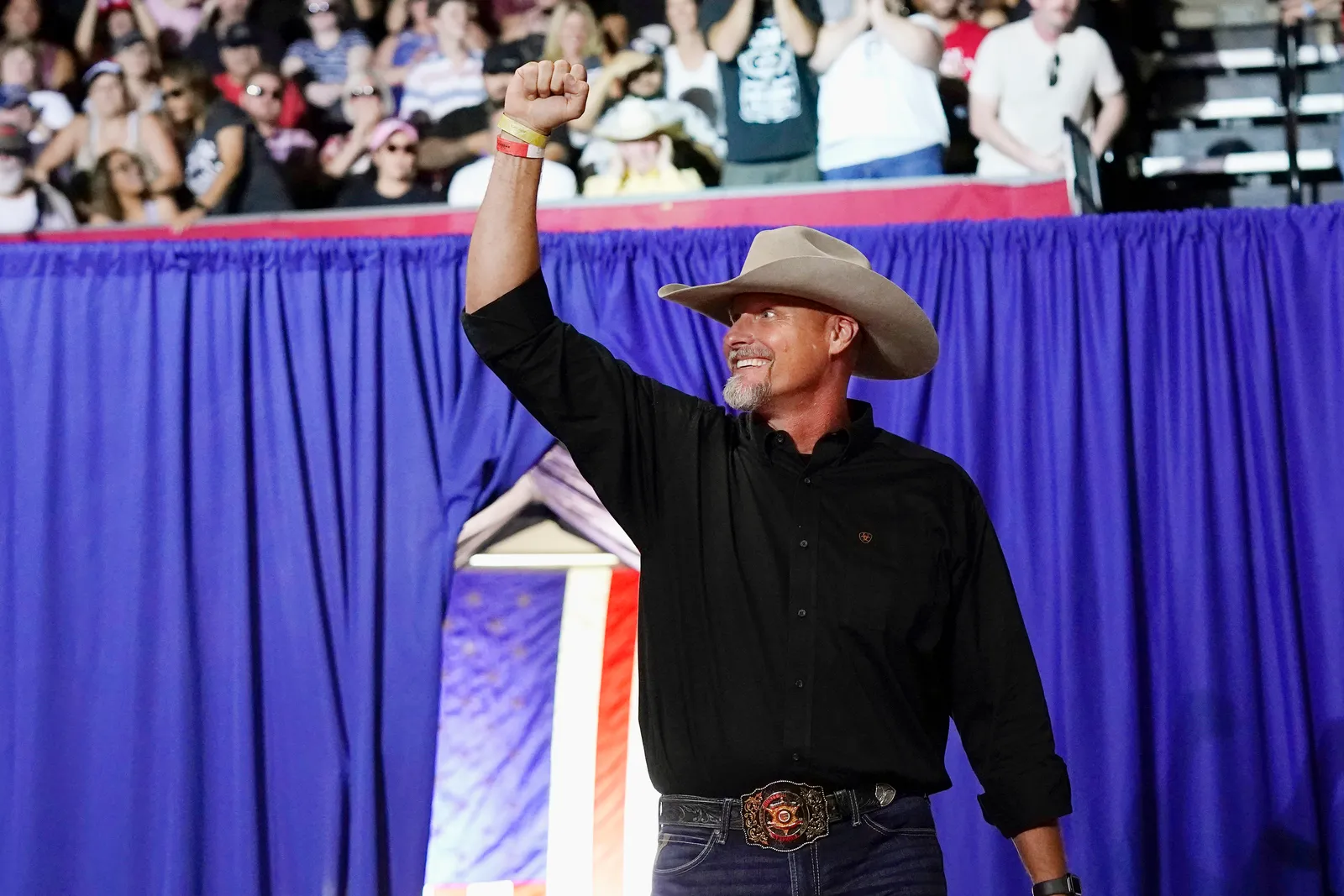
Mark Lamb, the former Pinal County sheriff, won Arizona's 5th District House primary Tuesday despite allegations of sexual misconduct and abuse of power that he denied. The result tees up Lamb for November to replace Rep. Andy Biggs (R-Ariz.), and it spotlights how GOP primary voters respond to scandals when a president backs the candidate.
Mark Lamb won Arizona’s 5th District House primary Tuesday after fending off a late, self-funded challenge from Republican rival Daniel Keenan, who poured nearly $2 million of his own cash into making Lamb’s alleged sexual misconduct and abuse-of-power central to the race. Lamb will now enter November as the heavy frontrunner in the deep-red Phoenix-area district to replace Rep. Andy Biggs (R-Ariz.), who is running for governor.
The primary outcome is the headline: Lamb survived the attempt to drag the scandal into the center of the vote, and he did it while relying on President Donald Trump’s endorsement. The sources say Keenan tried to use the allegations as the defining political fight in the contest. Lamb denied the allegations, and his campaign, bolstered by Trump and Arizona-based Turning Point USA, managed to ward off the attacks. Trump reinforced his endorsement in mid-July, even as Keenan tried to keep the claims fresh.
For executives and investors watching politics like it moves markets, the important part is not gossip. It is the mechanism. This race illustrates how endorsement-driven coalition building in a dominant-party primary can overpower reputational risk, at least with the subset of voters who actually decide crowded GOP nomination fights. The story notes that Lamb’s win “reveals the strength of Trump’s endorsement,” and it frames this as part of a broader pattern: GOP primary voters have shown willingness to accept scandal-ridden candidates when they are favored by the president.
That dynamic matters beyond one district because the personnel pipeline in American politics often starts in primaries, not generals. Lamb’s victory positions him to take on the practical realities of lawmaking from a district already tilted hard toward Republicans. In that environment, the cost of controversy can fall compared to the upside of being the preferred nominee of the party’s most influential brand leader. Keenan’s approach, according to the source, was straightforward and expensive: self-funding at nearly $2 million to push the allegations hardest and force voters to answer a single question, “Do we reward the scandal?” Lamb’s win suggests that question may not have landed with the decisive slice of primary voters.
The allegations themselves are specific and wide-ranging, which is part of why this is more than a generic “campaign mudfight.” In May, the Arizona Republic launched a multi-part investigation alleging that Lamb engaged in a yearslong pattern of sending sexual images and instigating intimate encounters between him, his wife, and others. One woman involved, Jillian Stannard, accused Lamb of encouraging her husband to have sex with other women, including Lamb’s wife. She also alleged that Lamb threatened her by telling her there would be consequences when Stannard raised concerns to religious leaders. Screenshots the Republic obtained of messages with another woman, Tammy Peacock, suggested Lamb, then a sitting county sheriff, threatened to leverage Arizona’s revenge porn law against her.
Lamb’s side disputes the framing and the underlying claims. In a statement last week, Lamb spokesperson Ed Morabito told POLITICO that “these allegations are false and come from long-discredited political opponents.” In other words, the campaign did not treat the investigation and its allegations as a “soft landing” situation. It treated them as an organized partisan attack. That distinction can matter in primary contests, where voters may be more likely to sort information through their existing political identity than through forensic detail.
The background also helps explain why Lamb had resilience. The source describes Lamb as a former Pinal County sheriff who served until 2024, and it says he earned national notoriety as a gun-toting critic of the Biden administration’s immigration and border policy. That gives him a specific audience and a pre-established media profile, not just the normal incumbency halo. The source also says Lamb secured Trump’s backing for the 5th District contest last year, and that he was bolstered by Turning Point USA, which is aligned with a particular style of conservative mobilization. When a candidate already has a known political brand, the opposition has to overcome not only allegations, but also the candidate’s “category lock-in” with voters who see the president’s endorsement as a proxy for credibility.
Second-order implications for decision-makers are not confined to politics. For board members, operators, and anyone who sits near governance risk, the takeaway is about how reputational crises are adjudicated when incentives are aligned. Primary voters are not choosing between two policy platforms in the same way they would in a general election. They are selecting a standard-bearer under pressure, and the winning credential in this case was not scandal clearance. It was Trump’s endorsement and the coalition infrastructure around it, paired with a denial strategy that labeled opponents as “long-discredited.”
The strategic stakes are immediate for Lamb and his allies, but also for peers navigating high-scrutiny environments. The source signals that no significant endorsements were lost after the scandals, and Trump reinforced his endorsement in mid-July. If that pattern holds in other races, it becomes a warning for anyone assuming scandal automatically forces a retreat. In a system where party leaders can reframe risk as part of the expected political fight, the “who has the biggest brand multiplier” may matter as much as the allegations themselves. For ambitious politicians, campaign strategists, and organizations with political exposure, this is the new reality: in the loudest primaries, money can spotlight claims, but endorsement can decide whether voters care.
This story's Key Insights and Take-aways are locked.
Create a free account to unlock Executive Actions for one credit.
Register to UnlockAlways free for Executives Club members. Join the Club
More in Politics

LA County: DOJ's 20,000 'noncitizen' voter list is 'unreliable,' includes U.S.-born
Preliminary review by Los Angeles County election officials finds errors in the federal list, raising the stakes for voter roll integrity ahead of November.

Trump's $1.5B Pentagon chip investment lands in North Carolina
A $1.5 billion defense infusion for North Carolina chipmaking signals a new era of Pentagon-backed reshoring - here's what it means for the industry.

Nigeria confirms first Ebola case in Abuja, a woman just off a Uganda flight
Health Minister Muhammad Ali Pate says the patient flew in from Uganda, putting Africa's latest outbreak on Nigeria's doorstep.