
MAVEN’s aurora study proves a Dungey-cycle happens on Mars, via crustal mini-magnetospheres
Nature Communications backs a long-suspected mechanism, showing Mars lights up through an Earth-like process on smaller scales.
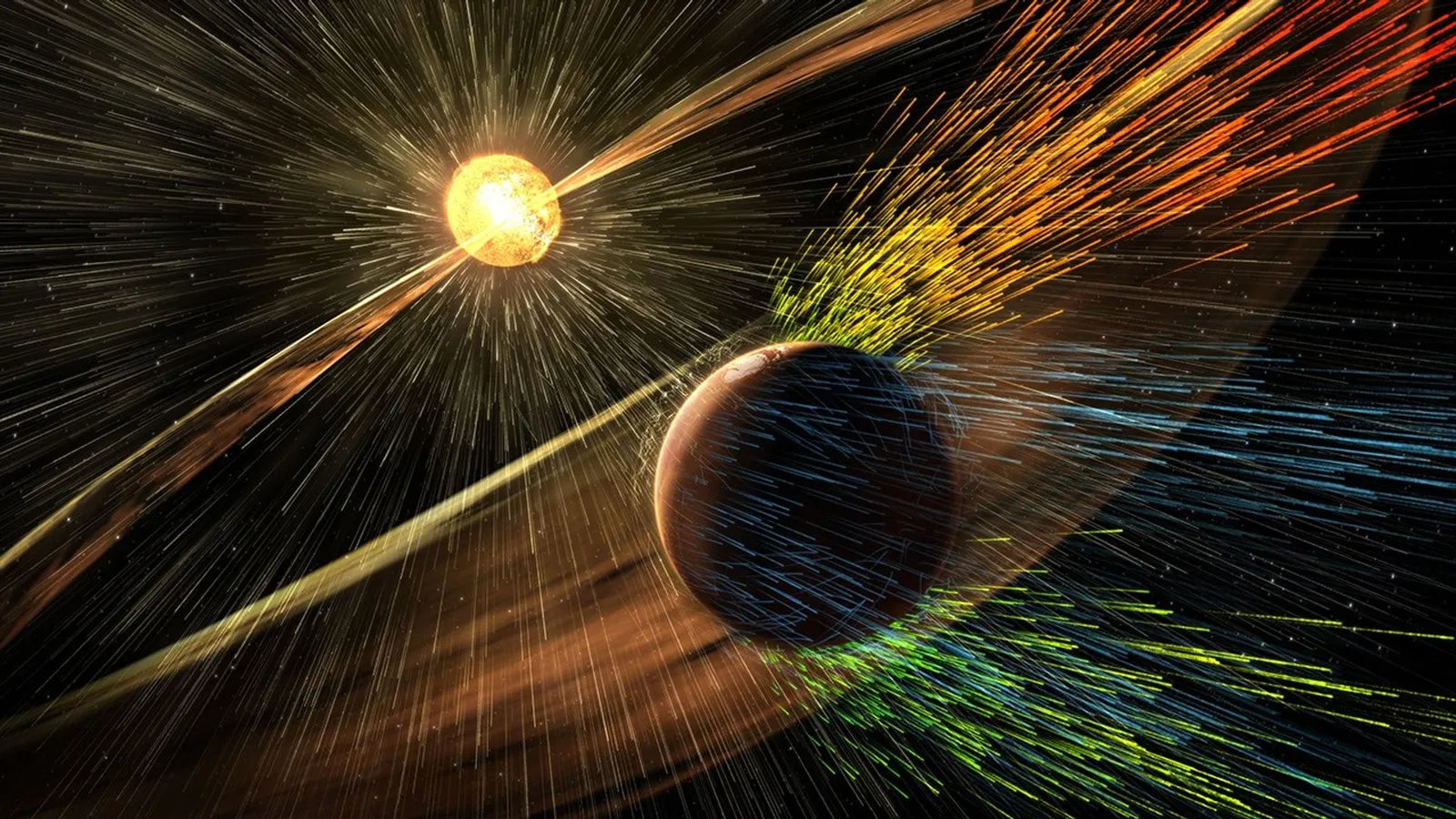
NASA’s MAVEN mission scientists, publishing results Thursday in Nature Communications, found evidence that a Dungey-cycle-like mechanism drives certain Martian auroras. The finding reshapes how mission planners understand Mars' space environment and why future robotic and crewed missions will face different-but-related physics.
Mars auroras just got a lot more legible. A new NASA MAVEN study, published Thursday in Nature Communications, says certain auroras on the Red Planet form through the same kind of mechanism that powers Earth’s auroras, specifically a Dungey-cycle-like process. The key twist is scale and setting: on Mars, the “mini” version runs over strong crustal magnetic fields because Mars lacks Earth’s global magnetic shield.
That difference matters because MAVEN did not just observe lights in the sky. The research connects how charged particles get energized and routed, using instruments aboard the spacecraft to piece together the physics behind localized auroras. The study used the Magnetometer and Solar Wind Electron Analyzer to determine magnetic configuration and derive electrical currents, plus the STATIC (Suprathermal and Thermal Ion Composition) instrument to measure plasma flows in the ionosphere. As lead author Shaosui Xu, an associate research physicist at the Space Sciences Laboratory at the University of California, Berkeley, put it, scientists knew magnetic reconnection was happening at Mars but did not expect it to be like the Dungey cycle.
To understand why this is a “puzzle piece,” you have to know what the Dungey cycle is supposed to do on Earth. When the Sun’s magnetic field lines get close to Earth’s magnetosphere, the large magnetic bubble protecting the planet, they can reconnect and inject energy and mass throughout Earth’s magnetosphere and magnetotail. Electrons then get fired back into Earth’s atmosphere to generate auroras. This process drives electrical currents, accelerates charged particles that create auroras, and controls the circulation of plasma in Earth’s magnetosphere and ionosphere.
Mars starts from a very different magnetic baseline. Earth’s magnetic field is created by our planet’s churning core. Mars does not have a global magnetic field like Earth; instead, it has numerous miniature magnetospheres arising from intensely magnetized crust scattered around the planet. Those regions formed around 4 billion years ago when lava cooled in the presence of Mars’ ancient global magnetic field, which has since disappeared due to intense solar wind stripping the planet’s atmosphere. MAVEN has observed highly localized auroras over these crustal fields, similar to Earth’s auroras at the poles, but the missing piece was how the electrons were being energized to make the auroras happen.
This is where the new evidence earns its headline. The study shows a miniature version of the Dungey cycle happening over Mars’ strong crustal magnetic fields. That provides a better look into the physics of Martian auroras and, crucially for planners, reinforces that similar reconnection-driven processes can operate across multiple scales in the solar system. In other words, Mars may not have Earth’s planet-scale magnetosphere, but the underlying electromagnetic choreography is still there, just redistributed across many smaller magnetic islands.
The mission context also adds urgency. MAVEN experienced a loss of signal with ground stations on Earth on Dec. 6, 2025, and on June 3 NASA declared the mission had concluded after finding the spacecraft to be unrecoverable. Even so, data from the mission is still being used to inform NASA science and future missions to Mars. This matters because it turns a painful operational endpoint into a prolonged scientific runway. When spacecraft lifespans end, the question is what you can still extract, and MAVEN’s answer is: enough to change how scientists model auroras and charged-particle behavior around Mars.
NASA’s principal investigator on MAVEN, Shannon Curry, a research scientist at the Laboratory for Atmospheric and Space Physics at the University of Colorado Boulder, called the result “a remarkable result that changes how we think of Martian auroras” and said it is an important step toward understanding why Mars and Earth have evolved so differently despite being governed by the same underlying physics. Curry also noted that uncovering more about the process helps scientists understand how the solar environment interacts with the Red Planet as a whole, which is essential for future robotic and crewed missions.
For executives and board-level thinkers, the business-relevant angle is straightforward: space weather and charged-particle environments are not just scientific trivia. They are part of the risk and reliability picture that mission architectures have to respect, from spacecraft operations to surface and human exposure planning. MAVEN’s findings do not replace engineering work, but they improve the physical models that inform how teams anticipate what the Sun, Mars, and the local magnetic landscape will do to charged particles. And if reconnection-driven cycles can occur on both large and small scales, then “where” and “how” those processes show up in different planetary magnetic environments becomes a design input, not an afterthought.
At the center of this study is a chain of measurement. The Magnetometer and Solar Wind Electron Analyzer help define the magnetic configuration and electrical currents, while STATIC pushes toward the limits to measure plasma flows in the ionosphere. Xu called it “the final piece to the puzzle” in understanding these localized auroras. Set against the broader MAVEN mission’s legacy, the new publication underscores how incremental instrument-level insights can unlock system-level understanding, even after a spacecraft reaches the end of its operational life.
This story's Key Insights and Take-aways are locked.
Create a free account to unlock Executive Actions for one credit.
Register to UnlockAlways free for Executives Club members. Join the Club
More in Science

Alaska's 1,580-foot tsunami had warning signs. Scientists just found them.
Rapid glacier retreat, heavy rainfall, and thousands of tiny tremors preceded Alaska's 1,580-foot tsunami, a warning for every coastal community in a warming world.

The rare mutation that lets high-risk brains dodge Alzheimer's
Scientists found a natural defense against protein buildup, opening a new path to preventive treatments.

3,000 steps a day may halve Alzheimer's decline, study finds
New research links a modest daily walk to less tau buildup and nearly half the cognitive and functional decline, even for those with early signs.