
McConnell hospitalization leaves Senate defense subcommittee tied 14-14, imperiling $350B Iran funding
Two missing Republican senators collide with an election deadline, forcing Republicans to bet on reconciliation they may not win.
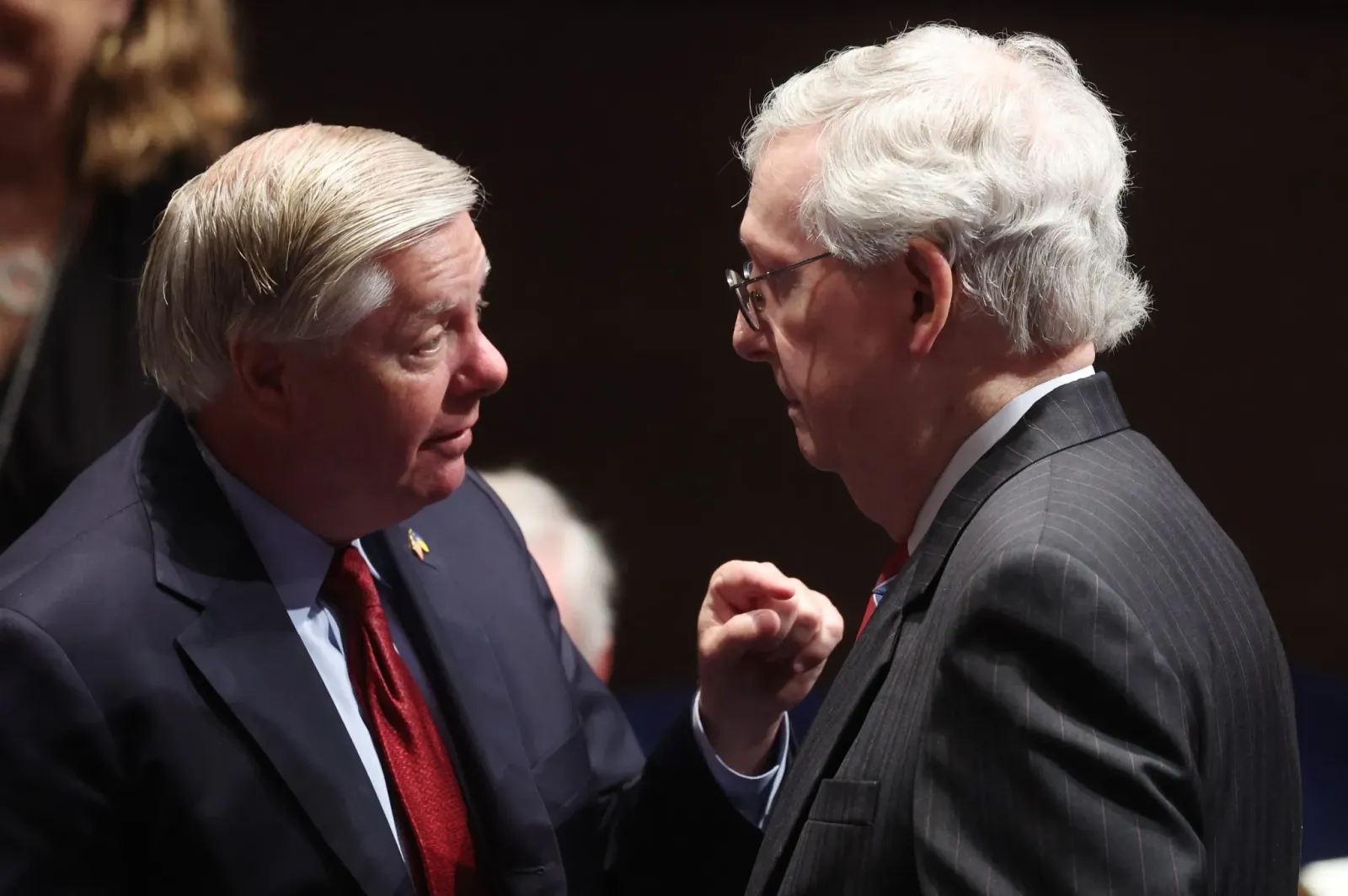
Sen. Mitch McConnell said he was hospitalized after a fall and treated for pneumonia, leaving him absent as the chair of the Senate Appropriations defense subcommittee. With the administration seeking an additional $350 billion for Iran-related defense needs, the absence helps create a 14-14 committee split and raises doubts about Republicans advancing defense appropriations.
Senate Republicans just got dealt a problem they cannot easily whip into shape. Sen. Mitch McConnell announced he was hospitalized after a fall and treated for pneumonia, and his continuing absence leaves a critical Senate Appropriations defense subcommittee with a 14-14 split between Republicans and Democrats, making a defense appropriations bill unlikely to reach the Senate floor.
That timing matters because the Trump administration has asked Congress for an additional $350 billion in defense funds amid the reignited Iran war. McConnell is the chair of that subcommittee, which drafts legislation for Pentagon funding, so when the chair is off the board, the mechanics of moving money slow down at exactly the moment lawmakers are trying to accelerate.
The immediate legislative bottleneck is made worse by the fact that two Senate Republicans are missing, not just one. The situation followed the unexpected death of Sen. Lindsey Graham after an aorta rupture. Graham served as a senior member of the Senate Appropriations Committee and chaired the Budget Committee. His sister, Darline Graham Nordone, will take his place in the Senate on Wednesday and serve the rest of his term, which eliminates some uncertainty around Graham's absence. But McConnell’s hospitalization is still an active operational disruption, and that is the part that can keep defense dollars from turning into legislation.
Zoom out for a second, because the stakes are not abstract. The Senate Appropriations Committee has not passed a spending bill for the 2027 fiscal year, including a $1.15 trillion base for defense outlays. The administration’s broader target is a $1.5 trillion defense budget, so it wants both the baseline increases and additional supplemental funding to respond to the Iran conflict. The supplemental ask is the $350 billion package, and the administration wants Congress to pass it through the reconciliation process.
Reconciliation is supposed to be the cheat code. It can bypass a Senate filibuster, requiring a simple majority of 51 votes to pass, instead of the traditional 60-vote supermajority. In plain English: it is a path that reduces the number of votes needed to get legislation to the finish line, which is especially tempting in a politically tight environment. But the source of friction here is that reconciliation only helps if you can actually assemble the coalition and keep legislative momentum while the rest of the calendar and committee process cooperate.
That friction is exactly what Peter McLaughlin, a political science professor at the University of Rhode Island, described as “a very tricky situation.” He pointed to upcoming midterm elections, disagreement within the party over the Iran war, and a big funding package that will require “pretty much partisan unity” on the Republican side. Meanwhile, the legislative calendar is working against speed. There are fewer than 30 scheduled sessions between now and the midterms, and an August recess eliminates an entire month of time in Washington. Legislators are also racing against a Sept. 30 deadline at the end of the fiscal year, when funding lapses. They could postpone the deadline with a continuing resolution (CR), but that raises the risk of shifting votes to after the midterms, which could allow Democrats to regain control of the Senate.
Then there is the war math that keeps pushing urgency upstream into Congress. The Iran war has already, by some estimations, cost the U.S. $113 billion, and some policy experts expect the total cost to be north of $1 trillion. With the U.S. and Iran launching renewed strikes against each other, the administration’s motivation to fund restoring munitions is even stronger because munitions have been slashed by more than half since the beginning of the conflict. When money moves slowly during a replenishment window, the second-order impact is felt on readiness, procurement timing, and the ability to sustain supply chains and contract cycles. Even if the request is “just” legislative, the practical output is how fast the Pentagon can replace what is being used.
Now to the governance and process angle, where McConnell’s absence becomes more than a personal headline. Without McConnell present on the Senate Appropriations defense subcommittee, Katherine Thompson of the Cato Institute, and a former Pentagon official in the Trump administration, said the 14-14 split makes it unlikely a defense appropriations bill can pass the panel and reach the Senate floor. She also argued that the situation reflects both Congress not moving expeditiously given limited working days they imposed on themselves, and the administration’s legislative strategy of requesting funding in the first place. Put differently: reconciliation may reduce one procedural barrier, but it does not solve committee arithmetic, scheduling constraints, and election-driven incentives.
Thompson also argued that Senate Republicans have a narrow range of options to buy time. Senate Majority Leader John Thune could cancel the August recess, a move she said would reflect well on the Republican party. She further predicted that the Senate will not pass the defense bill prior to the summer break and that Republicans and the Trump administration will not succeed in winning the supplemental funding for the Iran war. Her deeper critique targets the strategy sequence: while the “One Big Beautiful Bill Act” reconciliation package signed last year was a victory for the party, the subsequent immigration enforcement reconciliation package passed last month was asked to be reworked to comply with Senate rules requiring it be strictly budget-centric. Her point, grounded in the source, is that each time reconciliation has to thread tight Senate rule constraints, the margin for error shrinks.
For decision-makers and board-level leaders watching this from the outside, the second-order signal is simple: even when a government asks for large defense sums like $350 billion, the ability to turn requests into appropriations depends on a functioning internal legislative machine. Missing leadership at the subcommittee level, a tied committee, a fast-approaching Sept. 30 deadline, and an election calendar that punishes delays can all combine to shift outcomes from “intent” to “implementation.” And for companies and investors tied to defense procurement cycles, the difference between an early supplemental and a post-election scramble can determine who gets contracts on time, who renegotiates, and who waits.
This story's Key Insights and Take-aways are locked.
Create a free account to unlock Executive Actions for one credit.
Register to UnlockAlways free for Executives Club members. Join the Club
More in Politics

LA County: DOJ's 20,000 'noncitizen' voter list is 'unreliable,' includes U.S.-born
Preliminary review by Los Angeles County election officials finds errors in the federal list, raising the stakes for voter roll integrity ahead of November.
Trump's $1.5B Pentagon chip investment lands in North Carolina
A $1.5 billion defense infusion for North Carolina chipmaking signals a new era of Pentagon-backed reshoring - here's what it means for the industry.

Nigeria confirms first Ebola case in Abuja, a woman just off a Uganda flight
Health Minister Muhammad Ali Pate says the patient flew in from Uganda, putting Africa's latest outbreak on Nigeria's doorstep.