

Mice survive 22,110 feet on frozen volcanoes by eating toxic plants
A July 9 Science study maps the genetic and physiological hacks that let Andean leaf-eared mice thrive where humans cannot.
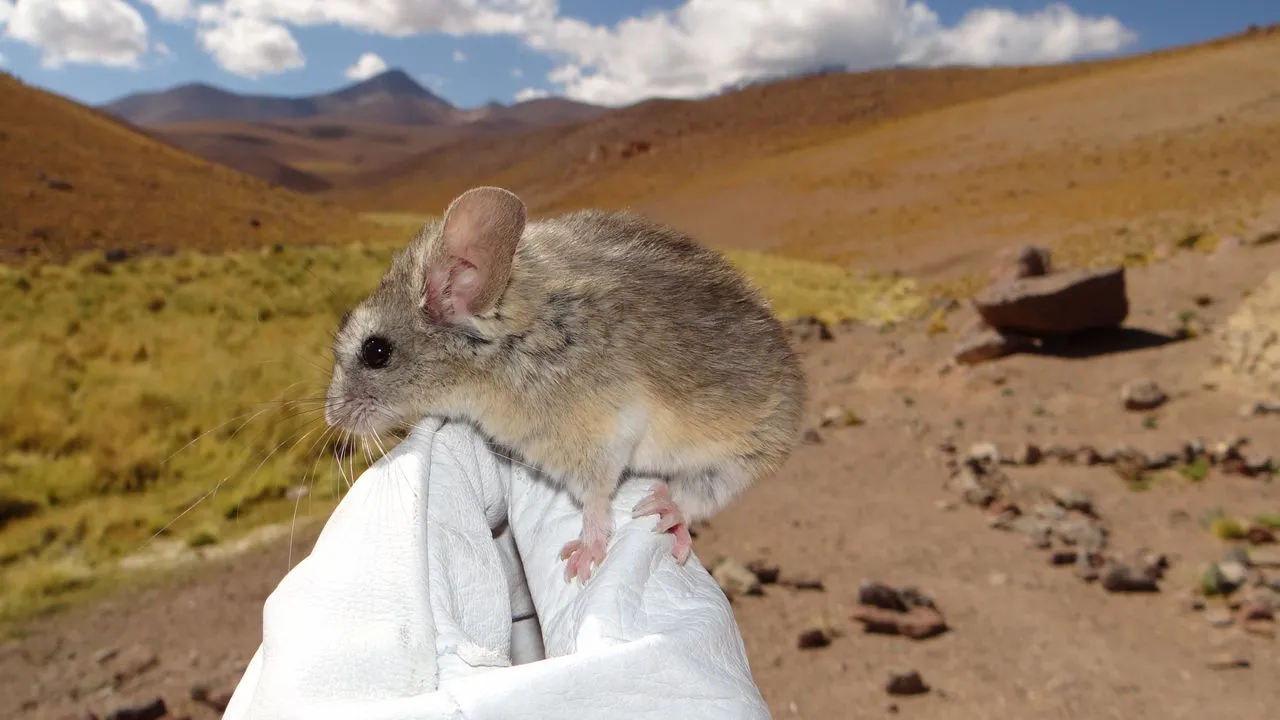
Jay Storz of the University of Nebraska-Lincoln and co-authors in a July 9 Science study explain how Andean leaf-eared mice (Phyllotis vaccarum) survive at record altitude. They do it with evolved mechanisms including detoxifying plants that would be harmful at these heights, plus adaptations for cold and oxygen stress.
If you’ve ever looked at a map and thought “humans live way too high already,” a new Science study just moved the goalposts. Andean leaf-eared mice (Phyllotis vaccarum) have been recorded at 22,110 feet (6,739 meters) on Llullaillaco, the world’s highest historically active volcano (now dormant), on the border between Argentina and Chile. The mind-blowing part is not that they survive. It’s that they survive with a full menu of functioning biology in conditions described as “not remotely compatible with long-term human survival.”
Jay Storz, a professor of biological sciences at the University of Nebraska-Lincoln, led the work that began with a high-risk field push in 2020. His mountaineering team recorded the mice at that 22,110-foot record altitude, and the new paper, published July 9 in Science, digs into the “how.” The headline mechanism is stark: these mice can eat plants that would normally be toxic, an adaptation tied to gene changes that help them digest and detoxify harmful foods in a landscape where vegetation and water are scarce.
This is also the kind of biological result that forces a rethink of what “limits” actually mean. Before the high-altitude mice were discovered, researchers assumed mammals could only survive up to around 18,000 feet (5,500 m) above sea level. The mice not only beat that earlier ceiling, but do it across a broad elevational range, from sea level along the desert coastline of northern Chile up to the summits of some of the Andes’ highest peaks. Storz called out that broad range as a key feature: the same species is dealing with radically different environments, which is exactly the setup where evolution has room to improvise.
To separate “cool observation” from “real mechanism,” the team studied mice at low, middle, and high altitudes between 2020 and 2023. The study wasn’t a lab-only affair. It combined mountain climbing and animal surveying techniques: Storz and collaborators ascended the mountains and set traps to catch and record mice. From there, they sent specimens to labs in Chile for physiological testing in small chambers, measuring adaptations to extreme cold and oxygen deprivation. They also sequenced the Andean leaf-eared mouse genome, looking for genetic signatures of local adaptation across elevations.
The results break into a few coherent biological themes. First, the high-elevation mice were better at maintaining body heat and oxygen levels than mice from lower altitudes, according to a statement released by the University of Nebraska-Lincoln. Second, and most relevant to that “toxic plants” hook, another gene adaptation enabled the high-altitude mice to digest food and detoxify plants that would otherwise be harmful to them, per a statement released by McMaster University in Canada. In plain English: at those sparsely vegetated volcanoes, the mice can’t afford to be picky. They’ve evolved a way to turn toxic plants into usable calories.
Third, behavior appears to adjust to the environment. The researchers found the high-altitude mice were much more active during the daytime, perhaps because predators are less of a factor and because those hours can be warmer. And even with all those local adaptations, the mice were still genetically similar across their elevation range. The study reports that mouse populations overlapped, preventing high-altitude individuals from becoming isolated and especially distinct from their low-altitude kin.
There’s also a blunt reality behind the science: to fully understand biology at this level, the researchers needed tissue-level study. That meant euthanizing some mice and preserving “voucher” specimens for museum archives. According to the study, the team collected 167 voucher specimens. Storz emphasized the value of biological records archived for future generations, and said the work was not having an impact on the viability of the mice populations; the animals were killed humanely, though details were not disclosed.
For decision-makers who live in the world of constraints, incentives, and tradeoffs, the interesting meta-story is that this paper shows survival engineering that is incremental, genetic, and environment-specific, not magic. Co-author Graham Scott, a professor of biology at McMaster University in Canada, framed the take-home message as life not only overcoming extreme conditions, but thriving: cold tolerance, oxygen deprivation solutions, and food scarcity workarounds. Scott also suggested competition is likely a major reason these mice occupy high elevations, while fewer predators may reduce risk. Then he raised a second question that is basically the next research frontier: are there any animals living higher than the mice? Birds are hard to pin down because they can fly, and there are records of birds at higher elevations, but Scott said the team thinks this is probably the highest-dwelling animal.
So what does this mean beyond “cute rodents survive in the ice”? It’s a reminder that biological systems can evolve rapid and specific solutions to stressors that we treat as hard boundaries. For executives and boards funding science, biotech, conservation, or even AI-like modeling of complex systems, that matters because it signals a broader truth: constraints are often negotiable, but only when the underlying system has the right genetic and physiological levers. In other words, the “ceiling” was not a wall. It was a question that evolution answered for these mice, one toxic plant at a time.
This story's Key Insights and Take-aways are locked.
Create a free account to unlock Executive Actions for one credit.
Register to UnlockAlways free for Executives Club members. Join the Club
More in Science

Alaska's 1,580-foot tsunami had warning signs. Scientists just found them.
Rapid glacier retreat, heavy rainfall, and thousands of tiny tremors preceded Alaska's 1,580-foot tsunami, a warning for every coastal community in a warming world.

The rare mutation that lets high-risk brains dodge Alzheimer's
Scientists found a natural defense against protein buildup, opening a new path to preventive treatments.

3,000 steps a day may halve Alzheimer's decline, study finds
New research links a modest daily walk to less tau buildup and nearly half the cognitive and functional decline, even for those with early signs.