

Mineral clouds can heat sub-Neptunes’ interiors by up to 2,600°C and melt magma oceans
Computer simulations show vaporized-rock clouds trap core heat, skew atmospheres, and make habitability tougher than JWST hoped.
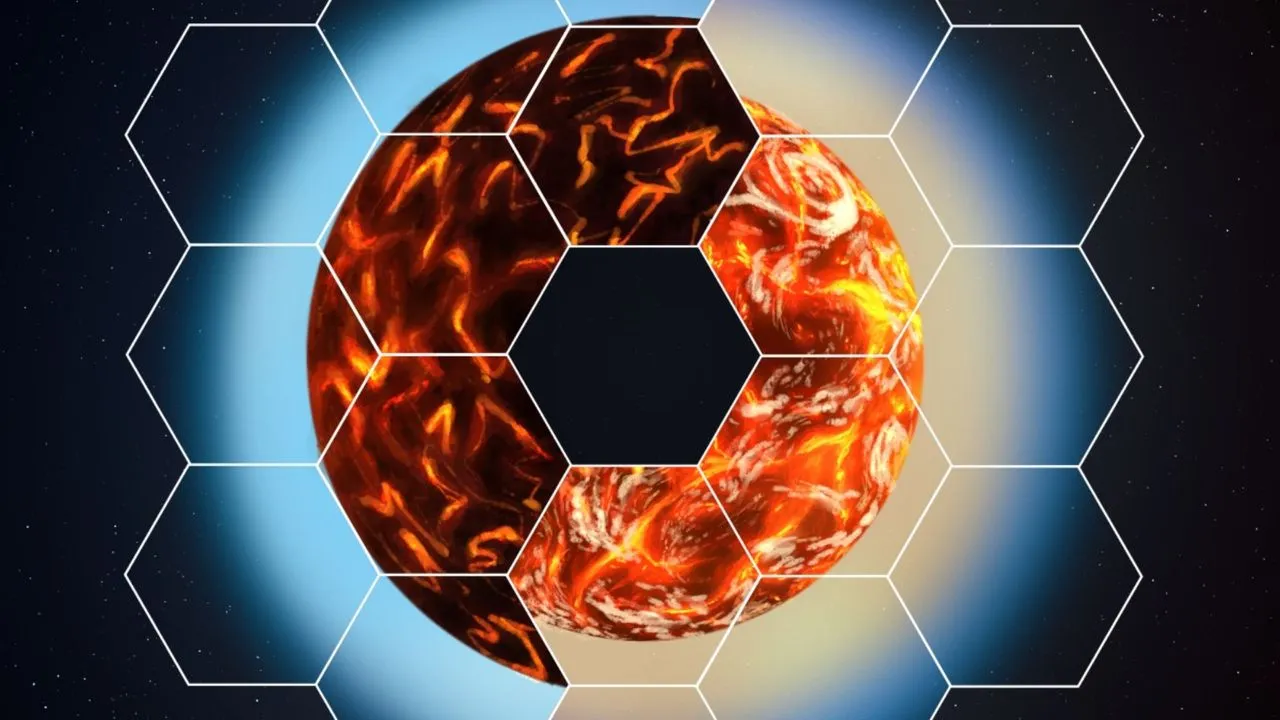
Astronomers at Arizona State University, led by Sagnick Mukherjee, modeled how mineral clouds from vaporized rock behave in sub-Neptune exoplanets. Their July 8 Astrophysical Journal Letters results suggest cloud-driven heating can raise the atmosphere-interior boundary by roughly 1,400 to 2,600°C, potentially producing magma oceans and confusing JWST composition measurements.
Sub-Neptune exoplanets might not just be “mysterious,” they might be actively cooking themselves from the inside out. In new simulations published July 8 in Astrophysical Journal Letters, a team led by Arizona State University astronomer Sagnick Mukherjee found that clouds made of vaporized rock can trap heat so effectively that the temperature at the atmosphere-interior boundary rises by roughly over 1,400 to 2,600 degrees Celsius. That is hot enough to push solid surfaces into molten, magma-ocean territory.
This matters because astronomers are using the James Webb Space Telescope (JWST) to infer what these planets are made of by analyzing their atmospheres. The catch is that if mineral clouds alter temperature deep in the planet, and if magma oceans exchange gases with the air above them, then the atmospheric “fingerprints” may not faithfully represent the planet’s bulk composition. In other words, the thing JWST is designed to measure could be getting rewritten by the planet itself.
Let’s ground the setup. Sub-Neptunes are planets larger than Earth but smaller than Neptune, and they’re especially mysterious because we do not have a world of this type in our solar system. They are thought to contain a rocky core surrounded by a deep atmosphere, but the composition and structure of those atmospheres are still uncertain. Some sub-Neptunes could be hydrogen-rich like Jupiter’s. Others might be rich in water vapor and carbon-based organic molecules. And in some scenarios, a sub-Neptune might even fit the “hycean world” paradigm, where a thick hydrogen atmosphere encases a global ocean of liquid water.
JWST has been probing the atmospheres of several sub-Neptunes to learn more about their bulk composition, because the atmosphere should (in principle) be representative of what these planets are made from. But so far, results have been inconclusive. The new work offers a mechanism for why that could be happening, centered on the physics of deep, dense atmospheres. In sub-Neptunes, the atmosphere can be so deep and crushing that pressures near the boundary between the atmosphere and the solid body can turn minerals into vapor. That vapor then forms clouds.
The minerals named in the study include aluminium oxide, iron, magnesium silicate, manganese sulfide, potassium chloride, sodium sulfide, and zinc sulfide. Using detailed computer simulations, the team explored what these mineral clouds do to both the surface and the atmosphere. Their findings were blunt: when these mineral clouds form deep down, they act as efficient insulating blankets. Heat leaks outward from the core, but the clouds trap it. The result is a hotter atmosphere-interior boundary, alongside a noticeable cooling in the upper atmosphere because heat is prevented from escaping.
For some of the planets the team modeled, the extra heat is enough to melt the planet’s surface, creating a magma ocean. Team-member Matthew Nixon of Arizona State University said this directly in the study description, linking the trapped heat to surface melting. One example the paper discusses is GJ 1214b, a sub-Neptune orbiting a red dwarf star 48 light-years away. At one time, GJ 1214b was thought to be a cool water-world. But JWST’s discovery in 2025 of metallic vapors and carbon-dioxide haze in its atmosphere ruled out the earlier picture. Now, the study suggests the planet’s surface, undetectable beneath the thick atmosphere, could be completely molten.
Now comes the second-order problem for measurement. If magma oceans exist, they do not just sit there like silent puddles. Gas can seep out of the magma and diffuse into the atmosphere, which in theory enriches the atmosphere in oxygen, silicon hydride, and silicon monoxide. Going the other way, the magma absorbs ammonia, methane, and water vapor from the atmosphere. The atmosphere therefore becomes enriched by material from underground while also getting depleted in some gases astronomers would expect to be more abundant. That exchange can skew JWST’s attempts to infer bulk composition from the spectrum of atmospheric gases, because you are not just seeing primordial atmosphere, you are seeing chemistry in motion.
Finally, the study points to long-term consequences for sub-Neptunes themselves. Extra heating deep down would also impact the future of these planets, keeping their lower atmosphere bloated and preventing the planet from contracting over billions of years. And if these findings are correct, they could place a huge obstacle on sub-Neptunes being habitable. Even if the atmosphere-interior boundary is not hot enough to form magma, the surface could still be too hot for liquid water or life. For decision-makers watching the broader trend, the strategic takeaway is simple: even as JWST improves detection, the “interpretation layer” is getting more complicated. Planetary scientists, instrument teams, and funding stakeholders should treat sub-Neptunes as systems with active heat and chemistry drivers, not passive targets.
This story's Key Insights and Take-aways are locked.
Create a free account to unlock Executive Actions for one credit.
Register to UnlockAlways free for Executives Club members. Join the Club
More in Science

Alaska's 1,580-foot tsunami had warning signs. Scientists just found them.
Rapid glacier retreat, heavy rainfall, and thousands of tiny tremors preceded Alaska's 1,580-foot tsunami, a warning for every coastal community in a warming world.

The rare mutation that lets high-risk brains dodge Alzheimer's
Scientists found a natural defense against protein buildup, opening a new path to preventive treatments.

3,000 steps a day may halve Alzheimer's decline, study finds
New research links a modest daily walk to less tau buildup and nearly half the cognitive and functional decline, even for those with early signs.