
Minnesota’s Kate Adamala’s SpudCell completes a full cell cycle, without being alive
The first artificial cell that feeds, divides, and “evolves” answers what minimum life needs, and what it enables.
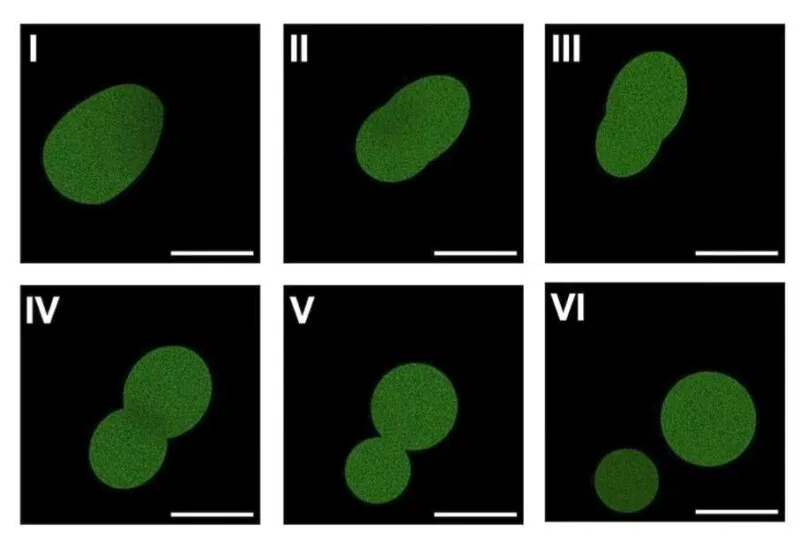
Kate Adamala and colleagues at a Minnesota lab created SpudCell, an artificial cell built from known chemical components that can grow, replicate its genome, divide into new generations, and demonstrate natural selection and competition. For decision-makers, it is a credible new blueprint for engineerable biology, plus a near-term constraint: it still needs lab-provided ribosomes and a limited metabolism.
A Minnesota team led by biochemist Kate Adamala has created SpudCell, the first artificial cell with a complete lifecycle. In the work presented in a preprint paper published while awaiting peer review, SpudCell is described as capable of the core moves you associate with living systems: it can feed, replicate its genome, divide into new generations, and even outcompete “siblings” when genetic changes make it grow faster.
The bigger point is not that SpudCell is “alive.” Adamala is explicit about that. Instead, the research is framed as proof about the minimum qualifications for something to be considered living-like function. The team assembled SpudCell entirely from known chemical components and uses it to test how much genome capacity, division mechanics, and cellular machinery are required to run a full cycle. That combination makes this more than a science-fair headline; it is a potential engineering foothold for a field that has historically been locked behind messy, hard-to-standardize biology.
Let’s break down what SpudCell actually does, because the mechanics matter if you are a funder, operator, or board member thinking about “what comes next.” The genome in SpudCell is 90 kilobase pairs (kbp), where 1 kbp equals 1,000 base pairs. Prior scientific work cited in the article estimated a minimal genome could be as small as 113 kbp, while human genomes contain around 3 million kbp. Put simply: SpudCell’s authors argue they built a smaller genetic “engine” that can still support a synthetic cell cycle.
Division also sidesteps a major bottleneck. Many cells rely on a cytoskeleton, the internal scaffolding that helps coordinate structure and cell division. SpudCell does not use a cytoskeleton. Instead, the article says SpudCells divide when proteins used to grow the cell crowd together at the membrane surface until mechanical stress forces the split. For executives, that is the kind of design choice that can reduce variables. If the division process is simpler and more predictable than nature’s version, then scaling experiments, standardizing protocols, and iterating on designs becomes less of a black box.
Then comes the “evolution” part, and it is described in concrete, testable terms. The team reports that when researchers introduced a genetic change that increased production of a fusion protein, cells with that change grew faster and produced more offspring. After five generations, the faster-growing variant outcompeted the original. That is a form of natural selection in a synthetic setting: not philosophical, not speculative. It is a demonstration that heritable genetic changes can shift competitive fitness inside a compartment that behaves like a cell.
Now, here’s the restraint that prevents this from becoming a sci-fi panic. SpudCell has limitations that keep it fundamentally dependent on laboratory conditions. Adamala tells The Register that SpudCell has a very primitive metabolism and cannot yet build its own ribosomes. Because it cannot generate the machinery required for protein production from scratch, researchers must keep SpudCell fed with liposomes carrying ribosomes, enzymes, lipids, and other molecular components needed to keep the synthetic cells functioning. That dependency makes survival outside very specific lab conditions unlikely, at least for the version described here.
The strategic implication is not “sentient microbes are here.” It is “engineerable biology might be less hypothetical than it used to be.” Adamala positions SpudCell as a chassis, something the field could adapt for multiple purposes: from formulating new drugs to creating artificial organisms. Her argument, as quoted, is that cells built from scratch could perform molecular transformations that industrial chemistry cannot. Natural living cells are already used as molecular factories, either via manipulated biology or via industrial processes with huge energy and environmental costs. SpudCell, if it can be improved, is presented as a way to reduce the gap between what we want molecules to do and what current manufacturing can feasibly accomplish.
But to get from a lifecycle in a lab dish to real-world products, the research still needs engineering upgrades. Adamala lists an immediate personal to-do list: ribogenesis, better metabolism, and more robust division. Those are not cosmetic tweaks. Ribogenesis addresses the biggest current dependency. Better metabolism is where autonomy lives or dies. More robust division is about reliability, throughput, and reproducibility, all of which are the practical obstacles that slow down commercialization even when the scientific core works.
There is also a governance and infrastructure angle that boards and institutional investors should notice. Adamala is taking the work out of the university lab and into a public-benefit institution called Biotic. The stated goal is to do the work publicly and openly, with a focus on standardizing artificial cell research. The article highlights her concern that every lab in this field is solving similar problems from scratch, and that institutional knowledge is not carrying over. Biotic is presented as an attempt to turn one-off breakthroughs into a shared engineering discipline built on open foundations, so the ability to engineer biology does not remain “only a few private hands ever hold.” In other words: this is as much a collaboration and standards play as it is a science play.
For peers in biotech, synthetic biology, and the capital stack around them, the stakes are clear. SpudCell is a real demonstration of an artificial system that can run a full synthetic lifecycle and undergo selection-like competitive dynamics, but it is not yet an autonomous production platform. That means timelines and business cases still hinge on solving ribosome production, metabolic capability, and division robustness. If those improvements land, the reward could be significant because biology would move closer to being programmable engineering rather than artisanal experimentation.
This story's Key Insights and Take-aways are locked.
Create a free account to unlock Executive Actions for one credit.
Register to UnlockAlways free for Executives Club members. Join the Club
More in Science

Alaska's 1,580-foot tsunami had warning signs. Scientists just found them.
Rapid glacier retreat, heavy rainfall, and thousands of tiny tremors preceded Alaska's 1,580-foot tsunami, a warning for every coastal community in a warming world.

The rare mutation that lets high-risk brains dodge Alzheimer's
Scientists found a natural defense against protein buildup, opening a new path to preventive treatments.

3,000 steps a day may halve Alzheimer's decline, study finds
New research links a modest daily walk to less tau buildup and nearly half the cognitive and functional decline, even for those with early signs.