

NASA’s Anil Menon launches July 14 with Roscosmos crews to reach ISS in 2 orbits
A two-orbit Soyuz rendezvous, scheduled docking, and a full eight months of research onboard the ISS.
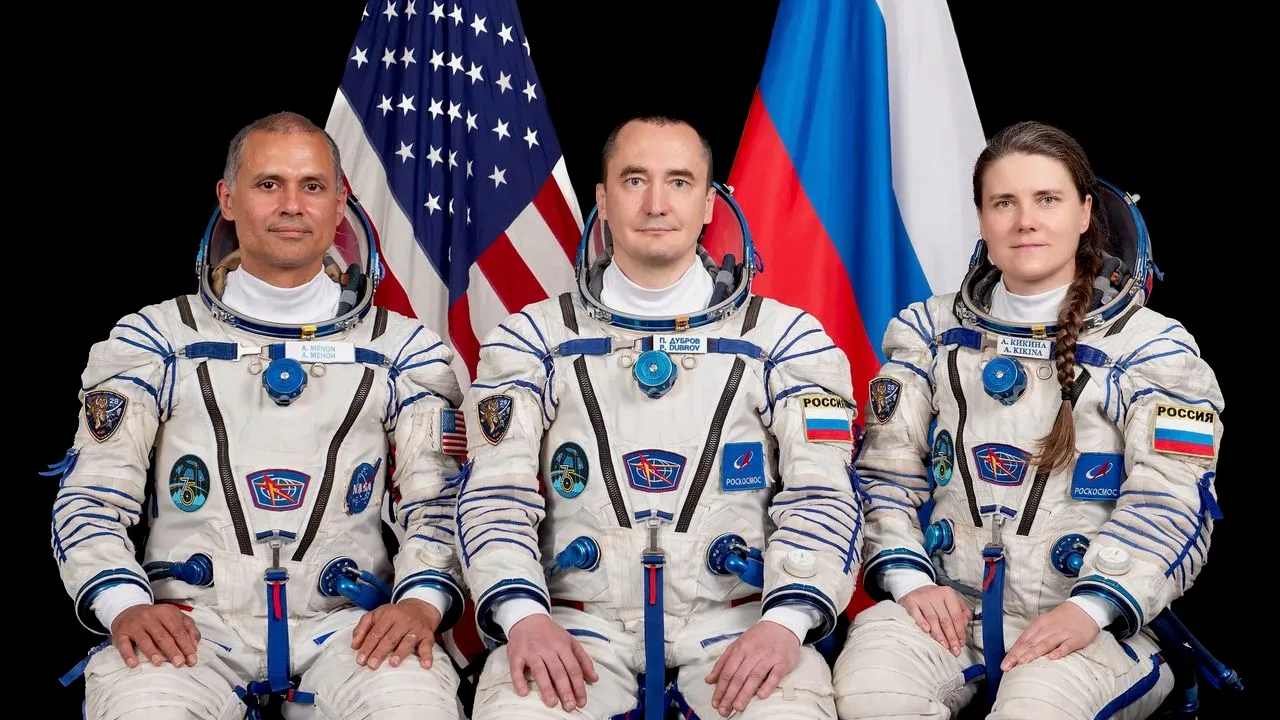
NASA astronaut Anil Menon is launching July 14 aboard Russia's Soyuz MS-29 with Roscosmos cosmonauts Pyotr Dubrov and Anna Kikina toward the ISS. The mission affects how decision-makers think about space workforce continuity, research priorities, and how commercial and government space capabilities reinforce each other.
Three people are headed for the International Space Station on Tuesday, July 14, and the schedule is tight on purpose. NASA astronaut Anil Menon, along with Roscosmos cosmonauts Pyotr Dubrov and Anna Kikina, is scheduled to lift off atop a Russian Soyuz rocket from Baikonur Cosmodrome in Kazakhstan at 10:47 a.m. EDT (1347 GMT; 7:47 p.m. local time). NASA and Space.com will also be running coverage live beginning at 9:45 a.m. EDT (1245 GMT), with rendezvous and arrival coverage starting at 1:10 p.m. EDT (1710 GMT).
If you are tracking the mission end-to-end, here is the key timing: the trio is expected to dock with the ISS at about 1:56 p.m. EDT (1746 GMT) after just two orbits. After docking, there will be a break before coverage resumes at 3:30 p.m. EDT (1930 GMT), leading into hatch opening expected around 3:55 p.m. EDT (1955 GMT) between the Soyuz and the ISS. That “two orbits” detail matters because it compresses the mission window between launch readiness and crew handover, which is operationally and programmatically important for agencies and contractors alike.
Menon and the cosmonauts are flying in Russia's Soyuz MS-29 spacecraft as part of the Soyuz MS-29 prime crew. The ISS is not empty when they arrive. The MS-29 team will join seven astronauts already living aboard the station: NASA's Jessica Meir, Jack Hathaway, and Chris Williams; the European Space Agency's Sophie Adenot; and Roscosmos cosmonauts Sergey Kud-Sverchkov, Sergei Mikaev, and Andrey Fedyaev. From an execution standpoint, this is how the ISS stays alive as a machine, not a moment. Crews rotate, but the station’s science and maintenance cadence continues.
For investors, operators, and governance-minded executives, the “who” is as relevant as the “when.” This will be the first spaceflight for Anil Menon, selected as a NASA astronaut candidate in December 2021 in the agency's Group 23. He is married to Anna Menon, who was picked in the next astronaut candidate class, Group 24, in September 2025. Anna Menon has already been to space, though not with NASA. In September 2024, while an employee of SpaceX, she flew on the company's Polaris Dawn mission to Earth orbit. That five-day flight was funded and commanded by current NASA Administrator Jared Isaacman and featured the first-ever commercial spacewalk. It reached a maximum altitude of 870 miles (1,400.7 kilometers), higher than any previous crewed Earth-orbiting mission had gotten. In other words: this mission sits inside a broader pattern of capability building where government and commercial space increasingly cross-pollinate.
Menon’s own background ties into that, too. The source notes he is a former SpaceX employee as well, and that he was the company's first-ever flight surgeon. He is going into an ISS assignment where the technical agenda goes beyond “get there, do science.” NASA officials say Menon will help conduct a wide variety of scientific experiments during about eight months onboard. Specifically, NASA said he will continue research to refine in-space production of semiconductor crystals to enable large-scale manufacturing of components needed for high-performance computers, artificial intelligence, and improved medical devices. NASA also said he will perform ultrasound using augmented reality and artificial intelligence methods that could eliminate the need for medical support from Earth on future space missions. If you care about downstream impacts, this is the through-line: semiconductor manufacturing and advanced medical support are both hard problems on Earth, and the ISS becomes a proving ground for approaches that could scale.
The other two crew members bring their own continuity. MS-29's flight will be the second-ever space mission for both Dubrov and Kikina. Dubrov lived aboard the ISS from April 2021 to March 2022. Kikina spent five months on the outpost, from October 2022 to March 2023. The source flags Kikina’s significance: she is the only female member of Russia's active astronaut corps, and she flew to and from the ISS back then on SpaceX's Crew-5 mission. That was described as a big deal in the source because she was the first Russian ever to fly on a private U.S. spacecraft. It was also the first cosmonaut to fly on any American space vehicle since December 2002, when cosmonauts Valery Korzun and Sergey Treshchov came back to Earth from the ISS aboard the space shuttle Endeavour.
All of this adds up to more than a schedule you can watch live. It is a live stress test for international coordination, supply chain reliability, and research continuity, with the ISS acting like a long-running platform that keeps paying off. For decision-makers, the strategic stake is clear: missions like MS-29 reinforce the ISS as a place where semiconductor production and AI-enabled medical diagnostics can be explored in microgravity, while crew rotations validate the human systems that make the science possible. If you run a space program, fund R&D, or oversee partnerships, you are not just looking at a rocket launch. You are watching how technical priorities, workforce pipelines, and cross-sector spacecraft capability converge for the next eight months of outcomes.
And yes, you can watch it. The live stream coverage starts at 9:45 a.m. EDT, rendezvous and arrival viewing kicks off at 1:10 p.m. EDT, and hatch opening is expected around 3:55 p.m. EDT.
This story's Key Insights and Take-aways are locked.
Create a free account to unlock Executive Actions for one credit.
Register to UnlockAlways free for Executives Club members. Join the Club
More in Science

Alaska's 1,580-foot tsunami had warning signs. Scientists just found them.
Rapid glacier retreat, heavy rainfall, and thousands of tiny tremors preceded Alaska's 1,580-foot tsunami, a warning for every coastal community in a warming world.

The rare mutation that lets high-risk brains dodge Alzheimer's
Scientists found a natural defense against protein buildup, opening a new path to preventive treatments.

3,000 steps a day may halve Alzheimer's decline, study finds
New research links a modest daily walk to less tau buildup and nearly half the cognitive and functional decline, even for those with early signs.