

Nature finds two super-puff planets lighter than candy floss, among least-dense ever
Two low-density gas giants orbit one star, reshaping expectations for what “planet” can weigh in at.
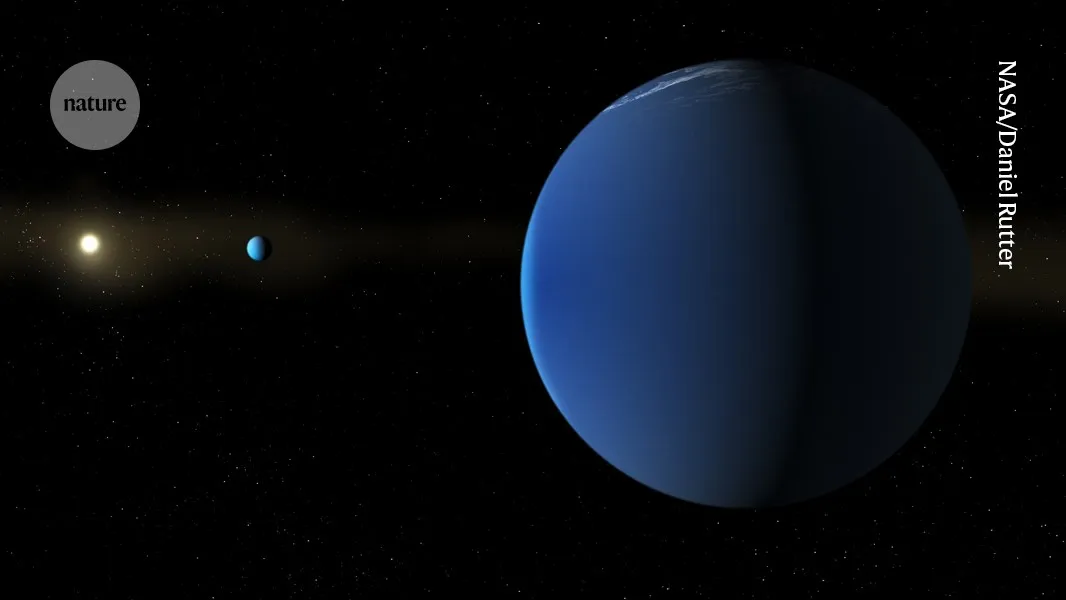
Nature reports on a pair of gas giants that circle the same star and are among the least dense planets ever found. The discovery matters because lower density changes how teams interpret formation models and how they price long-shot science risk.
Nature, in a piece published online 09 July 2026 (doi:10.1038/d41586-026-02114-2), reports the discovery of two “super-puff” planets that are remarkably light for their size. The headline fact is the headline punch: these gas giants are among the least dense planets ever found.
Why that matters immediately for anyone tracking exoplanets, space programs, or even the downstream tech that supports them: density is a primary clue to what a planet is made of and how it got there. If you can pack very little mass into a large planetary volume, you are not looking at a typical gas giant. You are looking at something more like an inflated balloon, the astronomical version of “how is this even standing up?” The Nature report frames these two planets as a pair, both orbiting the same star, which makes the system especially useful for testing whether the “super-puff” look comes from unusual planet-building conditions or from a shared environmental driver.
To decode “super-puff,” you do not need a PhD. Density is mass divided by volume. For a planet of a given size, unusually low density means there is less material inside than you would expect. That can happen if the atmosphere is extremely extended, if the planet’s outer layers are dominated by gas that stays puffed up, or if the planet’s overall structure is otherwise low in heavy elements. The Nature summary calls them gas giants, so the key takeaway is that they are not small rocky worlds. They are large planets that, astonishingly, do not “weigh” like typical gas giants. In other words, they are gas giants that behave, structurally, like something far less dense.
The “pair of planets around the same star” angle is a big deal for interpretation. When two worlds share a star, they share much of the astrophysical context: the age of the system, the star’s radiation environment, and the broad disk history that existed when the planets formed. Boards and investors do not usually get to fund “clean experiments” in nature, but planetary systems are the closest thing astronomy has. A same-star pair reduces the number of explanations you have to juggle. If one planet is weird, you can blame it on individuality. If both are weird in the same direction, you start suspecting that the system’s conditions systematically push planets toward low density.
There is also a calibration effect. For exoplanet science, each new data point shifts the boundary between “plausible formation pathway” and “model needs work.” Super-puff planets have been discussed as a class because their low densities challenge standard expectations. Nature’s characterization places this specific pair among the least dense planets ever found, which implies a more extreme end of the distribution than many prior discoveries. That matters for how researchers prioritize follow-up observations and how mission planners think about target selection.
Follow-up is not just a scientific hobby. Observation time is scarce. Telescope schedules are tight. The teams that secure time, the institutions that build instruments, and the sponsors that underwrite mission costs all operate under real-world constraints. When a system looks unusually low-density, it can change what instrument teams optimize for, such as what they expect to see in atmospheric signatures and how strongly they anticipate planets will be detectable in certain wavelength regimes. That means this discovery can ripple into operational decisions: what gets observed first, what gets revisited, and how confidently teams can interpret the measurements once they have them.
On the regulatory and governance side, exoplanet discoveries usually do not trigger new rules the way a pharmaceutical trial or a financial product would. But the public funding ecosystem and international collaboration frameworks that support space science rely on trust, track record, and reproducibility. A Nature publication is a credibility signal, and the date stamp, 09 July 2026, anchors it in a specific moment in the scientific calendar. That is important because it shapes where research communities converge quickly and where they demand additional checks. For institutions and boards, credibility signals are not abstract. They influence hiring, grants, partnership decisions, and whether a project becomes a platform for the next round of instrumentation.
Strategically, the second-order implication for peers is simple: super-puff planets force a rethink of what “normal” looks like in planetary demographics. If two gas giants in one system can land among the least dense planets ever found, then some fraction of exoplanet populations may be more structurally diverse than earlier models suggested. For executives in adjacent areas, the lesson is that even “basic” metrics like density can meaningfully reshape forecasts and interpretation. In other words, the universe keeps moving the goalposts, and the organizations that stay agile in how they interpret new evidence tend to win.
For decision-makers watching this space, Nature’s report offers a clear stake: low-density, same-star “super-puff” pairs are not just an interesting oddity. They are a stress test for formation theories, a potential guide for how to target future observations, and a reminder that the planets we thought we understood may still have huge variety hiding in plain sight.
This story's Key Insights and Take-aways are locked.
Create a free account to unlock Executive Actions for one credit.
Register to UnlockAlways free for Executives Club members. Join the Club
More in Science

University of Birmingham builds a 24,000-atom mini universe where time emerges without a clock
A quantum “mini universe” shows time can be a byproduct of internal change, not an external metronome.

UK hits 34C for 8th day, smashing prior 7-day record and extending heatwave risk
Eight straight days above 34C in the UK, breaking last year's best run, with next week heat likely to keep pressure rising.

NASA gives July 14 launch and docking coverage window for Soyuz MS-29
Follow Anil Menon, Pyotr Dubrov, and Anna Kikina from liftoff to Prichal docking, hatches open on NASA+.