

Nature hits Microsoft’s Majorana quantum claim, Legg says “basic Python errors” skewed results
A Nature-published critique argues Microsoft’s 2025 breakthrough story was narrowed by plotting filters and coding mistakes.
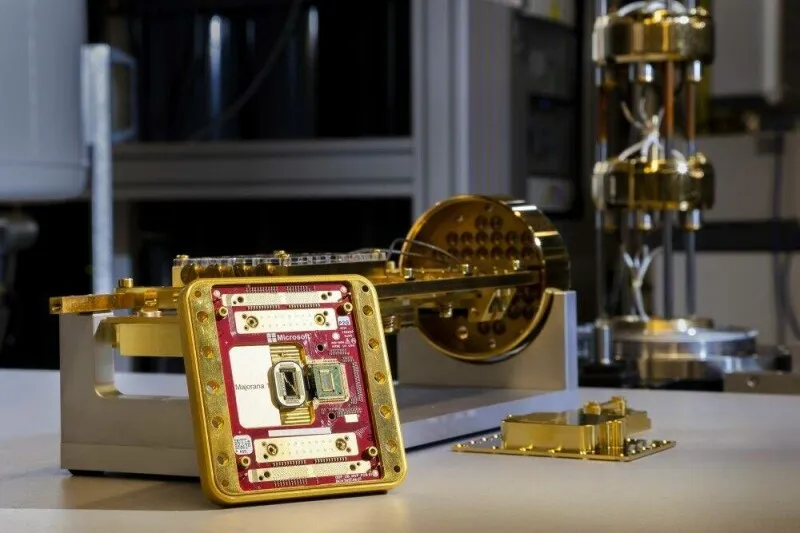
Microsoft’s 2025 Majorana quantum breakthrough claim faced a Nature peer-review critique by Dr Henry Legg of the University of St Andrews. Legg says “basic Python programming errors” and omitted raw data undermined the prerequisites for Microsoft’s topological quantum supercomputer roadmap.
Nature has published a peer-reviewed critique of Microsoft’s Majorana quantum breakthrough claims, and Dr Henry Legg, a lecturer at the University of St Andrews, says the work falls apart for a very specific reason: “basic Python programming errors” that, in his view, hid negative evidence.
The dispute traces back to Microsoft’s February 2025 announcement that its approach could create “a truly meaningful quantum computer not in decades, as some have predicted, but in years.” Legg argues that once you look beyond the published selection of transport data, Microsoft’s Topological Gap Protocol (TGP) did not actually demonstrate the prerequisites needed for topological quantum calculations. Nature accepted Legg’s paper, “On the robustness of topological gap detection via transport,” on April 20, scheduling it for publication on June 24.
To understand why this matters, remember the stakes in quantum breakthroughs are not just scientific. They are operational, reputational, and funding-driven. Microsoft already tied its Majorana program to government validation, including engagement with DARPA. The company later said that DARPA moved it into the final phase of the Quantum Benchmarking Initiative after “independently evaluating our results - those in the public realm and proprietary - with a team of highly qualified experts.” Legg’s critique attacks the internal logic of the 2025 story, which means every downstream claim about “years not decades,” chip robustness, and the plausibility of a scalable topological route is now in the crosshairs.
Legg’s core argument is that Microsoft’s analysis cherry-picked what supported its thesis by focusing on transport “tune-up” procedures and interpreting them narrowly. Microsoft’s TGP is designed to detect a phase transition that Legg says is prerequisite for using Majorana particles for topological quantum computing. But in his view, the published pipeline selectively highlighted only the largest purported topological region. As Legg put it, the TGP plotting code was set to highlight only the largest region, which he says led to the omission of other regions that would have passed the tune-up protocol.
He also argues that, when peer reviewers asked whether other regions existed, Microsoft inaccurately stated that it had investigated only the region passing the protocol within the explored range. In Legg’s formulation, the missing regions weren’t just a minor documentation issue. They change what the data suggests about whether the prerequisites are met. Legg goes further into the mechanics: he says Microsoft mishandled code by antisymmetrizing bias voltage using array index rather than physical value. If you evaluate the position in a data array instead of the actual voltage values that index represents, you can distort which physical regimes appear to work.
Legg describes two “pretty basic Python programming errors” that, in his reading, concealed alternative successful results from phase maps. First, he says the plotting software was hardcoded with a filter, specifically zbp_cluster_numbers=[1], forcing the display to show only the single largest region. He claims that changing this to zbp_cluster_numbers=[1,2] shows a second region. Second, he says the TGP software transformed the data by simply reversing a Python array (x[::-1]) based on index position, ignoring the actual physical bias voltages.
Microsoft counters that it stands by its results and roadmap. In a statement provided to The Register, Dr Chetan Nayak, technical fellow and corporate vice president of Microsoft’s quantum hardware group, said, “We stand by our results and our roadmap,” adding that skepticism and rigor are hallmarks of science and that its rebuttal was accepted and published by Nature. Nayak also pointed to Microsoft’s DARPA engagement, describing an independent evaluation of results by “highly qualified experts,” including proprietary data.
In its rebuttal, Microsoft disputes the validity of Legg’s analysis. The company argues that signal measurements were not intended to be exhaustive, and it characterizes the issue as a “minor off-by-one-pixel bug in our TGP processing.” It further says Legg’s critique centers on selective examination of transport tune-up procedures and narrow interpretations of isolated phrases in correspondence with referees. Microsoft adds that Legg relies on “unsubstantiated claims about our transport spectra” and does not engage with capacitance measurements at the core of the original study. The company concludes that Legg offers “no alternative physical model capable of reproducing the capacitance signal or the RTS phenomenology.”
This isn’t just a fight over a single plot. It is a clash over how much weight to place on the prerequisites implied by transport measurements and how directly the published data supports the claimed physical mechanism. And it comes as Microsoft has moved on to “Majorana 2,” which it announced in early June 2026 as a “next-generation topological quantum chip” developed with help from its own agentic AI. Legg says that hasn’t changed his assessment. He argues Majorana 2 is not available to customers and is not proven to even be a single qubit, and he calls a preprint based on a single device not something that “should really be given any credence.”
Legg also critiques what Microsoft claims improved. He says the “1,000 times more reliable” figure refers to the lifetime of a classical bit, specifically “the parity of the state,” and not evidence of a qubit that can hold a superposition. He adds that for Majorana 2, it is reasonable to ask why Microsoft does not report the X-measurement, describing it as important for the claims made last year. He speculates that Microsoft likely tried the measurement and it did not work, arguing that what he has seen looks like disorder physics and that Microsoft has not shown control over even a single qubit.
For executives and investors, the second-order implication is straightforward: when a Nature paper alleges omitted raw data and basic coding errors, it doesn’t just question one device. It tests the reliability of the analytic pipeline behind a roadmap, and it raises the compliance and governance questions around how frontier science claims are verified. If Microsoft is right that the issues are minor and within-science debate, the program can move forward with less friction. If Legg is right that the prerequisites were obscured, the credibility of the Majorana timeline, the interpretability of the published measurements, and the confidence of partners who must place bets on long-duration physics become harder to justify.
This story's Key Insights and Take-aways are locked.
Create a free account to unlock Executive Actions for one credit.
Register to UnlockAlways free for Executives Club members. Join the Club
More in Technology

Nvidia's $89B data center quarter: the 9 companies cashing in
The AI buildout is minting fortunes beyond GPUs, and memory, cloud, and cooling suppliers are riding the same wave.

Google quietly links your phone number to every Android account on your SIM
Adding a SIM now ties your phone number to all Google accounts - and future accounts inherit it. Here's the security and privacy stakes.

Hijacker AI 'Skynet mode' runs 100,000 attack steps against exposed models
Symantec caught a criminal AI agent that borrows other models, steals data, and mines crypto; the only relief is no confirmed victims yet.