
New study confirms momentum-flux theory: Feynman's reverse sprinklers work for 'silly sprinklers' too
A 2024 fluid dynamics framework explains why angular momentum drives rotation in both classic reverse sprinkler setups and playful lawn toys.
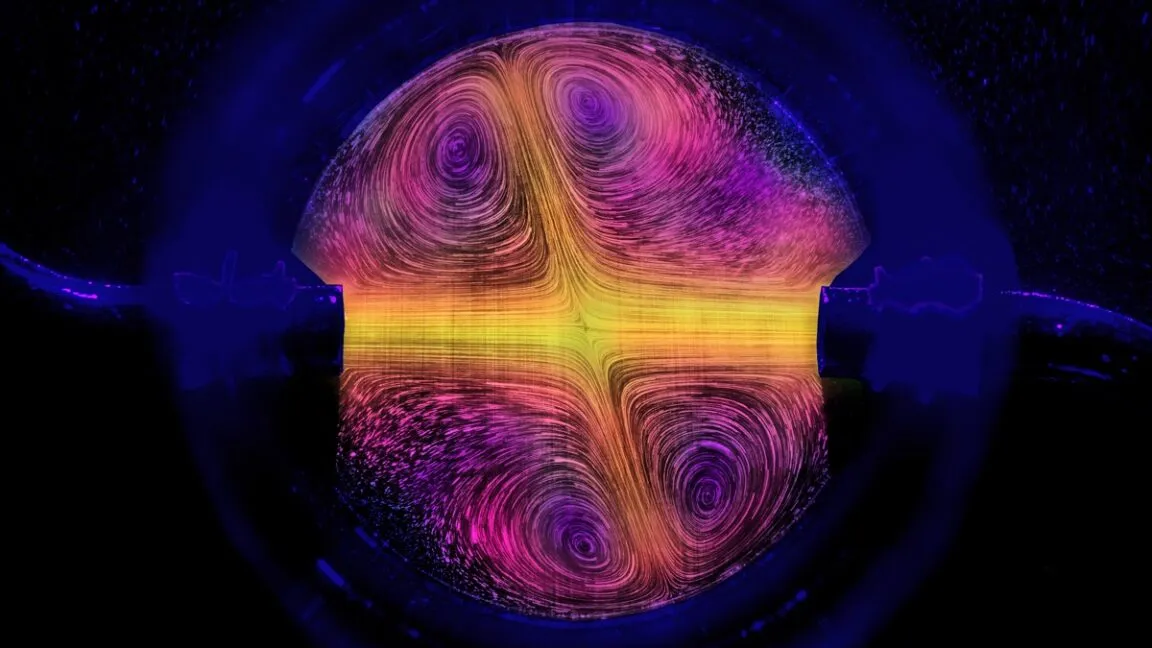
Researchers at New York University's Courant Institute ran experiments on multiple
Feynman’s reverse sprinkler puzzle was supposed to be a clever physics gotcha. Now it is getting a real experimental workout, and the result hits both the “classic” thought experiment and the joke version, “silly sprinklers.” In a study published in the Proceedings of the National Academy of Sciences, researchers at New York University’s Courant Institute tested different silly sprinkler designs and found that the same explanatory framework applies. That framework is tied to 2024 “momentum flux theory,” which describes how the flow of angular momentum in water drives rotation.
Here’s the key payoff: the new experimental evidence supports the idea that the rotation behavior is governed by angular momentum flow, not by an intuition that a reverse sprinkler should simply work like a regular sprinkler played backward. The physics is “more complicated” than that simple symmetry story. That complication is exactly what made the reverse sprinkler debate last. As the paper notes, the reverse sprinkler problem is associated with physicist Richard Feynman because he popularized the concept, but it actually traces back to a chapter in Ernst Mach’s 1883 textbook The Science of Mechanics (Die Mechanik in Ihrer Entwicklung Historisch-Kritisch Dargerstellt). In other words, this puzzle has deep roots, and its resolution keeps mattering.
To understand why this new result should matter to decision-makers, remember what puzzles like this represent in science and engineering: a mismatch between human intuition and physical mechanisms. The reverse sprinkler setup turns on a subtle fluid dynamics point. People assume time-reversal symmetry in a way that feels natural, then the flow disagrees. The source lays out the core tension with a direct quote from Feynman’s Surely You’re Joking, Mr. Feynman (1985): “The answer is perfectly clear at first sight,” he wrote, but “the trouble was, some guy would think it was perfectly clear [that the rotation would be] one way, and another guy would think it was perfectly clear the other way.” That is not just colorful history. It is the warning label for how teams can talk themselves into opposite conclusions when the underlying mechanism is the real bottleneck.
In this case, the bottleneck was clarified by a decade-spanning debate. Mach’s thought experiment stayed relatively obscure until, according to the source, a group of Princeton University physicists began debating the issue in the 1940s. Feynman, a graduate student there at the time, threw himself into the debate “with gusto” and even devised an experiment in the cyclotron laboratory to test his hypothesis. That detail matters because it shows how the scientific process moved from a conceptual riddle to laboratory testing. And now, the NYU Courant Institute experiments on silly sprinkler designs are doing something similar: translating a thought experiment into a controllable set of geometries and fluid behaviors.
The study’s practical move is also clever. “Silly sprinklers” are designed to create amusing loops and spirals of water jets, but they are also physical systems where the angular momentum story either holds or it does not. By testing multiple designs, the researchers are effectively checking whether momentum flux theory is robust across variations, not just a one-off explanation for the original riddle. The source explicitly connects the new work to the 2024 momentum flux theory and the “angular momentum of water flows drives rotation” idea. That connection matters because it tells you what kind of theory survives contact with messy reality. If a framework explains both the canonical reverse sprinkler puzzle and playful derivatives of it, it is likely capturing the mechanism that matters.
So what does this mean beyond the physics community? First, it underscores how “correctness” in fluid dynamics is often about the direction and transport of specific quantities, not about naive reversals. Momentum flux and angular momentum flow are the kind of mechanistic concepts that can influence downstream modeling, simulation, and design in engineering contexts where rotational flow appears, from mixing processes to irrigation and fluid transport systems. Even if this study is focused on sprinklers, the underlying method of validation is the transferable lesson: do not trust symmetry intuition alone; test the conservation and transport pathway that actually governs the motion.
Second, there is a governance and risk lesson for teams building technology or models. When a phenomenon invites competing “perfectly clear at first sight” interpretations, you want mechanisms that let you arbitrate disagreement with experiments or high-confidence simulations. The source shows that this puzzle already triggered years of debate between people who thought the rotation direction was obvious in opposite ways. In modern terms, that is what model risk looks like when the data or mechanism is under-specified. The new experimental support for momentum flux theory is a reminder that good theory should reduce ambiguity, not amplify it.
Finally, there is a community-level implication. The reverse sprinkler puzzle is famous partly because of how it traveled, from Mach to the Princeton debates to Feynman’s popularization, and then into contemporary experimental confirmation. The source’s timeline is basically a case study in how ideas can sit dormant, get re-litigated by new generations, and then finally be pinned down by targeted experiments. For executives and board members who oversee research-heavy organizations, that arc is familiar: you invest in the ability to keep asking the same question until the mechanism is actually measurable. Here, the measurables are tied to angular momentum flow, and the payoff is that the same explanation extends from “reverse sprinkler” to “silly sprinkler.”
This story's Key Insights and Take-aways are locked.
Create a free account to unlock Executive Actions for one credit.
Register to UnlockAlways free for Executives Club members. Join the Club
More in Science

Maya mathematician Sak Tahn Waax decoded: first named astronomer-operator found in the Americas
A Xultun mural yields the name Sak Tahn Waax and a Mars-Venus orbit formula dated to AD 781.

Climate disclosure helps Canadian firms win European institutional financing, new research finds
Disclose climate risks and impacts, and European investors are more likely to fund you. Ignore them, and funding gets harder.

NASA finds “aggressive” air taxi motion lowers comfort and willingness to fly
A multi-year VR study maps sudden maneuvers to passenger thresholds, guiding design and flight operations for air taxis.