

OpenAI will notify parents when teen accounts are kicked off ChatGPT for violence policy violations
Linked teen accounts will trigger parent alerts, turning moderation decisions into family notifications with real operational consequences.
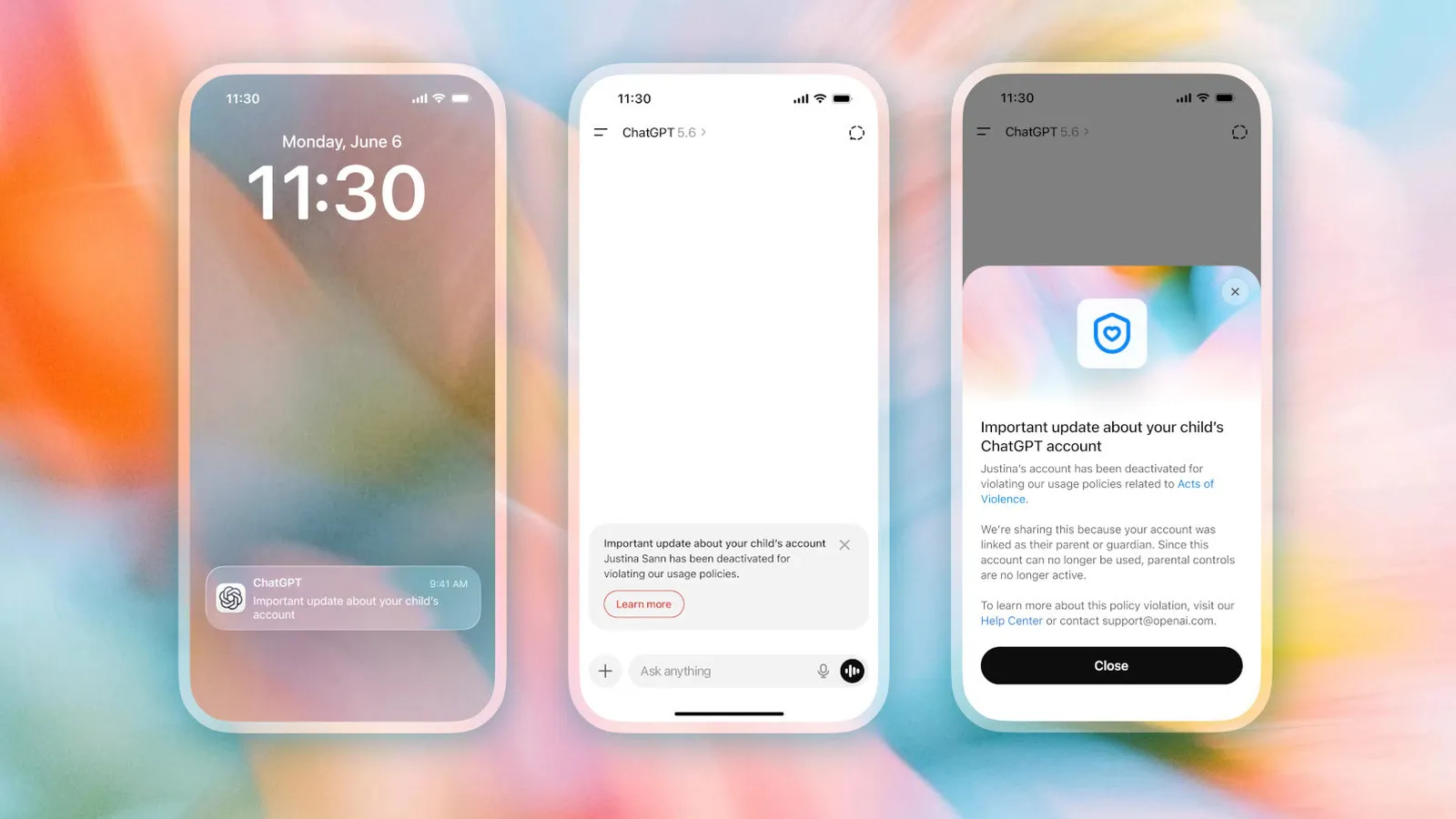
OpenAI says it will notify parents with linked teen accounts if their children violate its policies around violence. For decision-makers, this shifts enforcement from purely product-side moderation to broader accountability, with governance and reputational stakes.
OpenAI will start notifying parents if their teen is kicked off of ChatGPT after violating its policies around violence. That means moderation outcomes are no longer limited to the user experience, the account status screen, or an internal enforcement log. The company is preparing a new channel: a parent-facing notification tied to linked teen accounts.
For executives, the key detail is what this really changes. OpenAI is explicitly linking policy enforcement to family oversight, so a teen account disruption can become a parent event. This is a meaningful upgrade in how OpenAI treats safety compliance: it is taking actions required by its violence-related policies and translating them into notifications for guardians, rather than keeping enforcement entirely within the product.
To understand why this matters, it helps to zoom out to how safety and trust operations typically work in consumer AI. ChatGPT is a general-purpose assistant that can respond to countless topics, including ones where safety expectations are higher. In most moderation systems, enforcement is designed as a friction layer: warnings, temporary restrictions, or account changes. OpenAI's move keeps the enforcement, but expands the audience that receives the signal. Now, at least for a subset of users and scenarios tied to violence policy violations, the “who needs to know” includes parents.
This kind of policy-driven notification also changes the incentives around escalation and documentation. When enforcement affects teens and includes violence-specific rules, companies are not just managing user behavior. They are managing the expectations of caregivers, and potentially the expectations that regulators and lawmakers will form when they review how AI platforms handle harmful content. Even without additional details, the direction is clear: safety behavior is becoming more externally visible. That can raise the importance of internal processes like consistent rule application, clear thresholds for what counts as a violation, and careful account linkage practices.
There is also a privacy and systems-design angle that matters for boards and leaders. Notifications to parents imply account linking, access controls, and a mechanism for determining which parent receives which alert. From an operational standpoint, that is not a small feature. It requires deciding what data is transmitted, under what conditions it triggers, and how it is displayed. The source is specific about the trigger (violations of policies around violence) and the recipients (parents with linked teen accounts). That specificity should not be underestimated, because the engineering and compliance work to do this safely is exactly where product teams often hit hard tradeoffs between safety, usability, and data minimization.
Looking at the broader market, this move is part of a wider push across AI and tech platforms: safety is becoming a governance issue, not just a trust-and-safety issue. When enforcement reaches beyond the app boundary, it starts to look more like a duty-of-care framework. That is the kind of framing that tends to resonate with regulators, especially as governments examine how platforms protect minors. For companies in the AI space, even small changes in enforcement workflows can ripple into policy design, product UX decisions, and legal review timelines.
Second-order implications follow quickly. If a teen account is restricted or kicked off after a violence policy violation, parents may respond with different kinds of oversight, pressure, or even complaints. That can increase support volumes, create new customer service workflows, and push companies to clarify how and why enforcement happened. It can also influence teen engagement patterns, since families who receive notifications may adjust how their children use the service. In other words, OpenAI’s enforcement is no longer purely a teen-user learning loop. It becomes a household behavioral loop.
For peer executives, the strategic stakes are simple: this is a blueprint for making AI safety enforcement more visible to guardians. Even if other companies do not copy the exact approach, the market signal is that parent-linked notifications are becoming part of the safety toolkit. Boards that oversee product risk and compliance should treat this as an indicator that enforcement mechanics can quickly graduate into external-facing governance, and that safety decisions may come with family-facing consequences. The executives who get ahead of this will be the ones aligning product, legal, privacy, and customer support around a single question: when the system decides a teen violated violence-related policies, what happens next, and who finds out?
This story's Key Insights and Take-aways are locked.
Create a free account to unlock Executive Actions for one credit.
Register to UnlockAlways free for Executives Club members. Join the Club
More in Technology

Google quietly links your phone number to every Android account on your SIM
Adding a SIM now ties your phone number to all Google accounts - and future accounts inherit it. Here's the security and privacy stakes.

Hijacker AI 'Skynet mode' runs 100,000 attack steps against exposed models
Symantec caught a criminal AI agent that borrows other models, steals data, and mines crypto; the only relief is no confirmed victims yet.

Nvidia's AI-financier shift faces its first big test as neoclouds stumble
A rout in neocloud stocks is forcing investors to weigh Nvidia's hidden exposure as both supplier and lender to the AI buildout.