
OpenArt AI runs AMC ads to sell “vibe directing” like “vibe coding”
The text-to-video startup is putting its Director product on big screens, betting cinema audiences will want to steer AI creativity.
OpenArt AI, founded in 2022 by two former Googlers, is launching in-theater ads in AMC locations across Los Angeles, San Francisco, and New York to promote its Director text-to-video product. The move matters for marketers and creative leaders because it lands AI ad creation in the same place Hollywood debates “AI slop” and job risk.
OpenArt AI is trying to turn Hollywood’s argument into a marketing channel. This week, the AI text-to-video startup is launching ads in AMC movie theaters across Los Angeles, San Francisco, and New York to promote its Director product, CMO Insider reports it told the publication exclusively.
The pitch is built around a new phrase: “vibe directing.” Director lets users describe an idea, visual style, and narrative arc in conversational language, then generates videos up to five minutes long. OpenArt AI says the campaign, created entirely in-house using Director, is meant to show the output can be “fit for the big cinema screen,” and not just another example of low-quality AI. The company’s head of growth and operations, Stella Guan, frames it less as provocation and more as targeting the right audience for a tool it believes has matured.
Why this matters is simple: if you are a marketer, you want attention that does not evaporate the moment someone scrolls past. If you are a creative leader in Hollywood-adjacent industries, you want to know whether AI is becoming “just another production workflow” or whether it is turning into a reputational landmine. OpenArt AI is betting that cinema-goers are a high-signal audience for this particular message, even as the broader creative community has been increasingly sensitive to AI-generated content.
The tension is not theoretical. The source notes that AI has provoked backlash within Hollywood’s creative community over the technology’s potential to destroy jobs and the proliferation of low-quality “AI slop.” That phrase has become shorthand for the fear that generic, machine-generated outputs will flood the market, undercutting the craft and originality that audiences associate with professional filmmaking. At the same time, the piece points out that a growing segment of the industry, including Ben Affleck and Martin Scorsese, has become more open to embracing it to streamline and enhance their technical work. So OpenArt AI is entering a debate that has both reputational and practical implications.
OpenArt AI’s own positioning is to argue it has moved beyond the early “toy demo” era. The company’s ad campaign is also a kind of proof-of-process. According to the report, an in-house studio of six creative directors spent four days coming up with ideas for the ad using Director. The company also held a “movie night” screening marathon before selecting the final spot. That detail matters because it attempts to separate “AI makes everything instantly” from “AI is used inside a creative workflow.” If you are an executive deciding whether to invest, buy, or partner, that distinction often determines internal buy-in.
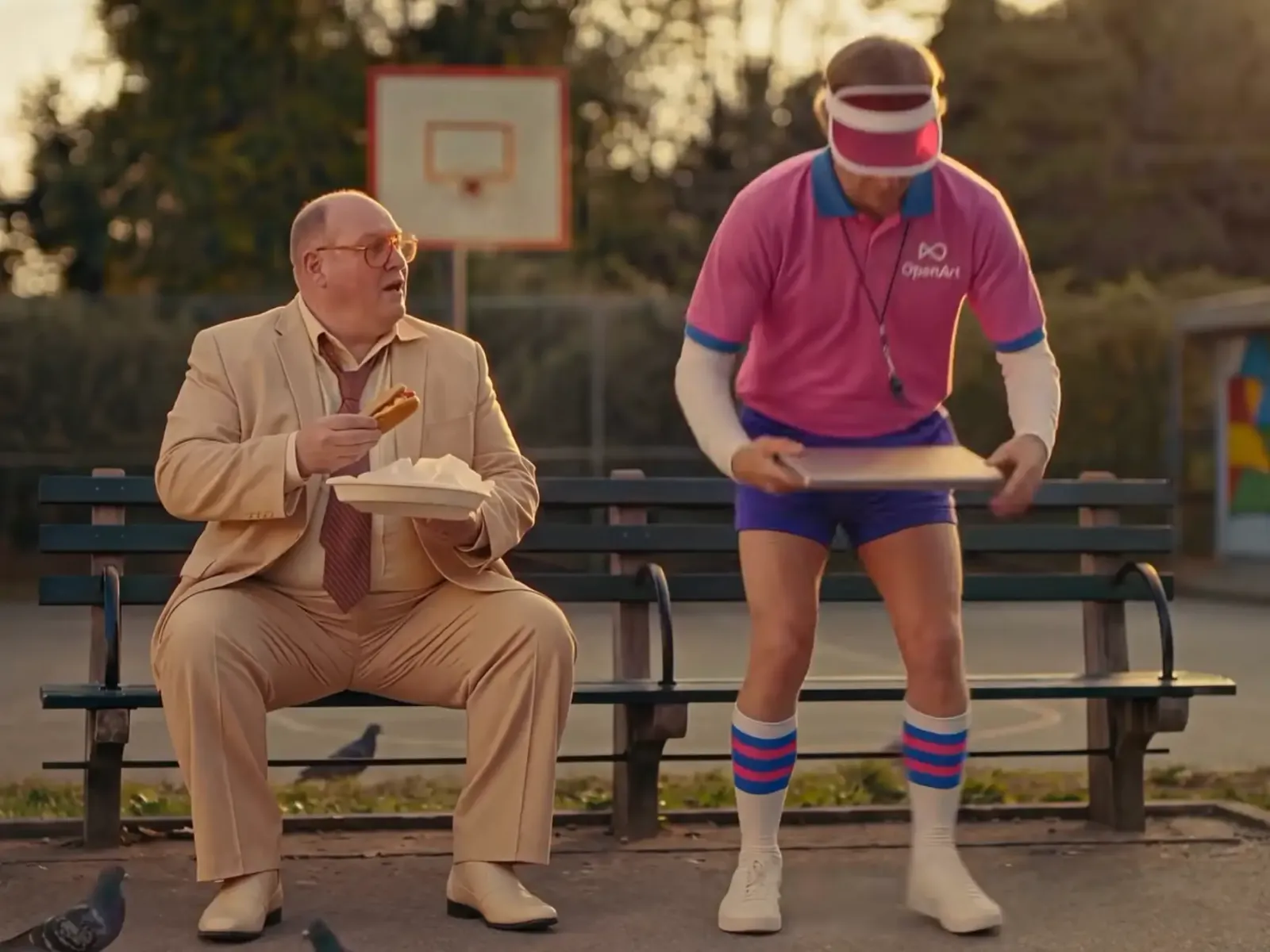
The actual ad concept is almost bluntly meta. The spot depicts a man eating a hot dog on a bench beside a basketball court. A “coach” character approaches, blows a whistle, and wields a laptop. The man says he has always wanted to make a movie about a penguin in the desert. The coach types it into OpenArt, explaining he can create any video he wants, “even a micro drama.” The man protests, “I don’t watch micro dramas.” This beats the marketing challenge in a clever way: it acknowledges the viewer’s skepticism while still demonstrating that the product can generate cinematic-looking narrative variations quickly enough to be part of the pitch.
For leadership teams, the capital and operational context is also worth noticing. OpenArt AI says it has grown to 8 million monthly active users, and it raised a $30 million Series A round in January led by Canaan Partners. The Director marketing campaign budget is described as being in the “low hundreds of thousands” of dollars. That is not chump change for a targeted brand test, but it also is not a moonshot where the company is guaranteed a proportional return. Choosing AMC theaters, alongside billboards, digital, and social placements in the same cities, suggests the company is optimizing for credibility and a concentrated “message test” more than pure scale.
There is also a strategic reason for the timing. One of the stickiest issues in AI marketing is consumer trust. The source cites a January survey published by the IAB and Sonata Insights: 30% of Gen Z respondents said brands using AI in ads were “inauthentic,” 26% said they were “disconnected,” and 24% said they were “unethical.” Those numbers do not say consumers hate AI. They say consumers hate misalignment. OpenArt AI’s campaign appears designed to close that gap by showing a more polished, cinema-oriented result and by emphasizing that the creative directors and production-like steps still exist.
Still, there are real constraints, and industry operators are warning against overpromises. James Poulter, CEO of the AI consultancy ThreePoint Labs, says AI companies need to be cautious about overselling how easy it is to create the top 1% of excellent. His point, as quoted in the source, is that even if models can generate cinematic things out of the box, if you do not have the “language of cinema or being a director,” you cannot steer the model to something that matches someone who does have that language. That is a product and go-to-market problem, not just a technical one. It implies the winners will be the companies that teach users how to steer, not just the ones that generate.
Guan’s response in the report is essentially: a lot of criticism is from people who are not aware of how far the technology has progressed since early iterations. She hopes the ad will demonstrate that AI can produce higher-quality output that belongs on big screens. Executives should read that as both reassurance and a challenge. If you are building or funding creative tools, the path forward is not only improving pixels. It is making the experience feel intentional, guided, and accountable to audience expectations.
Second-order, this AMC push also signals a broader shift in how AI products will market themselves. Instead of pitching to developers or niche creators, OpenArt AI is pitching to consumers who already think in genres, story beats, and cinematic standards. If it works, it could normalize AI-driven creative direction as a mainstream workflow, not a gimmick. If it backfires, it could harden the “AI slop” narrative into something that even savvy marketers cannot easily wash away. In either case, the executives watching today are not just watching ad performance. They are watching whether the market accepts a new metaphor for creation, “vibe directing,” and whether that metaphor becomes as sticky as “vibe coding” already is.
This story's Key Insights and Take-aways are locked.
Create a free account to unlock Executive Actions for one credit.
Register to UnlockAlways free for Executives Club members. Join the Club
More in Business

Epic and Google drop settlement bid, forcing rival Android app stores by July 22
Google told the court it is ready to carry third-party app stores starting Wednesday, July 22.
SK Hynix opens at $170, raises $26.5B, and tops foreign IPO records
In Friday's Wall Street debut, SK Hynix turns AI RAM demand into a $26.5B fundraising moment that rewrites comps.
China lands a reusable Long March booster, a first that matches SpaceX and Blue Origin
A barge landing and net-based recovery move China from theory to proof, reshaping the reusability race and satellite ambitions.