
Perseverance logs a 75-meter Martian rock record of repeated asteroid impacts
NASA’s rover found the “Broom Point member,” likely over 3.9 billion years old, and timed the violence.
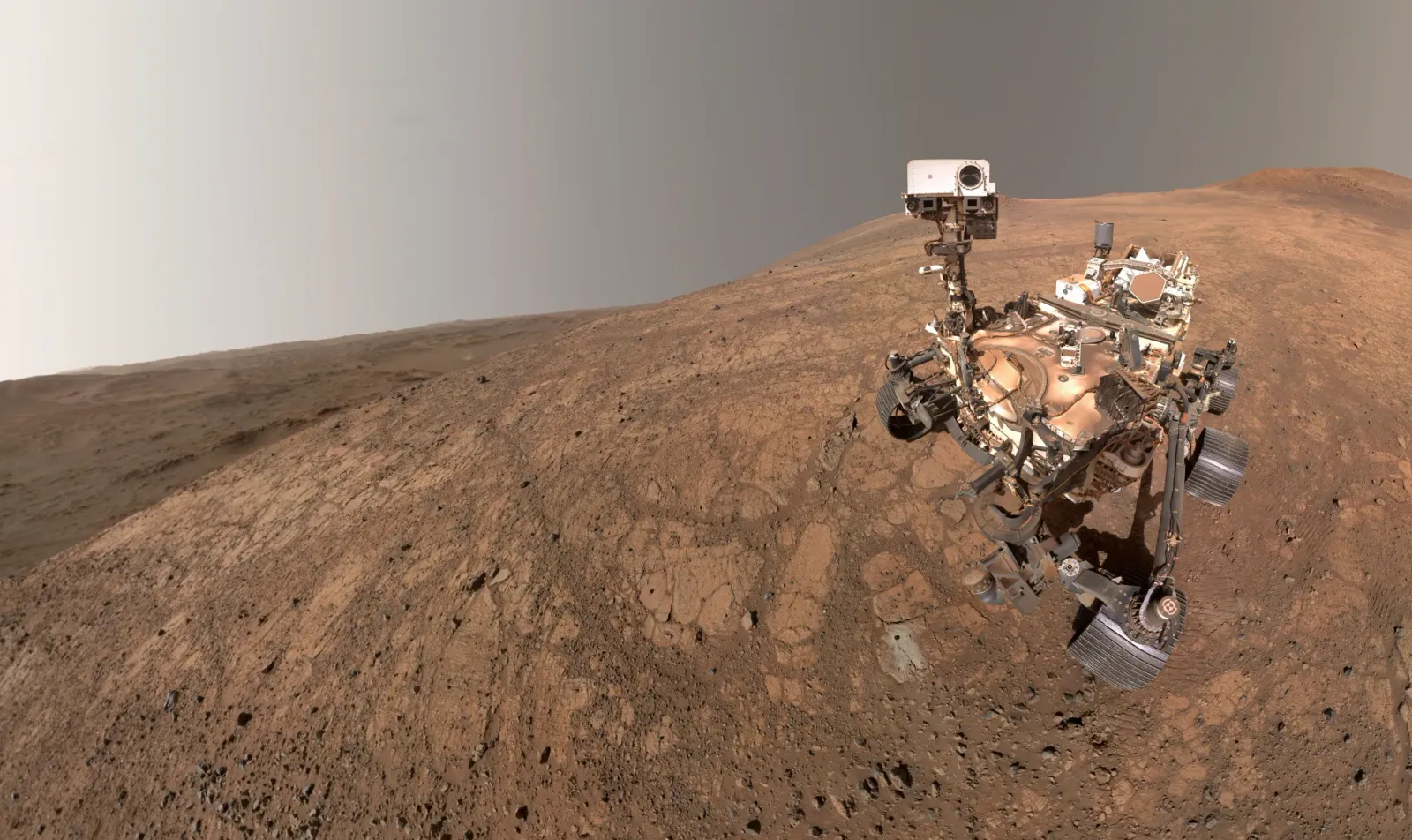
NASA’s Perseverance rover, with science team analysis published in the Journal of Geophysical Research: Planets, identified a 245-foot-thick (75-meter-thick) ancient rock stack on Jezero Crater’s rim. For decision-makers watching how space science translates into capability and credibility, the finding is a playbook for evidence quality: layered geology you can date, sample, and return.
NASA’s Perseverance rover just delivered one of the clearest “early Mars was chaos” datasets it has produced: a 245-foot-thick (75-meter-thick) stack of ancient bedrock on Jezero Crater’s rim, built by repeated asteroid impacts. The sequence, dubbed the “Broom Point member,” is likely more than 3.9 billion years old, meaning it preserves an impact record from an era so old that it barely exists in any form on Earth anymore.
Released Wednesday in the Journal of Geophysical Research: Planets, the analysis links the rocks to a long-running barrage of impacts by showing six distinct rock types stacked in repetition, including breccias of angular fragments alternating with layers of fine-grained, pulverized rock dust. Importantly, the team doesn’t just describe the layers. They infer formation mechanisms using physical clues: rock fragments pocked with gas-bubble cavities that indicate they were once molten, plus tiny dark glassy beads within the layers. Those beads are a decisive hint that volcano-like processes are unlikely, because volcanoes can generate glassy droplets but “rarely occur in such high abundance,” according to the source.
To understand why this matters beyond pure curiosity, zoom out to what Mars Exploration Program missions are trying to do. Perseverance’s job is not only to take pretty pictures. It is to explore geology in a way that can be sampled, studied, and eventually returned. That “event-to-evidence” chain is what makes Jezero Crater a high-value target: it is a location where Mars history is preserved, not erased. Ken Farley, Perseverance deputy project scientist at Caltech in Pasadena, California, framed the payoff bluntly. On Earth, the earliest geologic record is “fundamentally broken up, deformed, and erased by plate tectonics.” Mars lacks plate tectonics to recycle its crust, so ancient records remain intact, offering a “rare glimpse” at a geological time period that doesn’t exist on our own planet.
Geology, however, is rarely a single story. At Broom Point, the rover’s data after ascending the western rim of Jezero Crater in late 2024 helped build a layered narrative. The rover examined surrounding locations with its science instruments, and the team reports six distinct rock types, including breccias alternating with fine-grained dust layers. The repetition across the thick sequence signals repeated high-energy impact events in the region of early Mars. Alex Jones, a Ph.D. student in planetary geology at Imperial College London and lead author of the paper, explained the logic as a distance-and-size story: variable-sized impacts happened at different distances from where the rock sequence was accumulating, with some large impacts far away and smaller impacts nearby, but all debris ending up landing together and constructing the thick section.
The “how” gets even more interesting when you look at geometry. Several layers at Broom Point tilt at angles exceeding 80 degrees, nearly vertical. The source is clear: that steepness is far too extreme to be caused by the impact that created Jezero Crater itself. Instead, scientists suspect a cosmic one-two punch that reworked the landscape long before the rover arrived. First, a colossal asteroid impact created the 1,200-mile-wide (1,900-kilometer-wide) Isidis Basin, one of the largest impact basins on Mars, upending and tilting once-flat rock layers. Later, a second asteroid likely struck, forming Jezero Crater, which measures 28 miles (45 kilometers) across. That later event fractured and uplifted already-tilted rocks, producing the dramatic formations Perseverance sees today.
For executives and operators, the strategic implication is that the story is not just “what happened,” it is “what can be timed.” To pin down when these events took place, the Perseverance team collected two core samples, dubbed “Bell Island” and “Main River.” The source emphasizes a future capability: if a return mission brings these samples back to Earth, laboratory dating could determine when and how often impacts were occurring on early Mars, and by extension inform understanding of the infant Earth, whose own early impact record has been erased by billions of years of plate tectonics.
The paper also draws a vivid connection between impact physics and surface appearance. During this violent era, the source says it wasn’t “rain or snow falling from the sky,” but an almost constant barrage of molten rock droplets and pulverized dust kicked up by asteroid impacts. Jones compares the outcome to reading a cosmic weather report from 4 billion years ago. Put differently: the value is temporal. Layered rocks plus dated impacts can turn a vague “Mars was busy” into an impact timeline.
Zoom further out into the program and ecosystem. NASA’s Jet Propulsion Laboratory in Southern California, managed for the agency by Caltech, built and manages operations of Perseverance on behalf of the agency’s Science Mission Directorate in Washington, as part of NASA’s Mars Exploration Program portfolio. Arizona State University leads operations of the rover’s Mastcam-Z instrument, working with Malin Space Science Systems on design, fabrication, testing, and operation of the cameras. SuperCam is led by Los Alamos National Laboratory in New Mexico, where the instrument’s Body Unit was developed. SHERLOC was built at NASA JPL, and WATSON’s camera was built by Malin Space Science Systems. This matters because mission outcomes are shared between institutions. Findings like the Broom Point member become proof points that distributed teams can deliver instruments and data precise enough for high-confidence geological interpretation.
And for decision-makers who care about credibility, not just headlines: Jezero Crater is functioning like a durable archive. The same factors that make Mars scientifically useful also make it strategically persuasive for future missions. If you can reliably identify layered terrain, infer formation processes from measurable features like glassy beads and gas-bubble cavities, and collect cores to enable lab dating later, you are building a repeatable evidence pipeline. That is exactly the kind of capability board members, partners, and investors should want to see in any long-cycle, high-stakes science platform.
This story's Key Insights and Take-aways are locked.
Create a free account to unlock Executive Actions for one credit.
Register to UnlockAlways free for Executives Club members. Join the Club
More in Science

Alaska's 1,580-foot tsunami had warning signs. Scientists just found them.
Rapid glacier retreat, heavy rainfall, and thousands of tiny tremors preceded Alaska's 1,580-foot tsunami, a warning for every coastal community in a warming world.

The rare mutation that lets high-risk brains dodge Alzheimer's
Scientists found a natural defense against protein buildup, opening a new path to preventive treatments.

3,000 steps a day may halve Alzheimer's decline, study finds
New research links a modest daily walk to less tau buildup and nearly half the cognitive and functional decline, even for those with early signs.