
Pokémon Go’s 10th anniversary turned its 2015 trailer promise into a real Times Square battle
Nearly 2,000 players gathered Thursday in New York to hunt an escaped Mewtwo that mega-evolved in public.
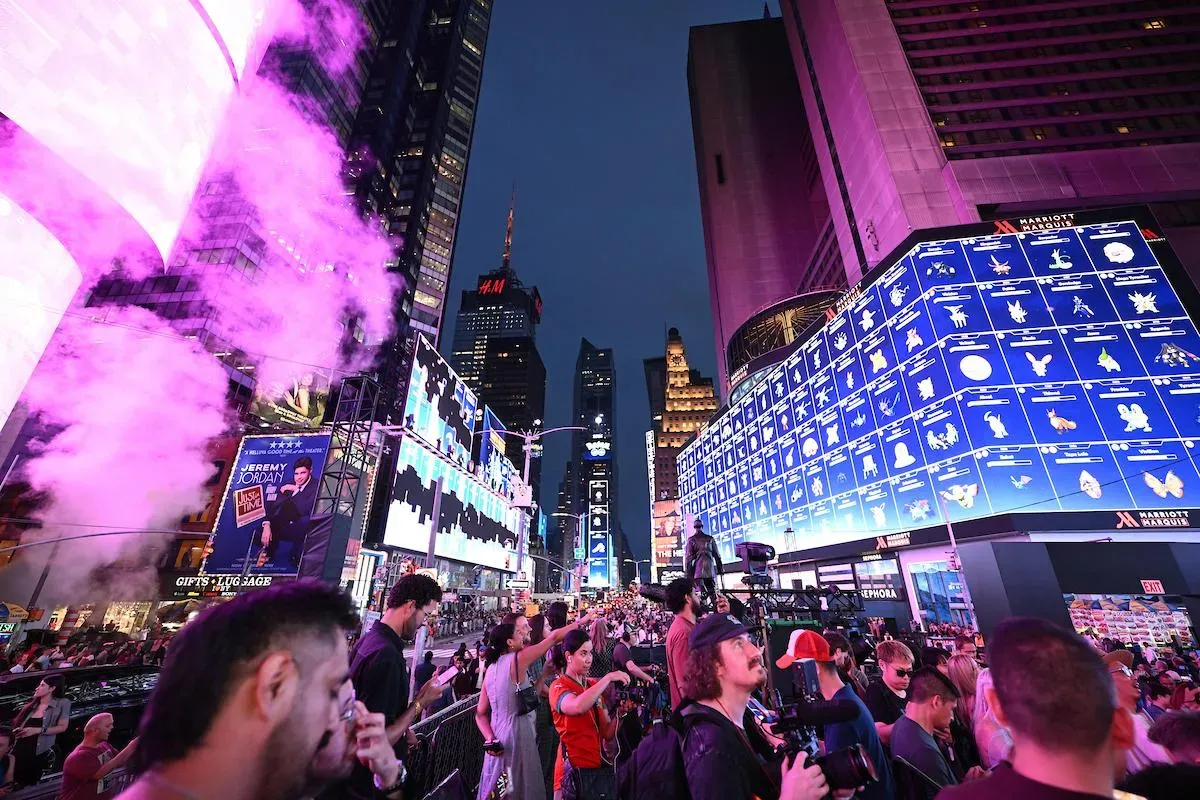
Niantic’s Pokémon Go used its 10th anniversary event in New York City to stage a live version of the fantasy shown in the game’s 2015 trailer. The event drew almost 2,000 players, many of them Pokémon Go influencers, for a special battle with an escaped, Mega Evolving Mewtwo.
When Niantic released the first Pokémon Go trailer in 2015, the concept sounded almost impossible: how could a bunch of people coordinate to catch a legendary like Mewtwo? This week, at Pokémon Go’s 10th anniversary event in New York City, the game answered that question with the kind of proof you can’t A/B test. Almost 2,000 players, many of them Pokémon Go influencers, packed into Times Square on Thursday evening to participate in a special battle.
The spectacle wasn’t subtle. Times Square briefly went dark before the billboards began lighting up, revealing an escaped Mewtwo that was Mega Evolving. And for once, the “here’s how it could feel” from a cinematic trailer wasn’t just a vibe. It was the event itself, turning a two-dimensional promise into a shared, location-based moment in front of real crowds.
That matters because the core product idea behind Pokémon Go was never only gameplay. It was mass participation tied to a physical place and a shared clock. In the early years, the world watched to see whether everyday players would show up, coordinate, and keep returning long enough for the ecosystem to become self-sustaining. A decade later, Pokémon Go is still doing something many tech products never manage: it converts attention into collective action, not just passive consumption.
The execution here also shows how Niantic thinks about community as infrastructure. Nearly 2,000 players is not a background detail. It signals that Pokémon Go’s “people power” is now a predictable, scalable resource. Influencers being present is equally revealing. These aren’t just fans filming from the sidelines. They are part of the amplification loop that keeps new players aware and existing players engaged. In other words, the event doubles as both a gameplay moment and a distribution event, using the crowd itself as the medium.
From a market perspective, this is a reminder that games can still win by building rituals. The modern attention economy is crowded with launches, updates, and paid campaigns. Pokémon Go’s anniversary did not compete on novelty alone. It leaned on the emotional payoff of a long-running story, and it dramatized that story with a location-based event that people could attend in person. For executives watching the mobile and interactive spaces, this is a strong signal that communities can be operationalized, not merely marketed. Players gather, the environment changes, the narrative escalates, and the product becomes the reason.
There is also a second-order implication that usually stays off stage. Large public gatherings and media-sized displays mean operations, coordination, and compliance are not optional. Even though the source does not spell out permits or enforcement mechanics, the visible crowd at Times Square implies that Niantic and event partners had to make the logistics work. When you scale physical-world experiences, the constraints shift from product engineering to real-world planning. That is the unsexy part of the magic, and it is often what separates “cool concept” from “repeatable playbook.”
Then there’s the regulatory framing, even if it stays implicit. A game that turns public space into interactive theater sits at the intersection of platform rules, location data expectations, and safety requirements. Over time, the way these systems are run tends to become more formal, because regulators and authorities care about crowd safety and how location-based experiences affect public life. Pokémon Go’s ability to stage a major, crowd-heavy event in a place like Times Square a decade into the product lifecycle suggests it has learned how to operate within those boundaries rather than constantly pushing against them.
For decision-makers across the industry, the strategic stakes are straightforward: Pokémon Go’s 10th anniversary didn’t just celebrate longevity. It demonstrated that the original promise of a trailer can be made real, at scale, with a live crowd and a shared in-game narrative. If you lead a company trying to build a community-driven product, the lesson is not “copy the mechanic.” It is that the strongest retention engines often come from coordinating people, places, and stories into one repeatable experience. A decade later, Pokémon Go is still proving it can turn virtual fantasy into physical participation, and that is exactly the kind of competitive advantage executives should pay attention to.
This story's Key Insights and Take-aways are locked.
Create a free account to unlock Executive Actions for one credit.
Register to UnlockAlways free for Executives Club members. Join the Club
More in Entertainment

12TB Steam 'teraleak' goes beyond Valve: GTA 3, Mafia 2 prototypes exposed
A 12-terabyte dump of Steam data reveals prototypes and builds of third-party classics like GTA 3 and Mafia 2, plus unreleased Valve content, rewriting game history.

LinkedIn's romance problem: 1 in 4 workers say dating on it is fair game
A new survey shows a quarter of U.S. employees treat the professional network as fair game for romance, even as LinkedIn bans it and removes hundreds of thousands of offending posts.

Enhypen's first No. 1 album breaks K-pop's Billboard 200 streak
The K-pop group's 98,000-unit debut tops the chart while Dolly Parton's catalog reentry shows how death reshapes streaming.