

Senegal’s Bassirou Diomaye Faye takes ECOWAS leadership, reshuffling regional priorities immediately
His new ECOWAS role arrives as Nigeria struggles with nearly 19 million out of school children and security pressures.
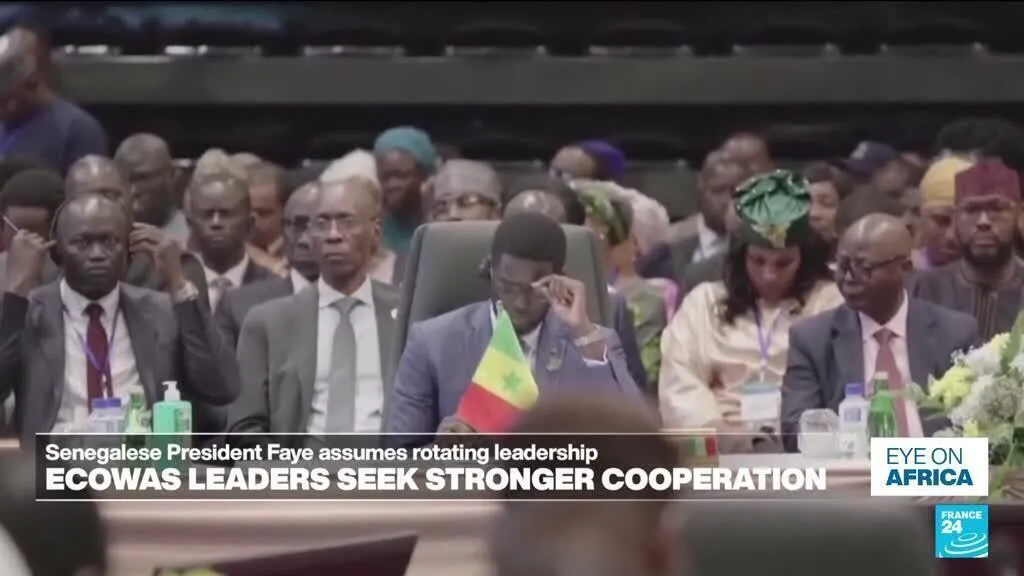
Senegalese President Bassirou Diomaye Faye assumes ECOWAS leadership tonight. The shift matters for regional coordination at a moment when Nigeria faces widespread school absences due to kidnapping threats.
Senegalese President Bassirou Diomaye Faye takes the helm of ECOWAS, stepping into a role that coordinates how West African states respond to crises and set shared priorities. Tonight’s dispatch frames it as a direct handoff of regional leadership, not a symbolic photo op. And while ECOWAS leadership always carries political gravity, the timing is what makes this moment feel urgent: Nigeria is dealing with nearly 19 million children out of school, with the threat of kidnapping keeping many classrooms empty.
Put differently, ECOWAS leadership will not be tested in the abstract. It will be tested by the basics of regional stability and service delivery. When kidnapping risk keeps children away from classrooms, the problem is not only humanitarian, it becomes a governance and security challenge. For decision-makers across the region, the pipeline matters: education is where long-term productivity, workforce development, and social stability get built. When those inputs collapse, costs show up later as unemployment pressure, weaker human capital, and higher political volatility. A regional bloc like ECOWAS is one of the few structures with enough cross-border reach to even attempt coordinated approaches, whether that means joint security efforts, safeguarding rules, or pressure on national systems to respond faster.
ECOWAS, historically, exists as a glue layer. Member states keep their sovereignty, but they often try to align on policy when the threats are shared. Kidnapping and armed violence are rarely neat, single-country events. Armed groups can move, recruit, extort, and disappear across borders. That is why a leadership change at the bloc level can matter to more than ceremonial diplomacy. It changes who can convene meetings, steer agenda-setting, and push member states toward common frameworks. It can also shift where donor attention goes, because multilateral momentum often follows the person holding the steering wheel.
For executives and board members, this is where regional governance becomes business context. Companies do not operate in a vacuum of product demand and supply chains. They operate in risk environments: logistics routes, labor availability, schooling for employees, and the general level of safety that affects attendance, movement, and procurement. When “nearly 19 million Nigerian children” are out of school, that signals an environment where insecurity is disrupting daily life at scale. That disruption can surface later in workforce readiness, higher turnover, and community instability that can complicate operating permits and local partnerships. It is not that ECOWAS leadership alone can reverse kidnapping threats overnight. It is that leadership becomes a lever for coordination, and coordination is often the missing ingredient when the problem spans regions.
Security and education are also politically linked. Governments facing persistent insecurity are forced into hard trade-offs. Do they prioritize immediate protection, or invest in longer-term resilience like schools, transport safety, and community deterrence? Where ECOWAS leadership lands can influence how quickly member states converge on joint approaches, and whether education risks are treated as an urgent security priority rather than a slow-burn development item.
And there is another thread in tonight’s edition, a reminder that regional identity is not only about conflict management. Tangier is celebrating the art of visual storytelling with the International Photography Festival. That detail matters because it points to a parallel reality in the region: public culture and narrative are powerful. Visual storytelling can shape how communities understand migration, hardship, resilience, and opportunity, especially in places where security events dominate headlines. For leaders, investing attention in culture and public communication can matter indirectly by strengthening social cohesion and public understanding, which is part of the broader resilience equation.
So what should peers watching this moment take from it? Bassirou Diomaye Faye’s assumption of ECOWAS leadership is a governance event with real-world consequences, especially when the news cycle simultaneously highlights Nigeria’s education crisis and security threats. The strategic stakes are simple: if regional coordination improves, member states can act faster, share more effectively, and reduce the compounding effects of insecurity on human capital. If coordination stalls, the damage spreads. For executives operating across West Africa, or investors underwriting growth in the region, the question is not whether ECOWAS can solve everything. The question is whether the leadership shift accelerates decision-making in the areas where insecurity already has a measurable footprint, like getting children safely back into school.
This story's Key Insights and Take-aways are locked.
Create a free account to unlock Executive Actions for one credit.
Register to UnlockAlways free for Executives Club members. Join the Club
More in Politics

LA County: DOJ's 20,000 'noncitizen' voter list is 'unreliable,' includes U.S.-born
Preliminary review by Los Angeles County election officials finds errors in the federal list, raising the stakes for voter roll integrity ahead of November.

Trump's $1.5B Pentagon chip investment lands in North Carolina
A $1.5 billion defense infusion for North Carolina chipmaking signals a new era of Pentagon-backed reshoring - here's what it means for the industry.

Nigeria confirms first Ebola case in Abuja, a woman just off a Uganda flight
Health Minister Muhammad Ali Pate says the patient flew in from Uganda, putting Africa's latest outbreak on Nigeria's doorstep.