

Sinner beats Zverev again, winning Wimbledon to claim his fifth Grand Slam
The Italian retains the Wimbledon men’s title, extends a 10-match winning streak over Zverev, and stakes his claim to the era.
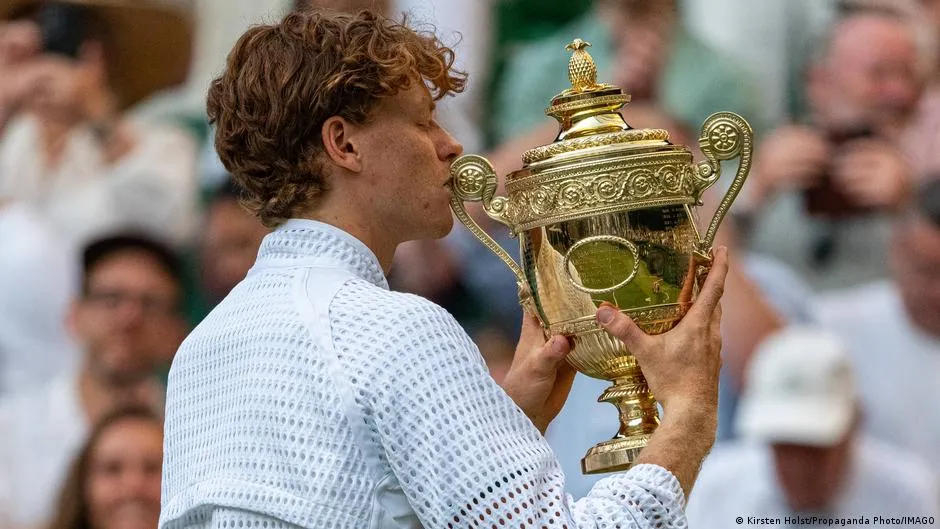
Jannik Sinner beat Alexander Zverev in the Wimbledon men’s final to retain his title. The result gives Sinner his fifth Grand Slam crown and stretches his dominance over Zverev to 10 straight victories.
Jannik Sinner retained his Wimbledon title by beating Alexander Zverev in Sunday’s men’s final. With the win, the Italian claims his fifth Grand Slam crown and sends a very specific message to the rest of the men’s tour: when Sinner is on, Zverev is not the answer.
This was not a one-off reversal. Sinner also extends his dominance over the German to 10 straight victories, turning a rivalry that often shapes tournament narratives into something more lopsided. For executives and investors who track performance and competitive positioning across industries, this is the sports equivalent of an entrenched advantage becoming a trend.
Start with what Wimbledon represents. It is not just another event on the calendar. For tennis players, it is a high-visibility, high-pressure stage where small margins matter and where mental toughness can be as decisive as technical skill. That is why “retaining” a title is such a loaded word. Winning once proves you can reach the top. Defending the championship proves you can withstand the added weight of expectation, the scouting, and the target on your back.
Now map the streak to incentives. In most competitive ecosystems, repeat outcomes are rarely accidental. A 10-match run suggests that Sinner has found patterns that consistently disrupt Zverev’s game plan. In business terms, think of it as repeatable execution under different conditions, not luck from a single favorable matchup. Even for people who only casually follow tennis, the headline number matters because it reduces uncertainty. It tells you that when Sinner and Zverev meet in high-stakes settings, the base rate is tilted.
There is also an industry-wide second-order effect: rivals change their development priorities when one opponent keeps winning. After enough losses, coaches and performance staff typically adjust training emphasis, match preparation, and strategic risk tolerance, because the old “default” approaches stop producing acceptable results. That can ripple across boards and backers, too. Talent investment decisions in sports are increasingly data-informed, and dominance patterns become part of how organizations assess ROI on training cycles, staffing, and schedule planning.
Wimbledon’s status also means commercial and media impact moves with results. Grand Slam champions tend to attract sponsors, appearances, and broader brand attention, and “fifth” adds a particular kind of credibility. It is easier to sell a story when it is not just one magical run but multiple title wins across major stages. Sinner’s fifth Grand Slam crown is, in effect, a brand asset reinforced by performance, not merely by hype.
For decision-makers in adjacent industries, the strategic lesson is similar: when a competitor demonstrates repeat superiority, your first task is not to chase their tactics blindly. It is to diagnose what is structural. Is it physical conditioning, match strategy, mental resilience, or an interaction effect where their strengths neutralize your strengths? In the source, the only hard facts we have are the Wimbledon final win, the fifth Grand Slam crown, and the 10 straight victories over Zverev. But those facts are enough to tell you that Sinner’s edge is consistent, not situational.
The stakes extend beyond this single final. A dominant champion reshapes how the tour calibrates itself. It influences who gets treated as a realistic contender, how players plan their hard courts and grass-court seasons, and how the competitive landscape is discussed by analysts and stakeholders. And for any athlete, investor, or operator trying to build a winning pipeline, the uncomfortable takeaway is this: sustained performance creates a moat, and once a rival crosses a threshold like a 10-match dominance streak, it becomes harder to catch up than the scores suggest.
Sinner’s Wimbledon retention, his fifth Grand Slam crown, and the continued streak over Zverev together crystallize a single storyline. The era is being claimed, match by match, final by final.
This story's Key Insights and Take-aways are locked.
Create a free account to unlock Executive Actions for one credit.
Register to UnlockAlways free for Executives Club members. Join the Club
More in Politics

Glacial collapse, not rain, killed 180 in Nepal's Himalayan flood
The Himalaya's extreme geography hid the true cause of Nepal's catastrophic flood, a glacial collapse that turned a geological battleground into a mass-casualty zone.

Iran’s Esmail Baghaei says Oman talks start shipping via Hormuz, not US talks yet
Temporary route plans with Oman aim to restart commerce while Tehran says Washington dialogue is not on the table.

Standards watchdog opens probe into Reform UK deputy leader Richard Tice over interests
The parliamentary standards commissioner says it began an investigation on 28 July into a possible undeclared interest.